wayground logo

Free Printable Worksheets

NEW

Font size

S
M
L
XL
Worksheets

Relative Age Practice Quiz

Total questions: 36

Worksheet time: 1hrs 14mins

Name
Class
Date
1.
A term that typically describes a species that no longer has any known living individuals
a)
Generation Time
b)
Fossil Record
c)
Extinct
d)
Speciation
2.

The theory that undisturbed layers of rock have the oldest layers on the bottom and the youngest on the top is called ______

a)

fossil record

b)

rock cycle

c)

law of superposition

d)

stratum

3.

Fossil #1 is found 700ft under ground and fossil #2 is found 300ft under ground, which is newer?

a)

Fossil #1

b)

Fossil #2

c)

Neither fossil is newer

d)

Both Fossils are the same age

4.
Which radioactive element is most likely used to date once living things?
a)

Uranium-235

b)

Thorium-232

c)
Carbon-14
d)

Potassium-40

5.
Which method determines a fossil's approximate age by examining which layer of earth is is found in?
a)

radioactive dating

b)

relative dating

c)

absolute dating

d)

fossil dating

6.
Based on the Law of Superposition, what can be concluded about fossils?
a)
fossils give clues about past climate patterns
b)
Fossils form from the hard parts of organisms
c)
The oldest fossils are found in the lowest rock layers
d)
The most recent fossils were advanced organisms
7.
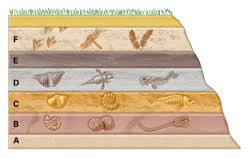
The diagram shows fossils in different rock layers. Which of these statements about the age of these fossils is most likely correct?
a)
Fossil A and C are the same age
b)
Fossil B is older than fossil C
c)
Fossils A is older than fossil B
d)
Fossil D is older than fossil C
8.
Why are advantageous traits more likely to be passed onto offspring?
a)
Because they are more likely to survive and reproduce.
b)
Because they come from dominant alleles.
c)
Because they come from recessive alleles.
d)
Because the trait is an acquired phenotype.
9.

Loss of natural habitats due to deforestation or human population growth, over harvesting, pollution, and introduction of alien species are factors that contribute to extinction. Which type of factor are they?

a)

Human causes

b)

Natural causes

10.

Changes in climate, large volcanic eruptions, changes in oxygen levels, and impacts from comets and asteroids are factors that contribute to extinction. Which type of factor are they?

a)

Natural Causes

b)

Human Causes

11.
Which rock layer in the diagram seems to be the oldest?
a)
F
b)
E
c)
B
d)
A
12.
According to the law of superposition, the oldest fossils are found 
a)
At the top of the rock layers
b)
Near the bottom of the rock layers
c)
In the middle of the rock layers
d)
Somewhat near the surface
13.
Which rock layer in the diagram seems to be the oldest?
a)
F
b)
E
c)
B
d)
A
14.
This rock was formed by smaller pieces of rock that settled at the bottom of a lake millions of years ago. What type of rock is this?
a)
Sedimentary
b)
Igneous
c)
Metamorphic
15.
Which of the following is the oldest?
a)
Layer L
b)
Intrusion D
c)
Intrusion H
d)
Layer E
16.
Which of the following correctly lists the layers in order from oldest to youngest?
a)
A, B, C, D, E
b)
E, B, C, D, A
c)
E, D, C, B, A
d)
C, B, A, D, E
17.
The rock formation labeled "P" is a(n)...
a)
fault
b)
intrusion
c)
inclusion
d)
unconformity
18.
Letter "F" is a....
a)
inclusion
b)
intrusion
c)
fault
d)
unconformity 
19.
In this rock layer diagram there are two unconformities, a fault at E and an intrusion at D. Which unconformity occurred first?  How do you know?
a)
Intrusion D occurred first because the instrusion has been moved by the fault.
b)
The fault occurred first because it has moved the intrusion D.
c)
Intrusion D occurred first because it can be seen in all of the rock layers.
d)
Fault E occurred first because it is a normal fault.
20.
Which Rock layer or intrusion is the youngest?
a)
A
b)
B
c)
C
d)
D
21.
An archaeologist made the following diagram of a dig site. What can be said about the pottery as compared to the skull found in the site?
a)
The rock layer with the pottery is more recent than the rock layer with the skull.
b)
The rock layer with the skull is more recent than the rock layer with the pottery.
c)
The rock layer with the skull is approximately the same age as the rock layer with the pottery.
d)
The rock layer with the skull has an absolute date of 17,000 years.
22.
How old do Paleontologists believe the Earth is?
a)
2016 years old
b)
3.54 billion years old
c)
4.54 billion years old
d)
4.54 million years old
23.
Relative age of a rock is the number of years that have passed since the rock formed?            
a)
true
b)
false
24.
Look at the diagram, what layer did animal E first show up in?         
a)
Layers #4
b)
Layers #5
c)
Layers #6
d)
Layers #7
25.

Which layer is OLDER? Layer M or Intrusion P?

a)

Layer M

b)

Intrusion P

26.

Which layer is OLDER? Layer E or Intrusion A?

a)

Layer E

b)

Intrusion A

27.

Which layer is OLDER? Intrusion M or Layer D?

a)

Intrusion M

b)

Layer D

28.
The rock formation labeled "P" is a(n)...
a)
fault
b)
intrusion
c)
inclusion
d)
unconformity
29.
Letter "F" is a....
a)
inclusion
b)
intrusion
c)
fault
d)
unconformity 
30.
In this rock layer diagram there are two unconformities, a fault at E and an intrusion at D. Which unconformity occurred first?  How do you know?
a)
Intrusion D occurred first because the instrusion has been moved by the fault.
b)
The fault occurred first because it has moved the intrusion D.
c)
Intrusion D occurred first because it can be seen in all of the rock layers.
d)
Fault E occurred first because it is a normal fault.
31.
Which Rock layer or intrusion is the youngest?
a)
A
b)
B
c)
C
d)
D
32.
An archaeologist made the following diagram of a dig site. What can be said about the pottery as compared to the skull found in the site?
a)
The rock layer with the pottery is more recent than the rock layer with the skull.
b)
The rock layer with the skull is more recent than the rock layer with the pottery.
c)
The rock layer with the skull is approximately the same age as the rock layer with the pottery.
d)
The rock layer with the skull has an absolute date of 17,000 years.
33.
How old do Paleontologists believe the Earth is?
a)
2016 years old
b)
3.54 billion years old
c)
4.54 billion years old
d)
4.54 million years old
34.
Look at the diagram, what layer did animal E first show up in?         
a)
Layers #4
b)
Layers #5
c)
Layers #6
d)
Layers #7
35.

Which layer is OLDER? Layer M or Intrusion P?

a)

Layer M

b)

Intrusion P

36.

Which layer is OLDER? Intrusion M or Layer D?

a)

Intrusion M

b)

Layer D