
NEW
Font size
S
M
L
XL
 Worksheets
Fossils
Total questions: 31
Worksheet time: 27mins
Name
Class
Date
1.
Scientists who study fossils are called
a)
Geologists
b)
Paleontologists
c)
Fossil Scientists
d)
Meteorologists
2.

What type of fossil is this?
a)
Mold
b)
Cast
c)
Preserved remains
d)
Trace fossil
3.

Which layer is oldest?
a)
A
b)
W
c)
G
d)
Z
4.

In which kind of rock do we usually find a fossil?
a)
sedimentary rock
b)
rock candy
c)
hard rock
5.
How old do Paleontologists believe the Earth is?
a)
2015 years old
b)
3.6 billion years old
c)
4.6 billion years old
d)
4.6 million years old
6.

According to the law of superposition, which layer is the youngest?
a)
A
b)
B
c)
C
7.

The era that dinosaurs ruled the Earth's land, air and oceans.
a)
Cenozoic
b)
Paleozoic
c)
Precambrian
d)
Mesozoic
8.

What is a fossil?
a)
the remains or physical evidence of an organism preserved by geologic processes
b)
fossils can be preserved in rock, amber, asphalt, or ice
c)
any naturally preserved evidence of animal activity
d)
fossil of an organism that lived during a relatively short period of time
9.
Fossilized tracks or other evidence of activity of an organism.
a)
trail
b)
trace
c)
index
d)
absolute
10.
Which of the following would NOT help an organism become fossilized?
a)
shell
b)
skeleton
c)
buried quickly with sediment
d)
soft body parts
11.
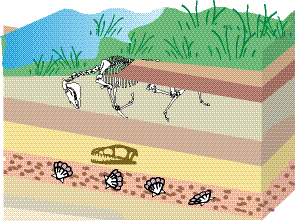
According to the law of superposition, the oldest fossils are found
a)
At the top of the rock layers
b)
Near the bottom of the rock layers
c)
In the middle of the rock layers
d)
Somewhat near the surface
12.
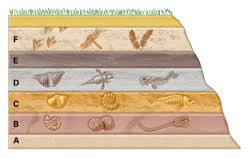
Which rock layer contains the newest fossils?
a)
F
b)
E
c)
B
d)
C
13.
_______ are the preserved remains or traces of living things.
a)
bones
b)
fossils
c)
artifacts
d)
organic matter
14.
Fossils can provide evidence of how life has changed over time, how Earth's surface has changed, and clues about what past environments were like.
a)
True
b)
False
15.
In what type of rock would you typically find fossils?
a)
igneous
b)
metamorphic
c)
sedimentary
d)
rocky
16.
Most fossils form from animals or plants that once lived in or near _____________
a)
deserts
b)
ice tundras
c)
water
d)
forrests
17.
Which parts of an organism are more likely to fossilize?
a)
the soft parts - skin, muscle
b)
the hard parts - bones, shells, stems
c)
all parts can become fossilized easily because the organism becomes buried by sediments
18.
A _______ is a hollow area in sediment in the shape of an organism or part of an organism.
a)
mold
b)
cast
c)
petrified fossil
d)
trace fossil
19.
A _______ is a solid copy of the shape of an organism.
a)
mold
b)
cast
c)
petrified fossil
d)
trace fossil
20.
_______________ are fossils in which minerals replace all or part of an organism.
a)
carbon films
b)
trace fossils
c)
petrified fossils
d)
amber
21.
These fossils provide evidence of the activities of ancient organisms.
a)
petrified fossils
b)
trace fossils
c)
molds
d)
amber
22.
A dinosaur track, a trail, and burrow are all examples of
a)
casts
b)
molds
c)
trace fossils
d)
preserved remains
23.
Becoming trapped in tar and amber, and freezing are other processes besides fossilization that organisms can be preserved.
a)
True
b)
False
24.

This is an example of a
a)
cast fossil
b)
mold fossil
c)
trace fossil
d)
carbon film
25.

True or False....Only dinosaurs have been fossilized.
a)
True
b)
False
26.

This type of fossil is a stone "copy"....also called petrification.
a)
preserved remains
b)
mineral replacement
c)
cast
d)
mold
27.

When we pressed our dinosaur bodies into the clay...What type of "fossil" did it leave us with?
a)
preserved remains
b)
trace
c)
cast
d)
mold
28.

What type of fossil is a mummy?
a)
mold
b)
cast
c)
mineral replacement
d)
preserved remains
29.

This is a picture of a petrified forest. Where tree trunks literally were turned to stone. What type of fossil are these?
a)
mineral replacements
b)
trace fossils
c)
preserved remains
d)
mold fossils
30.

True or False...All living things that die become fossils.
a)
True
b)
False
31.
True or False...Fossils have been found all over Earth.
a)
True
b)
False
Reset

