
 Worksheets
Planetary Motion
Total questions: 25
Worksheet time: 13mins
The gravitational force is strongest when charges are (select all that apply):
close together
far apart
have more mass
have less mass
Two bodies with mass will (select all that apply):
combine into a larger mass
attract each other
create gravitational fields
push each other apart
An object with mass attracts another object with mass is:
The Law of Universal Gravitation
Coulomb's Law
Newton's First Law of Motion
Newton's Third Law of Motion
The force of gravity is inversely proportional to:
Mass
Weight
Distance
Time
If Earth's mass was cut in half, what would happen to your mass?
increase because the gravitational force from Earth decreases
decrease because the gravitational force from Earth decreases
decrease because the gravitational force from Earth increases
it would not change, my mass is not affected by gravitational force

What is the Universal Law of Gravitation equation?
g = r2GM
Fe = ker2 q1q2
Fg =G r2m1m2
Fg = gm
Two objects can have both a gravitational attraction and an electrostatic repulsion.
True, if the objects have the same charge and have mass
True, if the objects have mass but were attracted and not repelling
False, charged particles have almost no mass
False, one field will cancel out the other
If every thing with mass has gravity, why does my cell phone not "stick" to me from gravity?
My mass is so small, the gravitational field does not extend past my body.
My cell phone's mass is too small to have gravity.
My cell phone is electronic and has an electrostatic field that cancels out the gravitational field.
My cell phone is not magnetic.
What type of force is gravity (select all that apply)?
a non-contact force
an repulsive force
a weak force
an attractive force
a strong force
Gravity affects which of the following (select all that apply):
the orbits of planets
the formation of matter just after the big bang
the weight of an object on Earth
the formation of stars and planets
the formation of light in stars
What type of force is the electrostatic force (select all that apply)?
a non-contact force
a contact force
a repulsive force
an attractive force
a weak force
What are the units for gravitational and electrostatic forces?
Coulombs
Newtons
Grams
Meters
What is Kepler's 2nd Law about?
the shape of the orbits
the speed or area an orbiting object travels
the size of the orbit an object has
the amount of time it will take for an object to orbit
When it is farther from the sun, a planet appears to move:
The Earth has an eccentricity of 0.0167 as it orbits around the Sun. Which diagram is the best representation of the orbit of the Earth around the Sun?


Planets orbit the Sun in a shape called a(n):
circle
ellipse
orbit
focus
Kepler's first law is about:
the shape of the orbit
the time it takes for a planet to orbit
the distance or speed a planet orbits
how fast a planet spins
An orbit is:
The path an object takes as it revolves around another object
The process of an object traveling around another object
The direction an object takes as it travels around another object.
The angle which an object moves around another object.
When a planet orbits the Sun, one of the foci of the elliptical orbit is the Sun. What is at the other focus?
The Earth
The moon
A black hole
Nothing
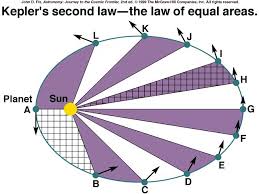
From which options below would the planet appear to be moving the fastest?
Position A to B
Position B to C
Position H to I
Position I to J
Celestial bodies (like planets) orbit because of balanced forces between:
gravity and the mass of the objects
gravity and motion of the orbiting object
gravity and the centripetal force
gravity and the centrifugal force
In orbits with low eccentricity (select ALL that apply):
have the foci close together
have the foci far apart
are very long and elliptical
are nearly circular
The gravitational field around an object is represented by:
g = r2GM
Fe = ker2 q1q2
Fg =G r2m1m2
Fg = gm
The gravitational field around an object is represented by:
g = r2GM
Fe = ker2 q1q2
Fg =G r2m1m2
Fg = gm
The gravitational force on Earth is:
9.8 N
9.8 s2m
6.0 x 1024 kg
unknown without another object's mass

