
 Worksheets
Bio QUIZ 3 Practice: CH15 Pedigrees, Karyotypes, H. Genome
Total questions: 45
Worksheet time: 1hrs 6mins

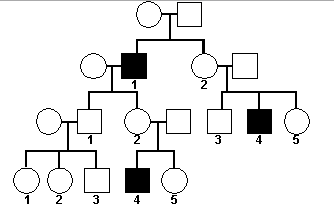
(hint: check your notes - "modes of inheritance")

If this pedigree shows a recessive disorder, what MUST the genotype of individual 4 be?
HH
Hh
hh
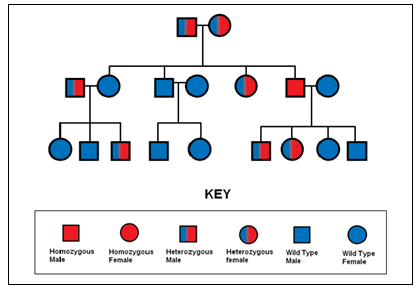


*A trait that is _____ appears in every generation, and affects males and females equally.
Autosomal Dominant
Autosomal Recessive
X link- Dominant
X link- Recessive


What is the correct genotype for individual I-2?


What type of heredity is shown in the pedigree?
Sex-Linked Dominant
Sex-Linked Recessive
Autosomal Dominant
Autosomal Recessive
In a pedigree, circles represent _____
males
females
In a pedigree, a person AFFECTED by a trait is
shaded
unshaded

Assuming a trait is AUTOSOMAL RECESSIVE, what genotype would make a person AFFECTED?
AA
Aa
aa
XAY
XaY
Assuming a trait is AUTOSOMAL RECESSIVE, what genotypes would make a person UNAFFECTED?
AA
Aa
aa
XAY
XaY

Assuming a trait is X-LINKED RECESSIVE, what are the genotypes of an AFFECTED person?
XAY
XaY
XAXA
XAXa
XaXa
The genotype XAXa represents a ________
dominant male
recessive male
dominant female
recessive female


**The failure of chromosomes to separate during gamete formation in called
nondisjunction
alleles
point mutation
cloning


*Digestive enzymes in your stomach and intestines help digest the food you eat. If you are lactose intolerant and cannot digest milk products, it is the result of a mutated message in your
Chromosomes
X or Y chromosomes
lysosomes
nucleolus
*Mustard gas removes guanine from DNA. For developing embryos, exposure to mustard gas can cause serious deformities because guanine _____.
is part of the genetic code.
produces energy for DNA replication.
causes mutations in DNA.
stores the building blocks of proteins.

*Sequences for the types of hemoglobin are shown. Sickle-cell anemia is caused by a mutation of one nucleotide in a gene. The type of mutation that causes sickle-cell anemia is known as _____.
a point mutation
an inversion mutation
an insertion mutation
a framshift mutation
*In a species of plant, the sudden appearance of one plant with a different leaf structure would most likely be the result of _____.
chromosomal mutations.
asexual reproduction.
slow environmental changes.
stable gene frequencies.

*How can Diagram 1 be identified?
normal male
male with Down syndrome
normal female
female with Down syndrome
*How can Diagram 2 be identified?
normal male
male with Down syndrome
normal female
female with Down syndrome

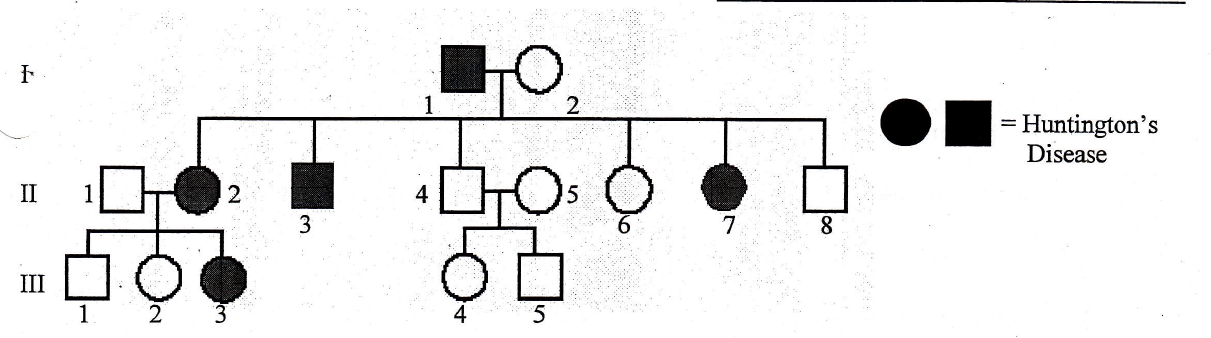
*What pattern of inheritance is shown in the pedigree above?
autosomal dominant
autosomal recessive
sex- linked dominant
sex- linked recessive
*What pattern of inheritance is shown in the pedigree above?
autosomal dominant
autosomal recessive
sex- linked dominant
sex- linked recessive
*What is the genotype of individual III-8?
AA
Aa
aa
None of these

*_____ is a technique used to organize DNA fragments in order of size.
Restriction enzymes
PCR
Gel electrophoresis
Cloning
*A diagram showing the history of one trait in a family is called a _____.
pedigree
punnet square
venn diagram
Karyotype

*A photograph of all of the chromosomes arranged in pairs is called a _____.
pedigree
punnet square
venn diagram
Karyotype

*The diagram shows an unpredicted change in the genetic material of two chromosomes. The change in DNA is called a _____.
Translocation
Duplication
Replication
Transcription
*All of the statements EXCEPT one are true about mutations. Which statement is false?
Mutations MUST be present in parents and then passed to offspring.
Mutations can be positive and produce organisms with improved traits.
Mutations can be silent, and not affect the organism that has them, if the mutation is in a non-critical area.

