wayground logo

Free Printable Worksheets

NEW

Font size

S
M
L
XL
Worksheets

Passive and active transport

Total questions: 20

Worksheet time: 14mins

Name
Class
Date
1.
In passive transport, molecules move from an area of __________ concentration to an area of __________ concentraiton
a)
high, low
b)
low, high
c)
water, salt
d)
active, passive
2.
Which of the following is not a type of passive transport?
a)
Osmosis
b)
Diffusion
c)
Endocytosis
d)
Facilitated Diffusion
3.
What is the difference between active and passive transport?
a)
Active does not need energy and passive uses ATP (energy)
b)
Active uses ATP (energy) and passive does not need energy
c)
Active stores transport proteins and passive releases 
d)
Active uses hormones and passive does not 
4.
What does semi-permeable mean?
a)
Only some things can move through membrane
b)
Nothing can move through membrane
c)
Reagan can move through membrane
d)
Membrane connot be moved through
5.
What are three types of passive transport
a)
Transport proteins, Endocytosis, Exocytosis
b)
None of the ones listed
c)
Osmosis, Diffusion, Facilitated diffusion 
d)
Touchdown, interception, football
6.
Diffusion is the movement of molecules from an area of higher concentration to an area of lower concentration.
a)
True
b)
False
7.
Osmosis is the diffusion of
a)
Iodine
b)
Oxygen
c)
Water
d)
Fruit punch
8.
What are 3 types of active transport?
a)
Riding a bike, Running through the mountains, walking on the beach
b)
Osmosis, Diffusion, Facilitated Diffusion
c)
Sodium/potassium Pump, Endocytosis, Exocytosis
d)
Throwing a ball, Playing tennis, driving a car
9.

Diffusion is a form of...

a)

Active Transport

b)

Passive Transport

10.
Diffusion is the movement of molecules from
a)
an area of equilibrium to an area of high concentration.
b)
an area of low concentration to an area of high concentration.
c)
an area of high concentration to an area of high concentration.
d)
an area of high concentration to an area of low concentration.
11.

The movement of water through a semi-permeable membrane is called ___________.

a)

active transport

b)

respiration

c)

osmosis

d)

diffusion

12.
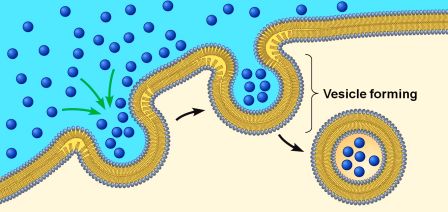
What type of transport is this?
a)
Endocytosis
b)
Exocytosis
c)
Diffusion
d)
Sodium-Potassium Pump
13.
What type of transport is this?
a)
Endocytosis
b)
Diffusion
c)
Exocytosis
d)
Osmosis
14.
Which form of active transport is being shown?
a)
Facilitated Diffusion
b)
Exocytosis
c)
Endocytosis
d)
Protein Pumps
15.

Which differences between active and passive transport?

a)

pH

b)

Using energy

c)

Temperature

d)

Power and pumping

16.

What is the difference between osmosis and diffusion?

a)

Using energy

b)

Temperature

c)

Protein channel

d)

Concentration gradient

17.

What is the concentration gradient?

a)

the highest concentration

b)

the lowest concentration

c)

difference between high concentration and low concentration

d)

the sum of the high concentration and low concentration

18.

Sodium and potassium pumping process has a(n) ........... concentration gradient?

a)

Low

b)

High

c)

Medium

d)

Against

19.

Entering oxygen from lungs into our blood is the ..................

a)

Osmosis

b)

Diffusion

c)

Endocytosis

d)

Exocytosis

20.

Exiting the carbon dioxide from our blood is called............

a)

Osmosis

b)

Diffusion

c)

Exocytosis

d)

Endocytosis