Worksheets
Third Quarter EQT Review
Total questions: 46
Worksheet time: 27mins

Q. A performer pulls a tablecloth out from under a complete set of dinnerware as shown in the illustration below. Which of the following best explains the performer’s success at leaving all the dinnerware on the table?
the inertia of the dinnerware
the large mass of the tablecloth
the placement of the dinnerware
the rough material of the tablecloth
Q. An object moving with constant speed has
a net force greater than zero.
a net force equal to zero.
a net force less than zero.
a constant force.
Q. Unbalanced forces can make an object accelerate by
changing its speed
changing its direction
both A and B
neither A nor B
Q. Which of the following is an example of an unbalanced force?
book sitting on a table
car sitting in the garage
person on an elevator going down
person leaning on a wall
Q. Two dogs are pulling on the same shoe, but the shoe stays in the same place. What is happening?
One dog is pulling with a greater force.
Both dogs are pulling with the same force.
Both dogs are pulling the shoe in the same direction
Neither dog is a bulldog.

Q. During interval BC, what must be true about the forces?
Forces are increasing.
Forces are decreasing.
Forces are balanced.
Forces are unbalanced.

Q. Which line segment represents balanced forces?
AB
BC
CD
AD

Q. The date table below lists the mass and speed of four different objects. Which object has the greatest inertia?
A
B
C
D

Q. Which of the following best explains why this happens?
The crash test dummy gets lighter as the car accelerates
The car is moving forward faster than the crash test dummy.
There is no reaction to the force of the car taking off.
Gravity is pulling the crash test dummy in the direction the car is moving.

Q. Which graph shows how the speed of an object would change if a single constant force were applied to the object over a period of time?
A
B
C
D

Q. When you pull the wagon forward suddenly, the ball will
hit the front wall
hit the back wall
fly up in the air
stay where it is

Q. If a 1kg stone is dropped from a bridge 100 meters above a gorge, which graph of distance traveled verses time represents the motion of the freely falling stone?
A
B
C
D

Q. The displacement time graph shown represents the motion of a cart along a straight line. During which interval was the cart accelerating?
AB
BC
CD
DE
Q. A ball with a mass of 1kg is moving in a straight line at the same speed as a ball with a mass of 10kg.
Both balls are brought to rest in 4.0 seconds. What is true of the force required to stop the balls?
It takes less force to stop the 1 kilogram ball because it has less inertia.
It takes more force to stop the 1 kilogram ball because it has more inertia.
It takes the same force to stop both balls because they are moving at the same speed.
It takes less force to stop the 10 kilogram ball because it has less inertia.
Q. A cart is rolling down a special ramp where there is no friction at all. What will happen if the amount of mass on the cart is increased?
The cart will accelerate less.
The cart's acceleration will not be affected
The cart will accelerate more
The cart will move at a constant velocity
Q. According to Newton’s second law of motion, in which of these situations is the object accelerating?
a book on a shelf
a rock sitting on the ground
a helium balloon tied to a lamp post
a ball that has been thrown upward
Q. Kristen pushes an 8kg ball and a 5kg ball toward Jeremy. She wants the balls to reach Jeremy at the same time. How should Kristen push the balls?
She pushes the 8kg ball more gently than she pushes the 5kg ball.
She pushes the 8kg ball harder than she pushes the 5kg ball
She pushes the 8kg ball in a different direction than she pushes the 5kg ball.
She pushes the 8kg ball and the 5kg ball equally.

Q. Susan gently pushes the tip of her finger against the eraser on her pencil and the pencil does not move. Which of the following figures best illustrates the interaction of forces between Susan’s finger and her pencil?
A
B
C
D
Q. A force of 50 newtons is exerted by a bat on a baseball. The force exerted by the baseball on the bat is
less than 50 Newtons
50 Newtons
more than 50 Newtons
9.8m/s2
Q. You stand on a skateboard and push off the ground with one of your feet. The reason that the skateboard moves forward is that the force you apply to the skateboard
equals the force applied to you by the skateboard
is larger than the force applied by you to the skateboard.
A. equals the force applied by the ground to the skateboard.
is larger than the force applied by the ground to the skateboard.
Q. We are able to walk forward because
we push on the air.
we push on the ground
the air pushes on us.
the ground pushes on us.
Q. Whenever an object exerts a force on another object, the second object exerts a force of the same magnitude, but in the _____ direction to that of the first object.
Opposite
same
right angle
vertical
Q. Which situation is an example of Newton’s third law of motion?
A ball in a vacuum container moves in a straight line at a constant velocity.
A ball in a vacuum container accelerates when kicked with a great amount of force.
A person riding in a forward-moving car continues to move forward when the car stops suddenly.
A person in a canoe moves the paddle backward in the water, and the canoe moves forward in the water.

Q. This diagram represents a balloon that is moving in one direction while escaping air is moving in the opposite direction. What causes the balloon to move?
action-reaction forces
electrical forces
friction
gravitational potential energy

Q. A raft is floating on a lake. When Ali dives out of the raft in the direction indicated by arrow A, the raft moves in the direction indicated by arrow B. Which principle does this illustrate?
Force equals mass times acceleration.
Energy is neither created nor destroyed
For every action there is an equal and
opposite reaction.
An object in motion will stay in motion
until acted upon by an outside force.
Q. As a pendulum moves from the bottom of its swing to the top of its swing, the
kinetic energy of the pendulum increases
kinetic energy of the pendulum remains the same
potential energy of the pendulum decreases
potential energy of the pendulum increases

Q. As the pendulum swings from position A to position B as shown in the diagram, what is the relationship of kinetic energy to potential energy? (Neglect friction.)
The KE decrease is less than the PE decrease
The KE increase is more than the PE decrease.
The KE decrease is equal to the PE increase.
The KE increase is equal to the PE decrease.

Q. The diagram shown represents a frictionless track. A 10-kilogram block starts from rest at point A and slides along the track. As the block moves from point A to point B, the total amount of gravitational potential energy changed to kinetic energy is approximately
5 J
20 J
50 J
500 J

Q. Two vacationers walk out on a horizontal pier as shown in the diagram below. As they approach the end of the pier, their gravitational potential energy will
decrease
increase
remain the same
equal kinetic energy

Q. The diagram shows two bowling balls of equal mass. Ball A is resting near the edge of a shelf. Ball B is resting on the ground below. Which of these statements best describes the diagram?
Ball A has more KE than Ball B.
Ball B has more KE than Ball A.
Ball A has more PE than Ball B.
Ball B has more PE than Ball A.
Q. Noah carried a skateboard up a hill and then rode the skateboard down the hill. When Noah reached the bottom of the hill, he rolled to a stop. When did Noah have the most potential energy?
while carrying the skateboard up the hill
while standing on the skateboard at the top of the hill
while riding the skateboard down the hill
while standing on the skateboard at the bottom of the hill

Q. A skateboarder travels from location 1 to location 4 as shown below. At which location does the skateboarder have the most KE and the least PE?
1
2
3
4

Q. The diagram below represents a bicyclist at the top of a hill. Assume that the bicyclist does not apply the brakes as he rides down the fill. At which point will the bicyclist’s KE be closest to zero?
Point W
Point X
Point Y
Point Z

Q. The picture below shows the path of a basketball when a player takes a shot at the basket. At which point does the ball have the greatest PE?
Point A
Point B
Point C
Point D
Q. A student is investigating PE and KE by stretching a spring across a table. When the student lets go, the spring recoils. At which time is PE in the spring being converted into KE in this system?
when the spring is stretching
when the spring is fully stretched
when the spring is recoiling
when the spring is fully recoiled
Q. A surfer paddles out from shore in search of the perfect wave. The surfer has a weight of 500 N and the surfboard weighs 100 N. As a large wave reaches the surfer, she is pushed forward and upward. Which statement about her KE and PE is correct?
There is an increase in her KE only.
There is an increase in her PE only.
There is an increase in both her PE and KE
There is no change in her PE or KE.

1. How would you describe the relationship between the mass of a car and the kinetic energy?
As the mass of a car increases, its kinetic energy increases.
As the mass of a car increases, its kinetic energy decreases.
As the mass of a car decreases, its kinetic energy increases.
There is no clear relationship between mass and kinetic energy.
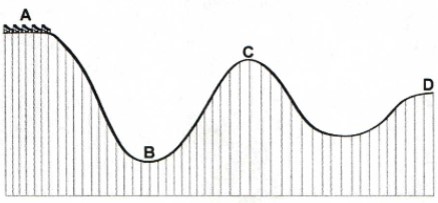
Based on the diagram of a roller coaster car on a roller coaster track, what statement is true?
The car at point A has more kinetic energy than the car at point C
The car at point C has less kinetic energy than the car at point B.
The car at point C has more kinetic energy than the car at point B.
The car at point D has less potential energy than the car at point B.

Where would this tossed baseball have the least amount of kinetic energy?
point W
point X
point y
point z

Which graph BEST shows the relationship of kinetic energy to potential energy as a book sits on the edge of a desk?
A
B
C
D

In the figure, potential energy is being converted into kinetic energy from
point A to point B
point B to point C
The only energy involved here is kinetic.
Energy is not being converted.