
 Worksheets
Optic and Light
Total questions: 30
Worksheet time: 28mins
Name
Class
Date
1.

This is an example of...
a)
Reflection
b)
Refraction
c)
Polarization
d)
Spectrum
2.
A plane mirror produces a/an
a)
a small, real image
b)
a large, real image
c)
a small, virtual image
d)
a same sized, virtual image
3.

A student placed a pencil in a cup of water. The pencil appears broken because light-
a)
always travels in a straight line
b)
bends when it passes through water
c)
makes the water in the glass evaporate
d)
reflects the pencil on the water's surface
4.

a)
Reflection
b)
Refraction
5.

What is the difference between reflection and refraction?
a)
Both involve light bending through a medium
b)
Reflection is light bouncing off a medium's surface and refraction is light bending through a medium
c)
Reflection is light bending through a medium's surface and refraction is light bouncing off a medium
d)
Refraction is light being absorbed in a medium and reflection is light being bent through a different medium
6.

Observe the picture of a student and a mirror. The student is seated at a table. What object will the student see in the mirror?
a)
Sun & Triangle
b)
Triangle & Square
c)
Heart & Sun
d)
Square & Sun
7.

Light travels at 300,000,000 m/s. Based on the picture, what material option below does light travel the slowest in?
a)
Vacuum of space
b)
Air
c)
Ice
d)
Lucite
8.

What is TRUE about the picture?
a)
The refractive index of the material in the top picture is lower than the refractive index of the bottom material
b)
We see light refracting toward the normal line
c)
The angle of incidence in the top picture is greater than the angle of refraction in the bottom picture
d)
All answers are correct
9.

What are Fiber Optics?
a)
Thin, flexible fibers of glass
b)
Flexible fibers of glass
c)
Thin fibers of glass
d)
Those glow toys
10.

What is the most prominent use of Fiber Optics today?
a)
Phones
b)
Television Screens
c)
The Internet
d)
MRI imaging
11.

For what are Fiber Optics mainly used?
a)
Long distance communication
b)
Imaging
c)
Phones
d)
Downloading Apps
12.

How do Fiber Optics work?
a)
By connecting and transferring energy
b)
By remitting and subtracting power from other fiber optics
c)
By using light pulses to transfer data
d)
By converting sound waves in to binary code
13.

How does light travel through the cable?
a)
Refraction and Reflection
b)
Refraction only
c)
Dispersion
d)
Total Internal Reflection
14.

_____ is a lens that is thicker in the middle.
a)
Convex
b)
Concave
15.
A Concave mirror is a __________ device.
a)
Convergent
b)
Divergent
c)
Polarizing
d)
None of the above
16.
A Convex mirror is a __________ device.
a)
Convergent
b)
Divergent
c)
Polarizing
d)
None of the above
17.
A convex lens is a __________ device.
a)
Convergent
b)
Divergent
c)
Reflective
d)
None of the above
18.
A Concave lens is a __________ device.
a)
Convergent
b)
Divergent
c)
Reflective
d)
None of the above
19.

_____ is a lens that is thinner in the middle..
a)
Convex
b)
Concave
20.

The picture details what process?
a)
Reflection of light
b)
Dispersion of white light
c)
Scattering of light
d)
Reflection and refraction
21.

What do water droplets in a rainbow act like?
a)
prisms
b)
flashlights
c)
reflectors
d)
lasers
22.
What is a ray of light?
a)
A curved line of light
b)
A type of fish
c)
A straight beam of light
d)
The entire spectrum of colors within white light
23.
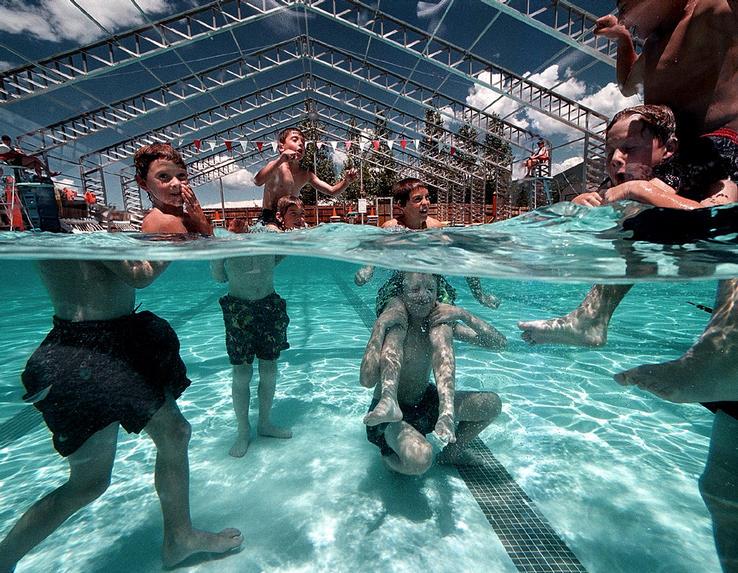
Why does the lower part of the child appear so much different in size from the upper part?
a)
The light rays that travel through water and then into air are refracted.
b)
The light rays that travel through water and then into air are enlarged.
c)
The light rays that travel through air and then into water are reflected.
d)
The light rays that travel through air and then into water are reduced.
24.

The Law of Reflection:
The angle of incidence is _________ the angle of reflection
The angle of incidence is _________ the angle of reflection
a)
bigger than
b)
the same as
c)
smaller than
25.
Opaque means...
a)
No light passes through it
b)
All light passes through it
c)
Some light passes through it
26.
If you're standing 12 meters in front of a plane mirror, how far away is your image from you?
a)
6
b)
12
c)
18
d)
24
27.
You are asked to design an astronomical telescope at normal adjustment using two convex lenses P and Q.
The power of lens P is 5 D and lens Q is 25 D.
Calculate the distance between lenses P and Q.
a)
2.04 cm
b)
20.0 cm
c)
24.0 cm
d)
30.0 cm
28.

The di for a real image will be a _________________ value
a)
positive
b)
negative
29.

The di for a virtual image will have a ______ value.
a)
positive
b)
negative
30.
A converging lens produces an image twice the size of the original. If the object is placed 0.40 m from the lens, and the image produced is 0.80 m from the lens. What is the focal length of the lens?
a)
0.351 m
b)
0.267 m
c)
0.416 m
d)
0.112 m
100 %

