wayground logo

Free Printable Worksheets

Font size

S
M
L
XL
Worksheets

US II STAAR Revew 1 (1877-1929)

Total questions: 145

Worksheet time: 2hrs 53mins

Name
Class
Date
1.

Where did the Union Pacific and the Central Pacific Railroads meet to complete the Transcontinental Railroad?

a)

San Francisco

b)

Sutter's Mill

c)

Promontory Summit

d)

Houston

2.

Why did the government want the Transcontinental Railroad built?

a)

To move prisoners west

b)

To encourage westward expansion

c)

To defeat Mexico

d)

To make peace with the Native Americans

3.

The Homestead Act required people to farm on land for _____ years to get _______ acres for free.

a)

10 years, 50 acres

b)

1 year, 80 acres

c)

7 years, 180 acres

d)

5 years, 160 acres

4.

Who were Forty-Niners?

a)

Prospectors

b)

Sailors

c)

Soldiers

d)

Native Americans

5.
What happened at Custer's Last Stand in the Battle of Little Bighorn?
a)
Custer killed all of the Lakota Indians.
b)
Custer and Sitting Bull made an agreement that the Native Americans Could have their land.
c)
Custer was killed, along with his entire force.
6.
This act forced Native American tribes to give up their ancestral land holdings and move to reservation lands elsewhere. 
a)
Homestead Act 
b)
Morrill Act 
c)
Dawes Act 
d)
Fort Laramie Treaty, 1868
7.
Adopting the customs and practices of the dominant culture.
a)
Nativism
b)
Ethnic Enclaves
c)
Assimilation
8.
The Dawes Act...
a)
Allowed the Plains indians to continue their tribal traditions of following the buffalo herds
b)
divided the plains Indians tribal lands into family plots as a way to encourage assimilation
c)
provided 160 acres of free land to white settlers
d)
established the route for the Transcontinental railroad
9.

When was the KLONDIKE gold rush?

a)

1800-1888

b)

1980-1990

c)

1896-1899

d)

1869-1876

10.

where was the KLONDIKE gold rush?

a)

Texas

b)

California

c)

Toronto

d)

Yukon

11.

What type farming was practiced in the Great Plains?

a)

Pastoral Farming

b)

Commercial Farming

c)

Dry farming

d)

Subsistence Farming

12.

What act helped settlement in the Great Plains?

a)

Navigation Acts

b)

Chinese Exclusion Act

c)

Homestead Act

d)

Kansas-Nebraska Act

13.

What were migrants who rushed to the California Gold Rush called?

a)

Forty-Niners

b)

Gold diggers

c)

Miners

d)

Longhorns

14.
Most immigrants on the East Coast were processed where?
a)
Washington, D.C.
b)
Ellis Island
c)
Angel Island
d)
Baltimore
15.
What is the term for the mixture of people of different cultures and races together into Americans?
a)
Mixing Bowl
b)
Angel Food Cake
c)
Fish Tank
d)
Melting Pot
16.
19th century Chinese immigrants are known for what?
a)
Work in building the Transcontinental Railroad
b)
Work in New York factories
c)
Contributions to the steel industry
d)
Contributions to John D. Rockefeller
17.
What processing station did Immigrants go through on the WEST coast?
a)
Ellis Island
b)
Angel Island
c)
Devil Island
d)
Alcatraz
18.
Which factor contributed most directly to the settlement and development of the Great Plains after the Civil War?
a)
hospitality of the Native American tribes inhabiting the region
b)
construction of railroads west of the Mississippi River
c)
freeing of slaves in the southern states
d)
influx of immigrants from eastern and southern Europe
19.
The United States experienced a period of greatly increased immigration in the mid-nineteenth century. In particular, there was a surge in the number of Irish immigrants. Why did Irish immigration increase during the mid-nineteenth century?
a)
the end of the Napoleonic Wars
b)
the Irish won their independence from the United Kingdom
c)
the Great Potato Famine in Ireland
d)
the spread of the Plague in Ireland
20.
Which of the following caused the most prejudice against new immigrants in the United States during the late nineteenth century?
a)
Americans believed that immigrants were transient and would hurt the communities when they moved on again.
b)
The United States had tense relations with many of the nations from which the immigrants came.
c)
Heavy immigration caused overcrowding in rural areas and a rise in the price of cropland.
d)
Americans feared that immigrants would refuse to assimilate into American culture.
21.
War, poverty, and discrimination are all examples of.......
a)
Pull Factors
b)
Push Factors
c)
Jump Factors
d)
Falling Factors
22.
Economic opportunities, religious freedom, and political and social equality are all examples of...
a)
Push Factors
b)
Pull Factors
c)
Falling Factors
d)
Jump Factors
23.
Which idea led to a rise in anti-immigrant groups and a demand for immigration restrictions?
a)
Melting Pot
b)
Birds of Passage
c)
Nativism
d)
All of the above
24.
Which amendment to the United States Constitution defines citizenship?
a)
16th
b)
14th
c)
13th
d)
None of the above
25.
What is a tenement?
a)
A new form of transportation
b)
Poorly built, overcrowded apartment buildings
c)
The end of immigration
d)
A revolutionary war in Africa
26.
What was the Chinese Exclusion Act?
a)
Letting Chinese in America with open arms
b)
Banning Chinese people from immigrating to the United States for 10 years
c)
The Europeans taking over China
d)
Italians Immigrating to China
27.
Which best describes the living conditions of most immigrants during the Industrial Revolution? 
a)
Most immigrants lived in rural areas with few other people around
b)
Most immigrants lived in cities in extremely crowded buildings
c)
Most immigrants lived in single-family homes
d)
Most immigrants lived in homeless shelters year-round
28.
Which best describes the working conditions of most immigrants during the Industrial Revolution? 
a)
Most immigrants worked long hours in low-paying industrial jobs
b)
Most immigrants worked as farmers in rural areas
c)
Most immigrants worked as bookkeepers or other professional jobs
d)
Most immigrants worked as tailors or other skilled jobs
29.
The transfer from the handy-craft system to machine technology and factories is called:
a)
Urbanization
b)
Revolution
c)
Industrialization
d)
Civilization
30.
Before the Industrial Revolution all products were created by
a)
Factories
b)
Hand
c)
Slaves
d)
Royalty
31.

The creation of the Erie canal played a key role in which development?

a)

New Orleans becoming a leader in manufacturing and trade

b)

Washington, D.C., becoming a cultural and political center of the nation

c)

Boston becoming one of the country's largest transportation hubs

d)

New York becoming an important commercial center

32.
  • Invention of the cotton gin
  • opening of lands along the Mississippi river
  • growing demand for cheap labor

Which change occurred as a direct result of these developments?

a)

reduction in skilled workers in the north

b)

expansion of manufacturing into the west

c)

reduction of trade with European countries

d)

expansion of slavery into newly acquired territories

33.
  • entrepreneurship
  • Competition
  • Private property
  • profit motive
  • consumer choice

Which of the following would be the best title for the list?

a)

Free Enterprise System

b)

Mercantile system

c)

Federalism

d)

Republicanism

34.

How did the invention of the cotton gin contribute to the expansion of the plantation system?

a)

by reducing the number of slaves needed for growing cotton

b)

by increasing the time needed to cultivate cotton

c)

by increasing the profitability of slavery

d)

by reducing the demand for raw cotton

35.

The invention of the steamboat most affected the U.S. economy by-

a)

decreasing the need for canals

b)

allowing more efficient movement of goods

c)

reducing the costs of settling in western territories

d)

transporting workers from southern states to northern states

36.

How did the growth of the railway system during the 19th century affect the U.S. economy?

a)

by helping expand the commercial markets of U.S. businesses

b)

by making it easier for people in rural areas to work in urban factories

c)

by helping strengthen the economic ties between U.S. and British companies

d)

by permitting faster communication between corporate leaders and their employees

37.
The Erie Canal connected New York to...
a)
Philadelphia.
b)
Panama Canal.
c)
Great Lakes Region.
d)
New England Shipping Towns.
38.

What did Samuel Morse invent?

a)

phonograph

b)

telegraph

c)

light bulb

d)

batteries

39.

What made the cotton gin such a useful invention?

a)

It was invented by the great Eli Whitney.

b)

It removed seeds from cotton efficiently.

c)

It increased slave labor.

d)

It became the South's main source of income.

40.

The laissez-faire economic policies of the United States during the nineteenth century led to

a)

a system of protective tariffs

b)

the creation of a national bank

c)

a largely unregulated market for industry

d)

a decline in immigration to western states

41.

Many women experienced expanded economic opportunities during the nineteenth century

because

a)

many men left to fight in a foreign war for several years

b)

raw materials from farms were in high demand by industry

c)

factory jobs provided many women independence and wages

d)

a constitutional amendment recognized women’s voting rights

42.

Frederick Douglass contributed to the abolitionist reform movement by

a)

writing legislation that banned enslaving people

b)

informing others about his early life as in slavery

c)

created a secret route for escaped enslaved people

d)

running for president as a member of the Abolition Party

43.

What was one major impact of this novel?

a)

The profits from book sales funded early labor organizations.

b)

Congress was inspired to pass laws outlawing the abuse of slaves.

c)

The Supreme Court overturned fugitive slave laws.

d)

Support grew for the abolitionist movement.

44.

What are standardized parts that can be used in place of each other?

a)

Interchangeable parts

b)

Factories

c)

Dynamos

d)

Assembly Lines

45.

A less expensive and easier way to make steel. It increased production and lowered the price of steel in the US dramatically.

a)

Industrial Revolution

b)

Bessemer Process

c)

JP Morgan

d)

Hull House

46.
The total or complete control of a service, product or industry that prevents competition
a)
Union
b)
Robber Barron
c)
Monopoly
d)
Captain of Industry
47.
________________ is the term used to describe the wealthy that used ruthless business practices. 
a)
Industrial Giants
b)
Captains of Industry
c)
Robber Barons
d)
Union Leaders
48.

Who was the oil tycoon who created the Standard Oil Company

a)

Carnegie

b)

Morgan

c)

Rockefeller

d)

Vanderbilt

49.
Cornelius Vanderbilt made his fortune in...
a)
flight
b)
oil
c)
railroads
d)
automobiles
50.

Company who Owns every step of production

a)

Horizontal Integration

b)

Vertical Integration

c)

Lassiez faire

d)

Corporation

51.

He invented the light bulb and helped "electrify America."

a)

Alexander Graham Bell

b)

George Westinghouse

c)

Cyrus McCormick

d)

Thomas Edison

52.

Term that means the government will not regulate or interfere in industry.

a)

Laissez Faire

b)

Open Door Policy

c)

Regulatory Restraint

d)

Socialism

53.

Andrew Carnegie's idea that the wealthy had a moral obligation to improve society for everyone.

a)

Gospel of Wealth

b)

Social Darwinism

c)

American Dream

d)

Principles of Scientific Management

54.

Mark Twain coined this phrase to describe industrial America and the corruption in political America

a)

Progressive Era

b)

Imperial America

c)

Era of Good Feelings

d)

Gilded Age

55.

someone who uses money and power to exploit workers and make huge profits

a)

captain of industry

b)

robber baron

c)

pilot

d)

barista

56.

business leader who uses money and power to promote industry and create jobs

a)

captain of industry

b)

robber baron

c)

cartoonist

d)

cartographer

57.

Rockefeller made his fortune by creating a monopoly with which company?

a)

US Steel

b)

Vanderbilt Railroad Lines

c)

Standard Oil

d)

Old Dominion Freight

58.

Andrew Carnegie was a poor immigrant who worked his way to own this industry which used the Bessemer process?

a)

US Steel

b)

Vanderbilt Railroad Lines

c)

Standard Oil

d)

Old Dominion Freight

59.

What part of the country did political machines control?

a)

Urban (city) governments

b)

Rural (country) governments

c)

The U.S. federal government

60.

What was the main reason for the rise of political machines?

a)

They bribed police officers to ignore crimes

b)

Nativists rigged elections in their favor

c)

Forced unions to keep factories open to low skilled workers

d)

Cities were overcrowded and couldn't get basic services needed for immigrants

61.

How did political machines get the support of immigrants?

a)

they promised to stop illegal immigration from Latin America

b)

They wasted money on military spending

c)

They helped them find homes and jobs in exchange for votes

d)

They developed a system to make becoming a citizen easier

62.

Many immigrants and poor families would be forced to live in dirty single room apartments called-

a)

Poor houses

b)

Brothels

c)

Tenements

d)

Debtor Jails

63.

The most famous political machine was Tammany Hall in New York lead by-

a)

Bill the Butcher

b)

Andrew Carnegie

c)

William "Boss" Tweed

d)

John D Rockefeller

64.
What were the very top leaders of political machines called?
a)
precinct captains
b)
party bosses
c)
ward bosses
d)
lieutenants
65.
President Garfield was assassinated because of his support for civil service reform. What did civil service reform involve?
a)
Requiring prospective government employees to pass a competency test before being hired or promoted
b)
Requiring prospective government employees to be endorsed by a U.S. senator before being hired or promoted
c)
Requiring prospective government employees to be endorsed by a U.S. representative before being hired or promoted
d)
Requiring prospective government employees to endorse by the president before being hired or promoted
66.
Reward for loyalty to a political party is called
a)
initiative
b)
favors
c)
patronage
d)
corruption
67.
Congress passed the ______ in 1883 that created merit-based exams for most civil service jobs in the federal government.
a)
Spoils System
b)
Pendergast Act
c)
Pendleton Act
d)
Hawley Act
68.

Book written by Upton Sinclar

a)

The Jungle

b)

The Octopus

c)

History of Standard Oil

d)

How the Other Half Lives

69.

Subject of The Jungle

a)

Problems such as poverty faced by people in the cities

b)

Abuses of the railroad company on farmers

c)

Horrible practices in Chicago Meat packing plants, such as rats on meat

d)

Political corruption in major cities

70.

Book written by Jacob Riis

a)

How the Other Half Lives

b)

The Jungle

c)

History of Standard Oil

d)

McClure's Magazine

71.

Subject of How the Other Half Lives

a)

Problems faced by those living in the inner city, such as poverty and poor living conditions

b)

Haphazard practiced in Chicago meat packing plants, such as rats running along the meat

c)

Political corruption in big cities where politicians were more concerned with profit and politics

d)

Abuses on farmers committed by the railroad company

72.

Legislation enacted as a result of the "The Jungle"

a)

Pure Food & Drug Act

b)

Tenement Housing Act

c)

17th Amendment

d)

21st Amendment

73.

What is a synonym for "conservation?"

a)

conversation

b)

preservation

74.

Booker T Washington's Job

a)

educator

b)

Fireman

c)

Officer

d)

Pilot

75.

Was Booker T. Washington a slave

a)

yes

b)

no

76.
-Born into slavery on a plantation in Virginia -Believed equality could be achieved through vocational education -Organized the Tuskegee Institute for agricultural and industrial education
a)
W.E.B. Du Bois
b)
Rosa Parks
c)
Martin Luther King, Jr.
d)
Booker T. Washington
77.
Which person accepted social separation and believed racial equality could be achieved through vocational education?
a)
 Booker T. Washington
b)
Martin Luther King, Jr. 
c)
. W.E.B. Du Bois                               
d)
William Lloyd Douglas
78.
Which of the following believed in full political, civil, and social rights for African Americans?
a)
William Lloyd Douglas
b)
W.E.B. Du Bois
c)
George Washington     
d)
Booker T. Washington
79.
The separation of people based upon race or some other characteristic is referred to as?
a)
Assimilation                        
b)
Civil Rights
c)
Segregation         
d)
Desegregation
80.

Booker T Washington and WEB DuBois both agreed

a)

white people are superior

b)

the telephone is the best invention

c)

Education for African-Americans is important

d)

Equal rights for all

81.

Booker T Washington

a)

was born rich

b)

equality for all

c)

believed education was not important

d)

was principal of the Tuskegee Institute

82.

In 1909, who helped found the NAACP?

a)

Booker T Washington

b)

Alexander Graham Bell

c)

WEB DuBois

d)

Thomas Edison

83.
According to Booker T. Washington, what would help African Americans gain equality?
a)
Learning skills and trades              
b)
Holding protests and strikes
c)
Attending meetings and elections
d)
Working longer and harder
84.
Men or women that fought for woman’s suffrage
a)
Suffragist
b)
Muckraker
c)
Klan Member
d)
People
85.
This organization helps fight to end discrimination against different races
a)
NSA
b)
WCTU
c)
NAACP
d)
RESPECT
86.
Depending on how much money you make, the government will tax you at different rates
a)
Tax Invasion
b)
Salary Tax
c)
Sales Tax
d)
Graduated Income Tax
87.
Writers that dig up the bad things going on in society
a)
Suffragists
b)
Muckrakers
c)
Students
d)
Chaffinators
88.
Campaign to stop abuse in the homes by urging people and the government to stop alcoholism.
a)
Women Suffrage
b)
Temperance Movement
c)
Alcoholics Anonymous
d)
Fair Weather Fan
89.
The ability to remove corrupt government officials from office
a)
Referendum
b)
Initiative
c)
Recall
d)
Primary
90.
This was created to allow women to vote nationally
a)
17th Amendment
b)
18th Amendment
c)
19th Amendment
d)
21st Amendment
91.
To preserve water, trees, plants, and other natural resources
a)
Precipitation
b)
Confurion
c)
Conservation
d)
Infusion
92.
The founder of the National Women’s Suffrage Association that helped lead congress to vote on woman’s suffrage
a)
Ida Tarbell
b)
Ida B. Wells
c)
Susan B. Anthony
d)
Francis Willard
93.
Banned people from making, drinking or selling alcohol
a)
17th Amendment
b)
18th Amendment
c)
19th Amendment
d)
21st Amendment
94.
Made it illegal to create trusts and monopolies
a)
Sherman Antitrust Act
b)
Sherman Antimonopoly Act
c)
Sherman Shortly Act
d)
Sherman No Business Act
95.
A way for people to vote directly on a proposed new law
a)
Recall
b)
Referendum
c)
Initiative
d)
Primary
96.
Trying to improve our nation by moving forward and preceding step by step
a)
Progressive
b)
Reform
c)
Era
d)
Chapter
97.
A process that allows voters to put a bill before a state legislature.
a)
Reall
b)
Referendum
c)
Initiative
d)
Primary
98.
Allowed alcohol by retracting the 18th Amendment
a)
17th Amendment
b)
18th Amendment
c)
19th Amendment
d)
21st Amendment
99.
The banning of alcohol.
a)
Institution
b)
Referendum
c)
Principal
d)
Prohibition
100.

Created a graduated income TAX

a)

16th amendment

b)

17th amendment

c)

18th amendment

d)

19th amendment

101.

direct election of SENATORS

a)

16th amendment

b)

17th amendment

c)

18th amendment

d)

19th amendment

102.

This foreign policy idea promotes staying out of world affairs.

a)

Imperialism

b)

Isolationism

c)

Globalism

d)

Communism

103.

This type of foreign policy encourages stronger nations to extend their influence over weaker ones.

a)

Imperialism

b)

Isolationism

c)

Globalism

d)

Communism

104.

Why did America annex Hawaii in 1898?

a)

Beautiful beaches

b)

Sugar Cane plantations

c)

It's location in the Pacific Ocean

d)

Tourism benifits

105.

Why did the U.S. want to open trade with Japan in the 1850's?

a)

The U.S. wanted access to Japanese markets before European nations.

b)

The U.S. wanted to create naval bases in Asia.

c)

The U.S. wanted to create an alliance with Japan's govt.

d)

The U.S. wanted new raw materials.

106.

Which American Secretary of State promoted an 'open door ' policy with China?

a)

John Kennedy

b)

John Lennon

c)

John Wayne

d)

John Hay

107.

Why was the purchase of Alaska criticized at the time?

a)

It was too expensive.

b)

It was too far away.

c)

It was seen as worthless.

d)

It was seen as too cold.

108.

Why was the queen of Hawaii overthrown in 1893?

a)

She was not liked by her subjects

b)

She tried to limit the influence of foreigners

c)

She tried to make the monarch too powerful

d)

She tried to give better treatment to native Hawaiians

109.

Theodore Roosevelt commanded a cavalry unit in Cuba known as the

a)

Rough Rollers

b)

Rough Riders

c)

Rough Company

d)

Rough Racers

110.

These types of exaggerated news stories helped push the U.S. into war with Spain.

a)

Red Journalism

b)

Orange Journalism

c)

Yellow Journalism

d)

Green Journalism

111.

The Platt Amendment

a)

gave the U.S. the right to intervene in Puerto Rico's business at any time it wanted.

b)

gave the U.S. the right to intervene in the Philippine Island's business any time it wanted.

c)

gave the U.S. the right to intervene in Hawaii's business any time it wanted.

d)

gave the U.S. the right to intervene in Cuba's business any time it wanted.

112.

After the Spanish-American War, the U.S. annexed which former Spanish territories?

a)

Cuba

b)

Columbia

c)

Puerto Rico

d)

Philippine Islands

113.

This American organization was opposed to the U.S. becoming an empire.

a)

Anti-nationalist league

b)

Anti-immigration league

c)

Anti-imperialist league

d)

Anti-internationalist league

114.

How did America end up getting the land it needed to build the Panama Canal?

a)

We supported a revolution in Columbia.

b)

We supported a revolution in Cuba

c)

We supported a revolution in Croatia

d)

We supported a revolution in Cambodia
115.
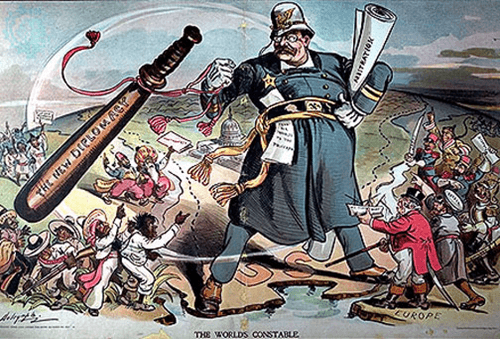
This political cartoon portrays which component of American Imperialism?
a)
Great White Fleet
b)
Monroe Doctrine
c)
Roosevelt Corollary
d)
Teller Amendment
116.
Which of the following defines the Roosevelt Corollary?
a)
Europe was not allowed to imperialize the Americas
b)
America was the police force for the Western Hemisphere
117.
Which country was imperializing Cuba before the US took it over?
a)
France
b)
Spain
c)
Colombia
d)
Mexico
118.
Which of the following defines the Monroe Doctrine?
a)
Europe was not allowed to imperialize the Americas
b)
America was the Police force for the Western Hemisphere
119.
What book did Alfred T Mahan write?
a)
The Jungle
b)
How the Other Half Lives
c)
The Influence of Naval Power Upon History
d)
Adventures of Tom Sawyer
120.
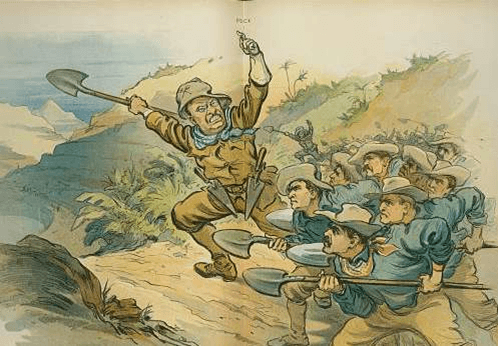
Which aspect of Imperialism does this picture represent?
a)
Roosevelt Corollary
b)
Monroe Doctrine
c)
Influence of Naval Power Upon History
d)
Spanish American War
121.
Which of the following describes the Teller Amendment?
a)
Promised that America would give Cuba its inedpendence
b)
Promised the US would give Hawaii its independence
c)
Promised the US would give the Philippines its independence
d)
Gave America control over Guantanamo Bay
122.
Emilio Aguinaldo fought for independence in which country that America imperilized?
a)
Hawaii
b)
Philippines
c)
Cuba
d)
Puerto Rico
123.
The following political cartoon refers to the construction of what by Teddy Roosevelt?
a)
Naval Base at Guantanamo Bay
b)
Suez Canal
c)
Panama Canal
d)
Washington Monument
124.
Which country becomes a possession of the US by way of the Foraker Act?
a)
Cuba
b)
Philippines
c)
Puerto Rico
d)
Panama
125.
At the beginning of WWI, President Woodrow Wilson believed that the United States should...
a)
send troops to Europe
b)
support Germany
c)
support Great Britain
d)
remain neutral
126.
What type of warfare was used in WWI?
a)
bench
b)
trench
c)
French
d)
wrench
127.
An alliance is...
a)
A time of quick economic decline
b)
An end to shooting and bombing
c)
A neighborhood of Spanish-speaking people
d)
A partnership
128.
Propaganda posters encouraged people to
a)
Go on strike
b)
Oppose the war
c)
Support the war
d)
Save money in banks
129.
The incident that started World War I was the assassination of 
a)
The Prince of Germany
b)
Abraham Lincoln
c)
Archduke Ferdinand
d)
the King of Austria-Hungary
130.
Who was president of the United States during World War I?
a)
Abraham Lincoln
b)
Theodore Roosevelt
c)
Bill Clinton
d)
Woodrow Wilson
131.
Who would be blamed for WWI?
a)
Serbia
b)
France
c)
Russia
d)
Germany
132.
Who was responsible for triggering the war through an assassination? 
a)
Franz Ferdinand
b)
Gavrilo Princip
c)
Kaiser Wilhelm
d)
Woodrow Wilson
133.
The attack on this ship killed over 100 AMericans in WWI.
a)
Titanic
b)
Santana
c)
Sullivan
d)
Lusitania
134.
Conscription  or drafting began in WWI due to this law.
a)
Sedition Act
b)
Propaganda Act
c)
Selective Service Act
d)
Treaty of Versailles 
135.
Why did the US Congress refuse to join the League of Nations? 
a)
They feared Hitler.
b)
They feared being drawn into foreign wars.
c)
Their distrust of Pres. Wilson
d)
They disagreed with all of the 14 points.
136.
What is a German submarine?
a)
subway
b)
uboat
c)
blitzkrieg
d)
dreadnought 
137.

Which of these helped create popular culture throughout the United States?

a)

the radio

b)

prohibition

c)

women's suffrage

d)

the KKK

138.

How did Prohibition contribute to the growth of organized crime?

a)

by making it easier for bootleggers to branch into other types of illegal activity

b)

by forcing police to enforce anti liquor laws

c)

by forcing farmers to grow grain for the production of alcohol

d)

by strengthening respect for the law

139.

At its heart, the Scopes Trial was a clash between

a)

religion and science

b)

biology and science

c)

evolution and science

d)

education and science

140.

How was Henry Ford able to reduce the sale price of the Model T?

a)

with the use of the assembly line

b)

changing locations

c)

importing all raw materials

d)

increasing the wages of his workers

141.

The literature of the Harlem Renaissance

a)

explored the pains and joys of being black in America

b)

explored the origins of jazz

c)

was written by Marcus Garvey

d)

argued for the separation of races

142.

Which of these best describes the "New Woman" of the 1920s?

a)

They wore shorter skirts, bobbed their hair, and went to speakeasies

b)

They stayed home and cooked and cleaned

c)

They rejected the idea of suffrage

d)

They preferred the same fashions as their parents

143.

Which 1920s president is best known for scandals and corruption?

a)

Harding

b)

Coolidge

c)

Hoover

d)

Trump

144.

Italians convicted of murder mainly because they were foreigners.

a)

Sacco & Vanzetti

b)

Scopes & Darrow

c)

Bryan & Darrow

d)

Mario & Luigi

145.

Period in the 1920s when suspected communists and other radicals were arrested due to the fear of the spread of communism.

a)

Red Scare

b)

Teapot Dome Scandal

c)

Scopes Trial

d)

KKK