
 Worksheets
Islam Cycle-4 Quiz
Total questions: 71
Worksheet time: 6hrs 55mins
which part of an atom moves to create current?
proton
neutron
electron
which of the following is not a drawback of solar energy?
sunlight does not have energy
cost
sun is not always out
solar energy is diffuse and hard to collect
which of the following is a drawback to wind energy?
migration of birds being interrupted
noise
disrupts the landscape
not available in all locations
Which renewable energy does not require spinning a turbine?
hydroelectric
wind
tidal
photovoltaic cells
if a tractor trailer truck is 20% efficient, what happened to the other 80%
energy is destroyed
energy is lost as heat
the 80% is still in the gas tank
energy is converted into matter
Which example is NOT a renewable resource?
Trees
Wind
Solar
Uranium (Nuclear)
What is one disadvantage of coal?
Coal produces air pollution.
There isn't a lot of coal left which makes it expensive.
The world isn't using a lot of coal which makes it an undesirable job.
You can only use it to roast hot dogs and cook hamburgers.
What is one disadvantage of renewable energy?
Electricity and power could become much cheaper.
Third world countries could have affordable energy.
Many people could become energy independent.
Most sources are expensive to get started.
How is geothermal energy harvested? (How do we get it?)
solar panels collect the sunlight.
The heat from the earth boils water to create steam.
We pump it from the earth and refine it into gasoline.
We drill for it and burn it like coal or wood.
What is one disadvantage of using hydropower?
Hydropower is a renewable energy resource. There are no disadvantages.
The power is used as electricity to power large buildings instead of homes.
Building dams can damage natural wildlife and water systems like lakes and rivers.
Most of the time there isn't enough water power to create electricity.
Crude oil must be refined before it can be used as fuel. What does "refined" mean?
Taxed
Created
Purified
Burned
What are the 3 main fossil fuels?
Coal, Oil, and nuclear fuel
Coal, Oil, and Natural Gas
Electricity, Gas, Petroleum
Coal, Oil, Non-renewable Resources
What is coal made of?
decomposed plant remains
decomposed sea creatures
lava
all of the above

What conditions are needed to form coal?
Heat and pressure
Heat
Moisture and pressure
Cool and moist
Why are fossils fuels so widely used?
They are renewable so they won't run out.
They pollution they produce is less compared to renewable energy sources.
They are easy to obtain and process.
They don't disrupt the environment when mined from the earth.
What changes wind energy into electricity?
Windmill
Windsock
Wind Turbine

The diagram above shows a wind turbine. Which section of the wind turbine converts wind energy to electrical energy?
blades
generator
rotor
pitch system
what does a wind turbine look like


How do geothermal power stations work
Cold water is heated up and the water power turbines under the water and turns it into electricity!
Cold water is pumped down and the cold water meets the hot water from inside the earth to produce steam to power turbines then creating electricity !
The hot water from inside the earth meets cold air and produces condensation which powers the turbines and turns it into electricity!
The electricity in our house is
AC
DC
BC
AD
An electric current that continually reverses direction over time is known as a(n)
direct current
alternating current
simple current
Moving a permanent magnet through a coil of wire will
demagnetize the magnet
the wire will become an electromagnet
the magnet will become electrified
a current will be generated in the wire
The number of cycles that are completed per second is called the ________ and is measured in _________.
frequency, Hertz
wavelength, meters
amplitude, meters
period, seconds
The period of a signal is 10 s. What is its frequency?
10 Hz
1 Hz
0.5 Hz
0.1 Hz
A voltage signal makes 33 complete back and forth cycles of vibration in 11 seconds. It's frequency is:
3.0 s
3.0 Hz
0.33 s
0.33 Hz
In a thermal power station, where is steam produced?
Furnace
Boiler
Turbine
Transformer
To which part is the turbine axle connected to?
Transformer
Generator
Furnace
Boiler
What is the function of the transformer?
To convert water to high pressure steam
To rotate the turbine axle
To increase the voltage produced by the generator
To transform mechanical energy to electrical energy
Which of the following rotates the turbine axle?
steam
water
magnet
brush
Which part in a power station produces electrical energy?
Turbine
Boiler
Generator
Transformer

How long does it take to produce fossil fuels?
hundreds of years
thousands of years
millions of years
billions of years

Why are we trying to use fossil fuelled power stations less?
Gases produced are bad for the environment
It is an expensive way of making electricity
Fossil fuels are running out
Its not very sunny in Wales
Primary winding of a transformer is determined by _________.
which winding has more turns
which winding is nearer to the load
which winding is connected to the source
which side has the highest voltage
What type of transformer is used to increase the voltage from power stations.
Step-down transformer
Step-up transformer
Why transformers work with A.C. current but not D.C.
A.C current produces changing magnetic field.
D.C current produces changing magnetic field.
D.C current is weak
A.C current is powerful
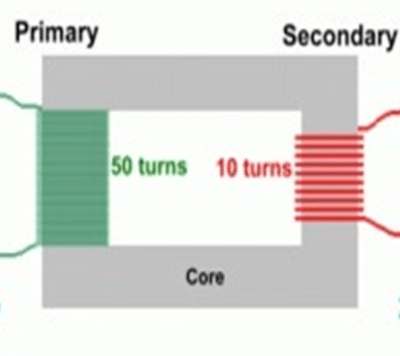
This picture is an example of a ________________.
Motor
Generator
Step-up transformer
Step-down transformer
Ratio of voltages is equal to ratio of _______________________.
number of iron sheets in core
number of coil
number of turns in coil
number of electromagnetic
A transformer has 100 turns in the primary coil and 25 turns in the secondary coil. When a 120 V is applied to the primary coil, what is the voltage in the secondary coil?
480V
30V
20V
450V
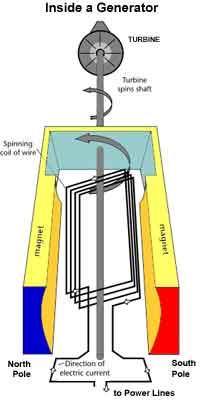
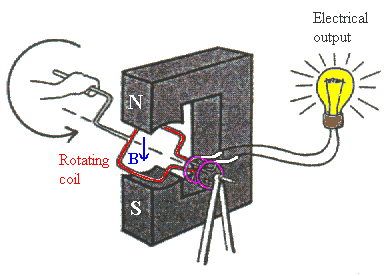

1.20 V


Determine the peak voltage
15 V
30 V
-15 V
-30 V

what types of signal is this?
Direct Current
Alternating Current

What type of signal is this?
Direct current
Alternating current

What type of energy conversion happen in boiler?
Chemical to Heat energy
Heat to Kinetic energy
Kinetic to Mechanical energy
Mechanical to electrical Energy.

What type of energy conversion happen in turbine?
Chemical to Heat energy
Heat to Kinetic energy
Kinetic to Mechanical energy
Mechanical to electrical Energy.
what kind of energy is stored in fossil fuel?
Heat
Kinetic
Chemical
Electrical
What is the pick voltage of US Grid electricity?
50
80
120
220
What is the frequency of US grid electricity?
50
60
70
80
How many times is US grid electricity is turning Off and ON in one second?
40
50
60
70
Why we need to have transformer in transmission line?
To connect the cable
It seems necessary
To reduce the transmission loss.
to make it less costly.
Magnetic field lines always travel what direction?
North to South
South to North.

