
 Worksheets
Cold War Review #1
Total questions: 68
Worksheet time: 41mins


Where was Korea divided?
18 parallel
34 parallel
38 parallel
15 parallel
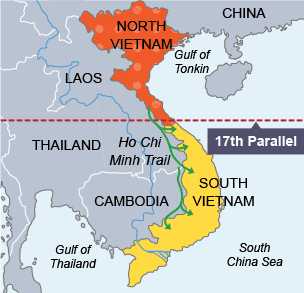


Images like this one refer to what theory about the spread of Communism in Asia (China, Korea, Vietnam)?
The Mar$hall Plan
The Domino Theory
Proxy Wars
Flexible Response
Which leader promoted communism in North Vietnam?
Ho Chi Minh
Mao Zedong
Truman's policy of preventing the expansion of communism was -
containment
deterrence
militarism
perestroika

What policy implemented in the Cold War said the U.S. would give military aid to a country that needed to resist communism?
Marshall Plan
Truman Doctrine
Domino Theory
Open Door Policy
During the Cold War, what policy did the U.S. follow to stop the spread of communism?
Open Door Policy
Big Stick Policy
Containment Policy
Dollar Diplomacy
Which individual/group contributed to the Red Scare by accusing American citizens of being communist spies?
McCarthy/HUAC
NAACP/Farm Workers Union
Nativists/Muckrakers
Philanthropists/Entrepreneurs

What happened as a result of the launch of Sputnik in 1957?
It started the space race between the USSR and U.S.
The U.S. government started NASA.
U.S. began to spend more money on math and science to maintain national security.
All of the above

During what Cold War event did the U.S. bypass a Soviet blockade in Germany without provoking a military conflict?
Berlin Airlift
Vietnam War
Watergate Scandal
Bataan Death March


What were the defining characteristics of the Cold War?
Prohibition, Flappers, Jazz
Arms Race, Space Race, Red Scare
Holocaust, Nazi Germany, Pearl Harbor
Poverty, Unemployment, Dust Bowl
What wars were fought during the Cold War as a result of containment and the Domino Theory?
Korean & Vietnam War
WWI & WWII
Civil War & Spanish American War
Persian Gulf & War on Terror

What amendment was passed to lower the voting age because it was unfair that 18-20 year olds were fighting in Vietnam but couldn't vote.
18th
22nd
24th
26th


Who is this picture of?
John F. Kennedy and Lyndon Johnson
Lyndon Johnson and Nikita Khrushchev
John F. Kennedy and Nikita Khrushchev
John F. Kennedy and Fidel Castro
When & where did JFK get assassinated?
April 14, 1865 in Boston, Massachusetts
November 22, 1963 in Peoria, IL
April 14, 1865 in Washinton, DC
November 22, 1963 in Dallas, TX
What was the Cuban Missile Crisis?
Cuban Revolution.
13 day crisis in which the Soviet Union and the United States faced off and came close to nuclear war.
Missiles not getting to Cuba.
Plot to hide U.S. missiles in Cuba.
What was the Cuban Missile Crisis?
Cuban Revolution.
13 day crisis in which the Soviet Union and the United States faced off and came close to nuclear war.
Missiles not getting to Cuba.
Plot to hide U.S. missiles in Cuba.
Who was the Communist leader in Cuba while Kennedy was President
Khrushchev
Castro
Johnson
Batista
Richard Nixon lost to who in the 1960 Election?
Reagan
JFK
LBJ
Eisenhower
Richard Nixon lost to who in the 1960 Election?
Reagan
JFK
LBJ
Eisenhower

Which of the following was a failed invasion of Cuban exiles in 1961 that made the Kennedy administration look incompetent?
D-Day
the Bay of Pigs
the Cuban Missile Crisis
the Gulf of Tonkin incident
What policy did the Kennedy administration take that allowed more military options in the event of an international crisis?
flexible response
the building of the Berlin Wall
brinkmanship
detente
Which of the following was most important in electing John F. Kennedy as president in 1960?
his religious views
his opponent’s Watergate scandal
his success in the televised debates
his handling of the U-2 incident
Which of the following was a dedicated phone that enabled the leaders of the US and the USSR to communicate with each other immediately in a crisis after 1963?
an early version of face-time
a hot line
satellite television
open computer access between the nations
What was the name of Kennedy’s legislative agenda?
the New Frontier
the Peace Corps
the Great Society
the Fair Deal
What was the name of the program of volunteer assistance to Asia, Africa, and Latin America that was started in 1961? (and still continues today)
the Peace Corps
the Jobs Corps
the Economic Opportunity Act
the Alliance for Progress
What is the name of the US space agency?
National Organization of Outerspace Travelers (NOOOT)
National Aeronautics and Space Administration (NASA)
National Outerspace Galaxy Organization (NOGO)
none of the above
Who was the first person to step foot on the moon?
Yuri Gargarin
Sargent Schriver
Neil Armstrong
Alan Shepard
What organization was formed at the end of WWII to prevent future wars?
the United Nations
the League of Nations
NATO
the Warsaw Pact

What was the US nuclear policy toward the USSR in the 1950s?
Massive Retaliation
Massive Response
Considered Response
Considered Retaliation
Click three ways that fear of nukes affected Americans in the 1950s?
Students did "duck and cover" drills at school.
Some people built bomb shelters.
The government rationed food.
People were scared that Communists were secretly destroying American society
Click on the names of the two famous spy cases that seemed to show that Communists were everywhere, and they were helping the enemy.
The Alger Hiss Case
The Rosenbergs Case
The Zuckerberg Case
The Nixon Case

This man claimed 205 state department workers were communist agents...who was he?
Joseph McCarthy
Richard Nixon
Dwight D. Eisenhower
Alger Hiss

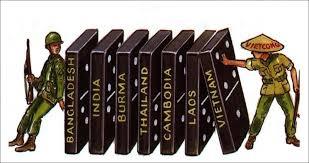
The idea in this picture is about...
The policy of Vietnamization
The policy of Communism
The policy of containment
The policy of Imperialism


Because of the Domino Theory, The United States will give military aid to....?
Diem's government

Cause: Because the United States joined SEATO...
Effect: US Involvement in Vietnam
Effect: US Involvement in World War II
Effect: US Involvement in the Civil War
Effect: US involvement in Cuba
Why was the Berlin Wall built?
To separate East and West Berlin
To keep people from leaving East Berlin
Both
Why did the USSR want to put missiles on Cuba?
To have more missiles because they couldn't match the nuclear power of the US
To counter the Warsaw Pact countries that were overthrowing communism
To counter the US missiles in Italy and Turkey
To counter the power of NATO

