
 Worksheets
USHC 1-4 Mid Term Review 24-25
Total questions: 73
Worksheet time: 57mins
Who had more power with the Articles of Confederation?
National Governments
State Governments
Federalist Paper that supported a representative democracy
Primary objective of the 85 essays was to?
Federalist Papers explained the checks and balance system (executive branch power of legislative branch.
Federalist Papers 7
Federalist Papers 73
Federalist Papers 51
Federalist Papers 10
Court case that established the concept of Judicial Review.
The power of the Supreme Court to determine if a law is constitutional.
In Farewell Address, Washington had 2 main suggestions for the USA name them.
Court case that was ignored by Andrew Jackson and led to the forced removal of Native Americans?
Worcester vs Georgia
Marbury vs Madison
McCulloch vs Maryland
Roe vs Wade
Federalist Supreme Court Justice that strengthened the supreme court and federal government with many of his rulings.
John Marshall
William Gray
Earl Warren
Thomas Knibbs
The Federalist papers were used to persuade people to (a) the Constitution. They included ideas like (b) and (c) .
Put the following events in order from first to last
Declaration of Independence
Articles of Confederation
Shays Rebellion
Creation of US Constitution
Whiskey Rebellion
Which of the following was the greatest thing to come out of the Articles of Confederation?
North West Land Ordinance
Taxable income
13th Amendment
Popular sovereignty
Match the following
Alien and Sedition Acts
Removal of your 1st Am. Right by Govt.
Virginia and Kentucky Resolutions
Nullification of the A/S Acts
Philanthropist
Proving goods to your community
Robber Barons
Using practices to get ahead and make $$
Homestead Acts
Providing "free" land to move out west
Which presidential campaign led to the split of the Republican Party in 1912?
Roosevelt vs Wilson vs Taft
Perot vs Clinton vs Bush
William McKinley vs William Jennings Bryan
The religious group that migrated to the west, due to persecution in the east, and ultimately settled in Utah were the (a) .
Which area of the map would you find African Americans known as Buffalo Soldiers post Civil War?
The process of nullification allows a state to do what, in regards to laws made by the Federal Government....... Think 10th Amendment
Approve unanimously to follow the law for the good of the country
Claim the law is unconstitutional, and follow their own regional/state interest
They have not choice, the rule of the Feds outranks the rule of the States
Claim that Great Britain would have never created these laws and secede from the Union.
The Necessary and Proper Clause, or Elastic Clause, allows for changes to this provided it is for the greater good due to the changing of the country... think document
(a)
Put the following events in order, think about cause and effect of each event to the next event.
Industrialization in America
Western Migration and movement of factories/industry
Industry offers jobs, immigrants flock to the USA
Workers want rights and protections, create Unions
Progressive Presidents take office and fight for "common people" to fix society
Place the policies/events under the presidential candidate that best fits.
Pro Big Business
Pro common man
Gold = Money
Bi-metalism
Anti-Union
Cross of Gold Speech
Election of 1896 Winner
Election of 1896 Loser
Match the following business with the owner.
Andrew Carnegie
Steel
John D. Rockefeller
US Standard Oil
J. P. Morgan
Banking
Cornelius Vanderbilt
Rail Roads
This was an attempt by Benjamin Franklin to unite the Colonies prior to the French and Indian War
How did the Colonies respond to the Albany Plan proposed by Benjamin Franklin?
Match the following
“all Laws which shall be necessary and proper for carrying into Execution”
Elastic Clause
life, liberty, pursuit of happiness
Declaration of Independence
Power to determine the constitutionality of a law
Judicial Review
Virginia and Kentucky Resolution
Nullification
Limited the power of the government
Bill of Rights
life, liberty, pursuit of happiness are all found in?
An Unjust Government can be overthrown, All Men are Created Equal are both found in?
Limited the Power of the U.S. Govt.
First 10 Amendment
All men are created equally
Unjust govt can be overthrown
Life, Liberty and the Pursuit of happiness
27 Amendments
Rule of Law
The govt should represent the people
Replaced the Articles of Confederation
consent of the governed
John Locke
Montesquieu
Rousseau
Social Contract Theory
James Madison
85 essays were written to ratify this document
Can't Tax
Can't regulate interstate commerce
Too weak to lead effectively
No branches of government
Northwest Ordinance

3 branches of government
Checks and balance system
Judicial Review
Strenghtened the Supreme Court
Federalist
Appointed for life
Preamble
Bill of Rights
Great Compromise
Elastic Clause
Fought for Civil Rights
Brown v Board of Education
1953-1969
Match the following
Marbury vs Madison
Judicial Review
Declaration of Independence
All men are created equal
Articles of Confederation
States have all the power
Virginia Plan
Representation base on population
New Jersey Plan
All states have equal representation
Ratify
Approve
Nullify
Void
Tariff
Tax on imports
Amend
Change
Suffrage
Vote
Which of the following ideas was part of George Washington's Farewell Address?
We need to rebuild our relationship with England.
We need to remain united at home and neutral abroad.
We need to support the Federalist Party.
We should offer charity and military aid to any nation in need.
What did Abraham Lincoln declare, early in his presidency, as his primary goal as President?
To enforce the Emancipation Proclamation
To preserve the Union
To end slavery throughout the entire country
To encourage sectionalism
Choose all that apply: Which of the following was the primary reason for secession, the Civil War, and eventually the 13th Amendment?
the annexation of Texas into the Union
the popularity of the abolitionist movement
the controversy over slavery as the nation moved west
Harriet Beecher Stowe’s book, Uncle Tom’s Cabin
What was the result of the disputed Presidential Election of 1876?
Reconstruction ended as federal troops were removed from the South.
Slavery was re-established in the South by state legislatures.
New state laws were passed in the South to guarantee equal rights for African Americans.
A constitutional amendment was adopted to correct problems with the electoral college system
What was the purpose of Black Codes during Reconstruction?
The codes were laws meant to protect the constitutional rights and liberties of freed slaves.
The codes were laws passed by mainly Southern states to keep African Americans subordinate to whites.
The codes established educational standards for freedmen.
The codes provided forty acres and a mule to freedmen.
What was the significance of the 54th Massachusetts Regiment during the Civil War?
The Regiment defeated Union troops at Fort Sumter.
The Regiment defended the Mississippi River at the Battle of Vicksburg.
The Regiment achieved a Union victory during the first naval battle fought between ironclads.
The Regiment gained respect and notoriety for African American soldiers who joined the Union.
“I was the conductor of the Underground Railroad for eight years, and I can say what most conductors can't say — I never ran my train off the track and I never lost a passenger.” ...
Which abolitionist leader is best associated with the quote above?
John Brown
David Walker
William Lloyd Garrison
Harriet Tubman
How were Frederick Douglass, William Lloyd Garrison, and the Grimke Sisters all similar?
They all supported the abolitionist movement.
They all supported the passage of Black Codes.
They all supported the nullification theory of States' Rights.
They all supported the plantation system in the South.
Which of the following are MOST associated with Andrew Carnegie?
(Choose 4 that apply)
Horizontal Integration
Vertical Integration
Standard Oil
Gospel of Wealth
Bessemer Process
Which of the following are most associated with John D. Rockefeller?
Choice (3) that apply
Standard Oil
Horizontal Integration
Kerosene
U.S. Steel

Study the image. (Remember, to best understand a visual prompt, you need to consider ALL the information presented: dates, characters/individuals represented, setting, descriptions, source, etc.)
Which idea of the late 1800s is MOST closely associated with the cartoon above?
Regulated Capitalism
Social Darwinism
Gospel of Wealth
Graduated income taxes
Which term BEST describes the United States government's policies towards Big Business during the Gilded Age?
Regulatory
Mercantilist
Laissez-faire
Progressive

Study the image below. (Remember, to best understand a visual prompt, you need to consider ALL the information presented: dates, characters/individuals represented, setting, descriptions, source, etc.)
The "Cross of Gold" speech, which is depicted in the cartoon above, was a Populist initiative promoting what?
Hard money, based on the gold standard
Deflation, in order to raise farm prices
Bimetallism, which based money on gold and silver
Muckraking, to expose the corruption of big business
In the late 1800s, why were the Homestead Steel Strike and the Pullman Railcar Strike unsuccessful?
The federal government only supported business owners.
Most workers refused to take part in the strike.
The Supreme Court ruled both strikes were illegal.
Factory owners hired children to replace the striker
Which of the following methods would be embraced by a union leader?
Child labor
Collective bargaining
Lockouts
Laissez-faire economics
Why did presidents and governors use military force during labor-management conflicts in the late 19th century?
in order to support industrialists and end strikes
in order to make employers sign collective bargaining agreements
in order to protect workers from the private armies of employers
in order to replace striking factory workers with soldiers
What was the primary purpose of the Interstate Commerce Act(1887), the Sherman Antitrust Act(1890), and the Clayton Antitrust Act(1914)?
to eliminate unfair business practices
ro reduce imports from foreign nations
to reduce the power of the unions
to increase the power of local governments
Which of the following was a MAIN reason the Chinese Exclusion Act was supported at both state and national levels?
The United States government wanted to retaliate against Chinese attacks on the American Navy.
Leaders wanted to stop Chinese religious influence in America.
Political and economic leaders wanted to reduce competition from Chinese laborers.
West Coast leaders wanted to reduce the amount of opium being smuggled into the United States.
Nativism, economic problems on the West Coast, and controversy over lower wages all led to the passage of which law?
The Chinese Exclusion Act
The Sherman Anti-Trust Act
The Voting Rights Act
The Homestead Act
Which of the following best describes the "New Immigrants" of the late 19th and early 20th Centuries?
Northern and Western Europeans
Southern and Eastern Europeans
Mediterranean Races from Europe, Africa, and Asia
Asians and Latin Americans
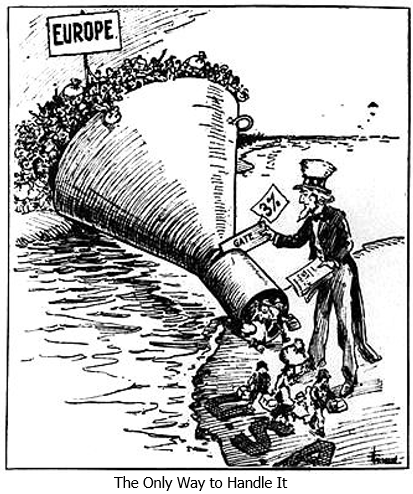
Why did the United States pursue the policy demonstrated in this cartoon?
to find a safer method of transport for people crossing the Atlantic Ocean
to improve relations with European countries
to limit the number of immigrants that entered the United States
to create an easier process for becoming an American citizen
Which is the best example of nativism in the late 19th century?
the creation of settlement houses
the founding of the American Federation of Labor
the passage of the Chinese Exclusion Act
the reliance on immigrants as sources of labor
Which of the following fostered the development of a national market by linking all parts of the country between 1840-1900?
Highways
Railroads
Radio
Electricity
Which of the following are MOST associated with Andrew Carnegie?
(Choose 4 that apply)
Horizontal Integration
Vertical Integration
Standard Oil
Gospel of Wealth
Bessemer Process
Which of the following are most associated with John D. Rockefeller?
Choice (3) that apply
Standard Oil
Horizontal Integration
Kerosene
U.S. Steel

Which economic concept is best illustrated by the cartoon?
Supply and demand
mercantilism
monopoly
trade
What impact did U.S. governmental policies have on business and industry during the late 1800s?
The U.S. government tried to control public and private utilities and transportation.
The U.S. government tried to limit and regulate industrial and business growth.
The U.S. government regulated industry for the public good.
The U.S. government provided little or no enforcement of regulations on industry.
In the 1830s, how did President Andrew Jackson fail to protect the natural rights of Native Americans?
Jackson supported legislation decreasing Native Americans' right to vote.
Jackson sought to annex the territories of Texas and Oregon.
Jackson enforced the relocation of Native Americans with the Indian Removal Act.
Jackson punished Native Americans for siding with Britain during the War of 1812.

Which late-1700s technological innovation best explains the change over time represented in the chart above?
Telegraph
Steam Engine
Cotton Gin
Railroads
As President, how did Andrew Jackson undermine the Supreme Court decision of Worcester v. Georgia?
He defied the court's ruling and allowed the Indian Removal Act to continue.
He supported the theory of nullification and states' rights.
He began an impeachment process of John Marshall in Congress.
He established voting and property rights for African American males.

Which of the following BEST explains the dramatic increase in the number of German and Irish immigrants to northern cities in the mid-1800s?
The growth of the cotton industry in the South supported the expansion of the northern textile system.
The large scale African American migration to the South created an abundance of available jobs in the North.
The KKK discouraged European immigration in the South, resulting in northern urbanization.
The decrease in cotton production led to high unemployment in the South.
Which Supreme Court case tried to protect the rights of Native Americans?
Gibbons v. Ogden
Marbury v. Madison
Dred Scott v. Sandford
Worcester v. Georgia
Which of the following were part of Henry Clay's American System?
(Choose 4 that apply)
Tariffs for the protection of domestic industry
Increased trade among the regions of the nation
Sale of federal lands to finance construction of colleges and universities
Internal improvements at the national government's expense
A national bank to encourage commerce
Which of the following were characteristics of President Andrew Jackson's Administration?
(Choose 2 that apply)
The expansion of suffrage to all white males
The abolition of slavery
The displacement of Native Americans
The annexation of Texas

What would be the best title for the map above?
British North America Before 1850
United States Territorial Expansion
Colonial North America
Wartime Land Acquisitions

Which event led to the acquisition of the territories shown in red and tan on the map?
Spanish American War
Oregon Purchase
Mexican-American War
Louisiana Purchase

In the mid-1800s, why did Northern cities like Lowell, Massachusetts see such dramatic population increases?
The purchase of the Louisiana Territory provided new land and mineral resources to frontier settlers.
Experimentation with utopian communities meant both men and women had expanded political and economic opportunities.
The migration of skilled labor to western territories led to a decrease in the number of available factory and farm workers in the East.
There was a direct connection between increases in Southern cotton production and factory opportunities in the North.
Treaty that provided the United States with much of the Southwest
Louisiana Purchase
Guadalupe Hidalgo
Adam Onis
Oregon Treaty

The green area on the map is
Oregon Treaty
Mexican Cession
The Alamo
Battle of Guadalupe Hidalgo

