wayground logo

Free Printable Worksheets

NEW

Font size

S
M
L
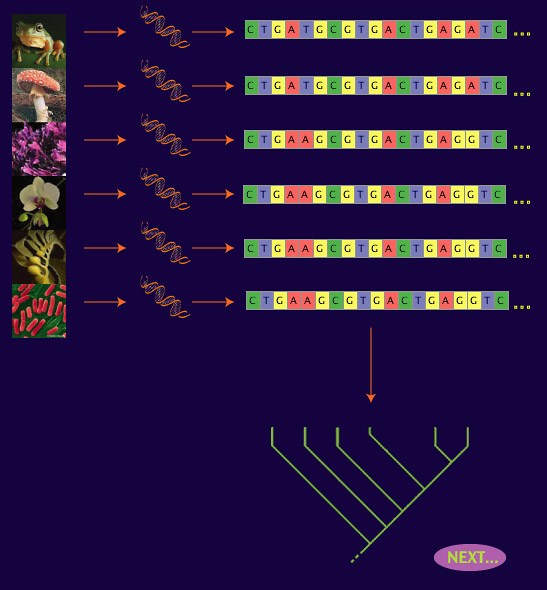
XL
Worksheets

Evolution and Classification Review

Total questions: 53

Worksheet time: 2hrs 46mins
Name
Class
Date
1.
What is the study of organisms at the early stages of development?
a)
DNA studies
b)
embryology 
c)
extinction
d)
fossil record
2.
What is this an example of?
a)
vestigial structures
b)
embryology
c)
homologous structures
d)
fossil record
3.
Which layer is the oldest?
a)
1
b)
2
c)
3
d)
4
4.
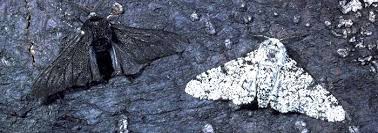
Predict which moth would increase in population
a)
light 
b)
dark
5.
Darwin wrote that organisms with traits that are best suited to the environment will ________________
a)
increase in number
b)
become extinct
6.
Which species’ DNA is most similar to the DNA of the toothed whale? 
a)
Hippopotamus 
b)
Baleen Whale
c)
Grazing Mammals
d)
Camels
7.
Two organisms that are closely related would have
a)
very similar DNA sequence
b)
exactly the same DNA sequences
c)
no proteins in common
d)
completely different DNA sequence
8.
The study of the early stages of development that is one evidence of evolution is:
a)
Homologous Structures
b)
Embryology
c)
Vestigial Organs
9.
The opossum and kangaroo both incubate their young in a pouch. This provides evidence that they---
a)
are descended from a common ancestor
b)
Have very similar skeletal structures
c)
belong to the same species
d)
must range great distances to eat
10.
The white feathers of a snowy owl allow it to blend in with its environment during the winter months (snow). This is an example of ________________
a)
Species
b)
Environmental Change
c)
Adaptation
d)
Variation
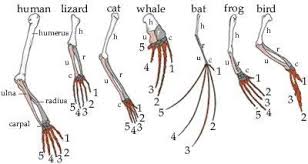
11.
The similarities of the bones in the diagram provide evidence that---
a)
The organisms shown lived in the same natural envionrment
b)
The organisms shown may have developed from a common ancestor
c)
The organisms shown have the same genetic diseases
d)
All vertebrate species have identical forelimbs
12.
A prey population consists of individuals with a variety of running speeds.
The adaptation that allows some of these animals to run fast would be an example of natural selection if it helps them —
a)
survive and undergo mutations in their DNA
b)
produce offspring that run at average speeds
c)
reproduce and increase the frequency of their genes in the population
d)
lower the mortality rates of the population
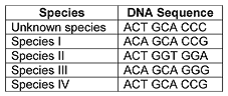
13.
According to this data, the unknown bacterial species is most closely related to: 
a)
Species I
b)
Species II
c)
Species III
d)
Species IV
14.
Certain insects resemble (look like) the bark of the trees on which they live. Which statement provides the best explanation  for this resemblance? (Peppered Moths)
a)
The trees caused mutations in the insects
b)
Natural selection played a role in this protective coloration
c)
The insect camouflage so they developed this coloration
15.
The similarities of organisms in which two areas numbered in the picture provide the best evidence for common ancestry?
a)
1 and 2
b)
3 and 4
c)
5 and 6
d)
7 and 8
16.
Which of the following is an example of the founder effect?
a)
Bald Eagles are hunted until near extinction, population recovers.
b)
Small group of iguanas floats to an island, starts a new population.
c)
Red fox pups are more likely to survive in a snowy environment if they are born white.
d)
Farmer chooses seeds from largest apples to plant next year.  This results in larger apples from year to year.
17.

_______ are two sources of genetic variation in a population

a)

Bottleneck and Bacteria

b)

Small Population and Viruses

c)

Mutations and Recombination

d)

Founder Effect and Artificial Mating

18.

A(n)________ is a measure of how common a certain allele is in a population.

a)

Allele Frequency

b)

Gene Pool

c)

Genotypical Number

d)

Genetic Drift

19.
There was once a large population of cheetah, but about 12,000 years ago most of the cheetahs were killed off because of human activity and only a few survived.  What is this an example of?
a)
Bottleneck Effect
b)
Genetic Drift
c)
Founder Effect
d)
Natural Selection
20.
Gene Flow tends to ___________ genetic variation (diversity)
a)
Increase
b)
Decrease
c)
Stabilize
d)
Exaggerate 
21.
Which of the following is NOT an example of natural selection? 
a)
People selectively breeding hamsters.
b)
Insect populations developing resistance to certain pesticides.
c)
Bacteria becoming resistant to antibiotics.
d)
Male birds of certain species developing colorful feathers to attract female mates.
22.
During meiosis (sperm formation), a developing male pig had a change in his DNA that resulted in his coat becoming spotted.
a)
Genetic Drift
b)
Non-random mating
c)
Mutation
d)
Natural Selection
23.
7 wild mustangs were taken from the prairies of Oklahoma after a Texas rancher purchased them and provided them with their own pasture. Those 7 mustangs eventually reproduced to have 122 offspring.
a)
Genetic Drift (small population)
b)
Non-random mating
c)
Gene flow
d)
Mutations
24.
Human babies don't do well if they are born too small. If they are too big, complications can occur during birth. Baby size should then be selected for by which method?
a)
stabilizing
b)
directional
c)
disruptive
25.
If finches with large beaks and finches with small beaks increase in a population while finches with average sized beaks decreases, which pattern of natural selection has occurred?
a)
Directional selection
b)
Disruptive selection 
c)
Stabilizing selection
26.
Evolution and natural selection act on a(n) 
a)
individual
b)
species
c)
population
27.
After experiencing the bottleneck effect or the founder effect, the gene pool and genetic diversity of a population
a)
increases
b)
decreases
c)
stays the same
28.
The theory of evolution by natural selection means that what is changing over time?
a)
The inherited traits of a population.
b)
The acquired traits of a population.
c)
Hair color and eye color
d)
Attractive features.
29.
Why are advantageous traits more likely to be passed onto offspring?
a)
Because they are more likely to survive and reproduce.
b)
Because they come from dominant alleles.
c)
Because they come from recessive alleles.
d)
Because the trait is an acquired phenotype.
30.

The graphs below show the changes in crab color at one beach.

Which of the following is most likely to have caused the change in the distribution?

a)

A new predator arrived that preferred dark-tan crabs.

b)

A new predator arrived that preferred light-tan crabs.

c)

A change in beach color made medium-tan crabs the least visible to predators.

d)

A change in beach color made medium-tan crabs the most visible to predators.

31.

A population of rabbits grows rapidly from one year to the next. Then one year, a disease strikes approximately one fourth of the adult rabbits. The disease remains with the population in the years that follow.

As explained by Darwin’s theory, which of these conditions allows the rabbit population to evolve by natural selection?

a)

The disease affects adult and juvenile rabbits equally.

b)

The disease reduces the ability of the rabbits to reproduce.

c)

Some rabbits are resistant to the disease, and they pass the resistance to their offspring.

d)

No rabbits are resistant to the disease, and all die when the disease strikes them.

32.
What are the 8 levels of classification of living things from most general to most specific?
a)
domain, kingdom, phylum, class, order, family, genus, species
b)
domain, kingdom, phylum, class, order, family, genius, species
c)
domain, kingdom, phamily, class, order, family, genus, species
d)
domain, king, phillip, class, order, family, genus, species
33.
The scientific name for water bear is Hypsibius dujardini.  What is its species?
a)
Hypsibius 
b)
dujardini
c)
water 
d)
tardigrade
34.
Who is the closest relative to the birds?
a)
crocodiles
b)
sharks
c)
fish
d)
amphibians
35.
Who is the closest relative to the sharks?
a)
crocodiles
b)
sharks
c)
ray-finned fish
d)
amphibians
36.
Which domain is capable of living in extreme environments like hot springs, geysers, or very salty waters?
a)
Bacteria
b)
Archaea
c)
Eukarya
37.
Which domain includes all animals and plants?
a)
Archaea
b)
Eukarya
c)
Bacteria
38.
To say that an organism is heterotrophic means...
a)
it cannot reproduce asexually
b)
it cannot make its own food
c)
it cannot breathe oxygen gas
39.
What is a species?
a)
A group of organisms that can mate with each other and produce fertile offspring. 
b)
A group of organisms that genetically are very different from each other. 
c)
A group of organisms that can mate, but do not produce offspring.
d)
Indivual organisms that live in the same environment. 
40.

Classifying organisms based on their characteristics is called...

a)

taxonomy

b)

sorting

c)

organizing

d)

grouping

41.

The scientific name for a lion is Panthera leo, what is the genus?

a)

lion

b)

Panthera

c)

leo

42.

Which kingdom contains organisms that are mostly multicellular, have cell walls, and can be decomposers or heterotrophs?

a)

Fungi

b)

Plantae

c)

Animalia

d)

Protista

43.
 You would find mushrooms in which kingdom?
a)
Plantae
b)
Protists
c)
Fungi
d)
Animalia
44.
An illustration and a dichotomous key are given. What is the correct classification for this organism?
a)
Class Insecta
b)
Order Amblygygi
c)
Order Araneae
d)
Order Scorpiones
45.
A dichotomous key for trees is provided. Hikers found a tree that has large brown cones and single sharp needles. What species of tree have the hikers found?
a)
Juniper
b)
Pine
c)
Spruce
d)
Fir
46.
What is the name of bird Z?
a)
Certhidea
b)
Geospiza
c)
Camarhynchus
d)
Platyspiza
47.

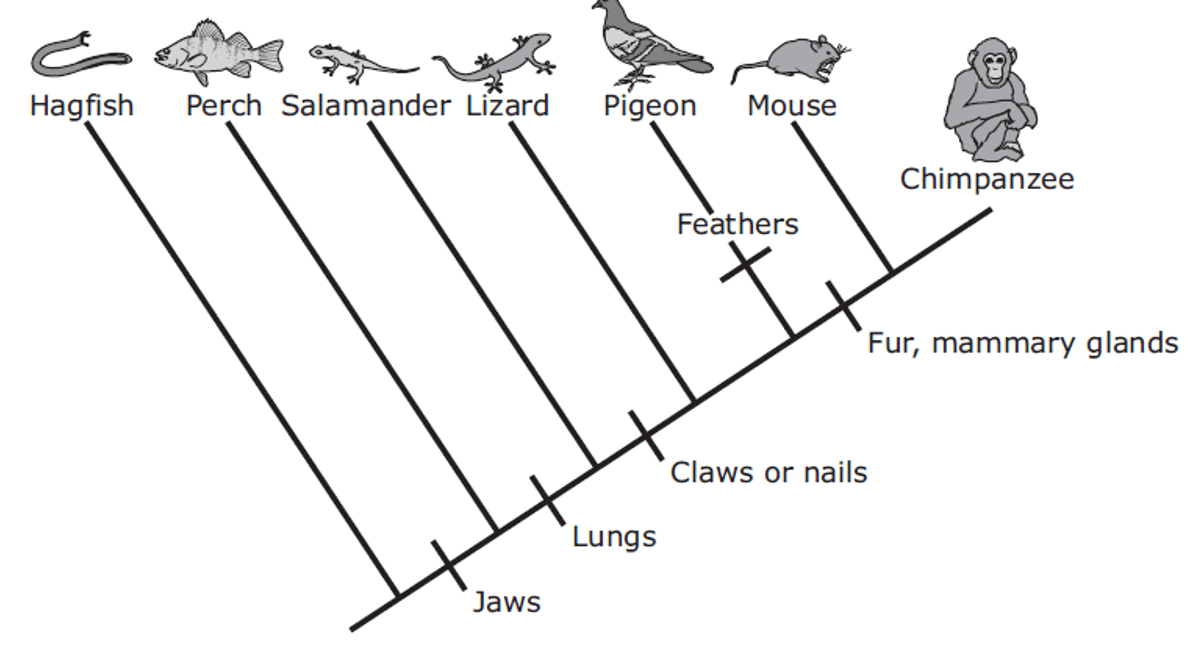
Which 2 animals are most closely related?

a)

A and B

b)

A and C

c)

B and C

d)

None of them are related

48.

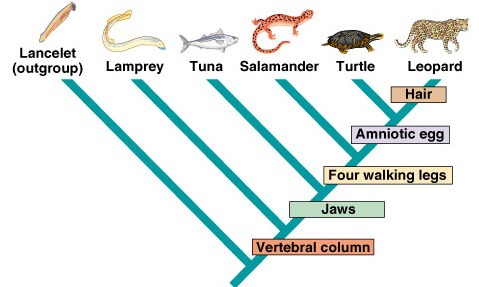
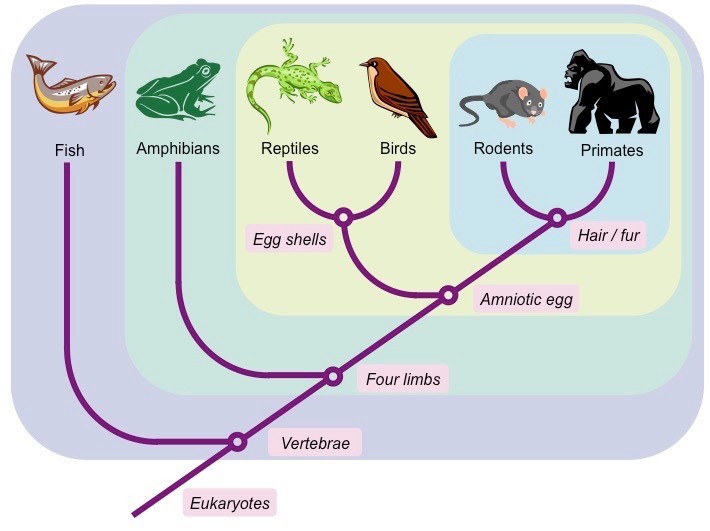
Which is the newest trait?

a)

Amniotic egg

b)

Walking legs

c)

Jaws

d)

Hair

49.

All the animals to the right of the salamander would have the common characteristic of...

a)

Fur

b)

Claws or nails

c)

Lungs

d)

Jaws

50.

What characteristic distinguishes amphibians from birds and reptiles?

a)

Amniotic egg

b)

Egg shells

c)

Vertebrae

d)

Hair/fur

51.
What does the word eukaryote mean?
a)
A cell with a nucleus
b)
A cell with DNA
c)
A cell with a cell membrane
d)
A cell without a nucleus
52.

All of the following have a nucleus except...

a)

Bacteria

b)

Animalia

c)

Plantae (Plant)

d)

Protista (Protist)

53.
Organisms that are classified as autotrophic are able to-
a)
be seen with the human eye
b)
move
c)
reproduce
d)
make their own food