

wayground logo

Free Printable Worksheets

NEW

Font size

S
M
L
XL
Worksheets

Wave Interactions

Total questions: 25

Worksheet time: 21mins

Name
Class
Date
1.

Constructive interference will cause the wave to

a)

Increase its amplitude

b)

Decrease its amplitude

c)

increase its frequency

d)

decrease its frequency

2.
A standing wave appears to be staying in one place.
a)
True
b)
False
3.

Destructive interference

a)

decreases amplitude

b)

increases amplitude

c)

increases wavelength

d)

decreases wavelength

4.

What is interference/superposition?

a)

occurs when two or more waves overlap and combine

b)

occurs when two or more waves combine and neutralize each other

c)

when one waves travels alone

d)

occurs when two or more waves combine and make each other bigger
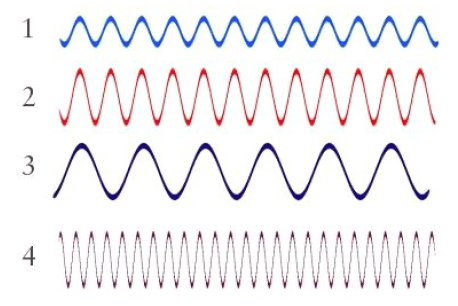
5.
Which wave in the diagram has the greatest wavelength?
a)
1
b)
2
c)
3
d)
4
6.
Which wave behavior do noise cancelling headphones use?
a)
diffraction
b)
refraction
c)
constructive interference
d)
destructive interference
7.
The high or low pitch of a sound is related to the ___________ of the wave
a)
decibel
b)
amplitude
c)
frequency
d)
rest position
8.
How loud or soft a sound is, is related to the _____________ of the wave
a)
amplitude
b)
frequency
c)
wave length
d)
rest position
9.

What is being shown in the diagram?

a)

resonance

b)

constructive interference

c)

standing wave

d)

destructive interference

10.
The combination of two waves to form a larger amplitude is what type of interference?
a)
Constructive
b)
Destructive
c)
Diffractive
d)
Refractive
11.
Waves can meet and form a smaller amplitude.  If this occurs, it is called
a)
Constructive
b)
Destructive
c)
Diffractive
d)
Refractive
12.
What is happening in this picture?
a)
Reflection
b)
Refraction
c)
Diffraction
d)
Absorption
13.

When a sound wave hits a wall and echoes back, this is an example of:

a)

Refraction

b)

Diffraction

c)

Reflection

d)

Interference

14.

What is shown in the diagram?

a)

Constructive Interference

b)

Amplitude Addition

c)

Positive Interference

d)

Destructive Interference

15.
a)

Constructive Interference

b)

Destructive Interference

c)

Standing Wave

d)

Doppler Effect

16.
What can you tell about this object's motion?
a)
Moving to the North (up).
b)
Moving to the South (down). 
c)
Moving to the West (left). 
d)
Moving to the East (right). 
17.
What can you tell about the motion of this object?
a)
Moving left.
b)
Moving right quickly.
c)
Standing still. 
d)
Moving up slowly. 
18.

What is shown in the diagram?

a)

reflection

b)

refraction

c)

diffraction

d)

deflection

19.

What is shown in the diagram?

a)

reflection

b)

refraction

c)

diffraction

d)

deflection

20.

What is shown in the diagram?

a)

reflection

b)

refraction

c)

diffraction

d)

deflection

21.

What is shown in the diagram?

a)

Doppler Effect

b)

standing wave

c)

longitudinal wave

d)

mechanical wave

22.

How many nodes?

a)

2

b)

3

c)

4

d)

5

23.

How many antinodes?

a)

1

b)

2

c)

3

d)

4

24.

How many waves are shown?

a)

1

b)

2

c)

3

d)

4

25.

What is shown in the diagram?

a)

constructive interference

b)

destructive interference

c)

Doppler Effect

d)

superposition
