wayground logo

Free Printable Worksheets

NEW

Font size

S
M
L
XL
Worksheets

The Structure of the Atom (Part 2)

Total questions: 49

Worksheet time: 48mins

Name
Class
Date
1.
What is at the center of every atom?
a)
An electron
b)
A compound
c)
A molecule
d)
A nucleus
2.
Which two particles make up the nucleus of an atom?
a)
Protons and Electrons
b)
Protons and Neutrons
c)
Molecules and Compounds
d)
Neutrons and Electrons
3.
The positively charged particles of an atom are the ________.
a)
electrons
b)
protons
c)
neutrons
d)
protons & neutrons
4.
The particles with no charge in an atom are the _______.
a)
electrons
b)
neutrons
c)
protons
d)
protons and neutrons
5.
The negatively charged particles of an atom are the ______.
a)
electrons
b)
protons
c)
neutrons
d)
protons & neutrons
6.
Which element has 31 protons ?
a)
Gallium 
b)
Germanium
c)
Gadolinium
d)
Polonium
7.
What is the mass number?
a)
the number of protons
b)
the sum of the number of protons and the number of neutrons in the nucleus of an atom 
c)
the number of electrons
d)
the number of neutrons
8.
What is the atomic number?
a)
number of protons
b)
number of neutrons
9.
 What is the mass number of this element?
a)
5
b)
27
c)
32
d)
59
10.
24.1% of all the isotopes of a an element have a mass of 75.23 amu, 48.7% have a mass of 74.61 amu, and 27.2% have a mass of 75.20 amu.
What is the average mass of this element?
a)
74.92 amu
b)
24.97 amu
c)
75.01 amu
d)
74.51 amu
11.
24.1% of all the isotopes of a an element have a mass of 75.23 amu, 48.7% have a mass of 74.61 amu, and 27.2% have a mass of 75.20 amu.
How many protons does this element have?
a)
32
b)
33
c)
34
d)
no way to know
12.
Calcium has three different isotopes. One has a mass of 35.00 amu; another has a mass of 41.00 amu; and another has a mass of 40.00 amu. Which isotope is the most abundant of the three?
a)
40.00 amu
b)
41.00 amu
c)
35.00 amu
d)
impossible to tell
13.
An element has three different isotopes. One has a mass of 35.00 amu; another has a mass of 36.00  amu; and another has a mass of 38.00  amu. What is the average atomic mass of this element?
a)
36.33 amu
b)
37.00 amu
c)
12.11 amu
d)
impossible to tell
14.
An element with 4.35% have a mass of 49.9461 amu, 83.79% have amass of 51.9405 amu, 9.50% have a mass of 52.9407 amu, and 2.36% have a mass of 53.9389amu.
a)
51.99 amu
b)
52.19 amu
c)
53.45 amu
d)
17.33 amu
15.
4.35% of all X atoms have a mass of 39.946 amu. 83.79% have a mass of 41.941 amu, 9.50% have a mass of 42.941 amu, and 2.36% have a mass of 43.939 amu. What is the average atomic mass of atom X?
a)
41.97 amu
b)
42.19 amu
c)
10.43 amu
d)
40.04 amu
16.
An isotope has three forms.  30% have a mass of 4 amu, 20% have a mass of 5 amu and 50% have a mass of 3 amu.  Average atomic mass will be closest to
a)
2 amu
b)
3 amu
c)
4 amu
d)
5 amu
17.
An element has two naturally occurring isotopes. One is 10.013 amu and is 19.9% abundant. The other is 11.01 amu and is 80.1% abundant. What is the average atomic mass? What element is it?
a)
9.012, Beryllium
b)
12.011, Carbon
c)
6.941, Lithium
d)
10.812, Boron
18.
Atom 1 has Mass=12  Protons=6
Atom 2 has Mass= 14 Electrons=6
Are these atoms isotopes of each other or different elements?
a)
Different Elements - Mg & Si
b)
Different Elements - Ar & Ca
c)
Isotopes of Carbon
d)
Isotopes of Magnesium
19.
Which of the following could have 82 neutrons?
a)
W-182
b)
Ta-181
c)
Cs-132
d)
Ba-138
20.
If X is the symbol for an element, which of the following two symbols represent    isotopes of the same element?  
I. 7735X  II. 7733X  III. 8137X  IV. 8135 X
a)
I and II
b)
III and IV
c)
I and IV
d)
I and III
21.
Isotopes are atoms of the same element that have the same number of __________ but different number of __________ . Therefore, isotopes of the same element have different masses. 
a)
protons, neutrons
b)
protons, electrons
c)
neutrons, protons
d)
electrons, protons
22.
The  mass of an atom is located  in the ___________ and the volume of an atom is made of the ____________
a)
electron cloud, nucleus
b)
electron cloud, energy levels
c)
nucleus, electron cloud
d)
nucleus, neutrons
23.
What is the name of this element?
a)
Helium
b)
Hydrogen
c)
Argon
d)
Silver
24.

What element is represented in this Bohr Model?

a)

Carbon

b)

Hydrogen

c)

Aluminum

d)

Lithium

25.
Identify this atom.
a)
Lithium
b)
Boron
c)
Carbon
d)
Neon
26.
Remember to use your Periodic Table of Elements to help you identify which Bohr Model is pictured...
a)
calcium
b)
magnesium
c)
bromine
d)
neon
27.

A wave with a large wavelength will have a ______ frequency and _____ energy

a)

high, low

b)

high, high

c)

low, high

d)

low, low

28.

The frequency of violet light is 7.5x10¹⁴ Hz. What is its wavelength?

a)

4.0x10⁻⁷ m

b)

4.0x10⁷ m

c)

2.25x10²³m

d)

2.25x10²³ Hz

29.

Red light has a wavelength of 675 x 10-9 m. What is its frequency?

a)

2.03x10¹¹ m

b)

4.44x10¹⁴ Hz

c)

4.44x10¹⁴ nm

d)

2.03x10¹¹ Hz

30.

What is the speed of light?

a)

3.0x10⁸ ms

b)

3.0x10⁸ m/s

c)

6.626x10⁻³⁴ Js

d)

6.626x10⁻³⁴ J/s

31.

What is Planck's Constant?

a)

6.63x10⁻³⁴ Js

b)

6.63x10⁻³⁴ J/s

c)

3.0x10⁸ ms

d)

3.0x10⁸ m/s

32.

Ground state means that an electron is...

a)

at its lowest possible potential energy

b)

in the first shell of an atom

c)

laying low for the weekend

d)

removed from an atom

33.

In order to go from ground state to an excited state, an electron must

a)

emit energy

b)

absorb energy

c)

rotate

d)

wiggle

34.

When an electron returns to ground state from an excited state, the atom will

a)

emit energy

b)

absorb energy

c)

rotate

d)

wiggle

35.

Shorter Waves have ____Energy,Longer Waves___Energy?

a)

Lower,Higher

b)

Higher,Lower

36.

What is the Electromagnetic Spectrum?

a)

A Group of Energy Waves That are Visible to the human Eye.

b)

The name Given to a Group of Waves that mostly are Invisible and can travel through empty Or outer Space.

37.

Visible Light Humans eyes Can't detect?

a)

True .

b)

False.

38.
Which statement is true about the ground state and the excited state of an electron?
a)
The ground state is the highest energy level of an electron.
b)
The excited state is the lowest energy level of an electron.
c)
The ground state is the lowest energy level of an electron.
d)
When an electron goes from the ground state to an excited state it releases light energy.
39.
As the wavelength of light increases
a)
the frequency increases.
b)
the speed of light increases.
c)
the energy decreases.
d)
the intensity increases.
40.
In the third energy level,
a)
there are two energy sublevels.
b)
the f sublevel has 7 orbitals.
c)
there are three s orbitals.
d)
a maximum of 18 electrons are allowed.
41.
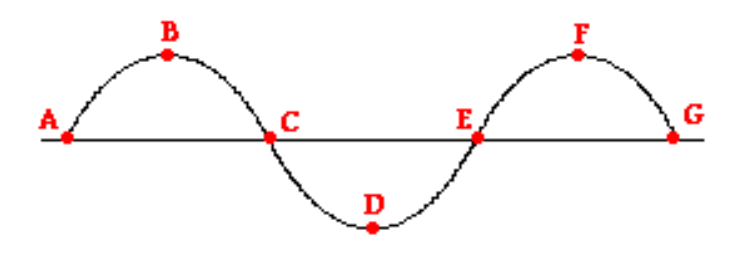
What is the lowest point on a wave?
a)
amplitude
b)
peak
c)
trough
d)
wavelength
42.
The maximum distance from the center line to the top of the crest or the bottom of the trough is called the __________ of the wave.
a)
amplitude of the wave
b)
wavelength of the wave
c)
frequency of the wave
d)
speed of the wave
43.
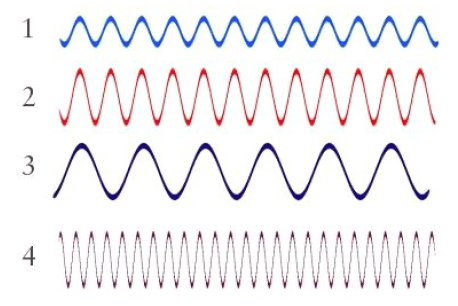
Which wave in the diagram has the greatest wavelength?
a)
1
b)
2
c)
3
d)
4
44.
Which wave has a greater frequency?
a)
A
b)
B
45.
Which wave has a longer wavelength?
a)
wave C
b)
wave D
46.
The unit of frequency is ___.
a)
meters
b)
nanometers (nm)
c)
m/s
d)
Hertz
47.
All waves carry
a)
energy
b)
light 
c)
matter
d)
particles
48.
Which vocabulary term is used to identify the distance between points C & G?
a)
Amplitude
b)
Crest
c)
Frequency
d)
Wavelength
49.
Which letter(s) represent the crest of the wave?
a)
A
b)
B & D
c)
B & F
d)
F