
 Worksheets
Acids and Bases Review Quizizz
Total questions: 67
Worksheet time: 4hrs 14mins
Which solution can turn phenolphthalein pink?
Sodium hydroxide
Vinegar
Tomato
Hydrochloric acid
Which solution would turn litmus red?
Potassium hydroxide
Sodium chloride
HNO3
Ammonia
Which solution would turn litmus blue?
HCl
Citric fruits
H2SO3
NH3

Which of the set of pH paper depicts that the dipped solution is highly acidic?
(compare with the pH scale and find out)


When using the Arrhenius model, what types of ions indicate that a compound is an acid?
H+
OH-1
When using the Arrhenius model, what types of ions indicate that a compound is a base?
H+1
OH-1
When using the Bronsted Lowry definition of acids and bases, the acid will ______________ a hydrogen proton.
donate
accept
When using the Bronsted Lowry definition of acids and bases, the base will ______________ a hydrogen proton.
donate
accept
In the following chemical equation, which compound is the acid?
HCl + NH3 → NH4+ + Cl−
HCl
NH3
NH4+
Cl−
What range of values on the pH scale represent solutions with a higher ratio of hydroxide (OH-) ions?
below 7
7
above 7
0-14
What is a titration?
when the moles of hydrogen ions is equal to the moles of hydroxide ions
adding a known amount of solution of known concentration to determine the concentration of an unknown
reaction in which an acid and a base react in an aqueous solution to produce a salt and water
the extent of ionization of an acid or base
HCl is:
an Arrhenius acid
a Bronsted Lowry acid
both an Arrhenius and Bronsted Lowry acid
a base
NaOH is:
an Arrhenius base
an Arrhenius acid
neither an acid nor a base
both an acid and a base
NH3 is:
a Bronsted Lowry base
an Arrhenius base
an acid
both an Arrhenius and a Bronsted Lowry base
pH is the measure of the concentration of ______.
Acids
H+ ion
OH- ion
Bases
According to Arrhenius, what is the definition of an ACID?
a substance that contains hydroxide and ionizes to produce OH-
a substance that contains hydrogen and ionizes to produce H+
a substance that contains hydrogen and ionizes to produce OH-
a substance that contains hydroxide and ionizes to produce H+
According to Bronsted-Lowry, what is the definition of an BASE?
a substance that donates a hydrogen (H+) ion
a substance that donates a hydroxide (OH-) ion
a substance that accepts a hydrogen (H+) ion
a substance that accepts a hydroxide (OH-) ion

What is the conjugate base in the following reaction?
HCO3-
HCl
H2CO3
Cl-
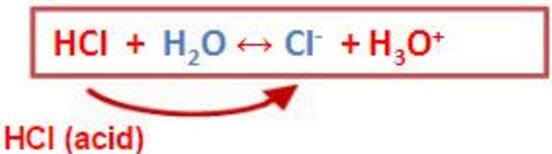
Which of the following are properties of acids but not bases? Select all that apply.
Changes the color of an indicator
Sour taste
Reacts with metals to produce hydrogen gas
Feels slippery
Neutralization is the process of an acid and a base reacting to form what? Select all that apply
An ionic salt
Hydronium ions
NaCl
Water
An arrhenius acid
produces hydroxide ions in a solution
is a proton donor
produces hydrogen ions in a solution
is a proton acceptor
An arrhenius base
produces hydroxide ions in a solution
is a proton donor
produces hydrogen ions in a solution
is a proton acceptor
A bronsted lowry acid
produces hydroxide ions in a solution
is a proton donor
produces hydrogen ions in a solution
is a proton acceptor
Water can act as both an acid and a base according to the bronsted lowry model. This means water is
neutral
conjugate
ionic
amphoteric
Acid-base conjugate pairs differ by a single
Electron
Proton
Neutron
Oxygen
Which of the following show an acid and its conjugate base pair (in that order)
H2SO4, SO42-
OH-, H2O
NH4+, H2O
H2CO3, HCO3-
Could C2H3O2- act as a base when placed in water?
Yes, because it can accept a H+
Yes, because it can donate a H+
No, because it cannot donate a H+
No, because it cannot accept a H+
For a solution, pH + pOH =
7
1.0 x 10⁻¹⁴
14
-log (1.0 x 10⁻¹⁴)
If the pH of a solution is 4.0, what is the pOH?
4.0
1.0 x 10⁻⁴
10
Cannot be determined from the information
The pH of a solution is 8.43. What is the hydrogen ion H+ concentration?
3.7 x 10⁻⁹ M
2.7 x 10⁻⁶ M
1.0 x 10-8.43 M
1.0 x 10⁻¹⁴

If the [H+] of a solution is 1 x 10⁻² M, the pH is
2
12
-2
1
If the pH of a solution is 5 the [H+] is
1.0 x 10⁵ M
1.0 x 10⁹ M
5.0 x 101 M
1.0 x 10⁻⁵ M
If the [OH-] of a solution is 2.7 x 10⁻⁴ M, the pOH of the solution is
10.44
3.56
1.00
-4.43
If the [H+] of a solution is 6.8 x 10⁻⁹ M, the pH is
8.17
5.73
9.99
8.62
if the [H+] of a solution is 8.4 x 10⁻³ M, the pOH of the solution will be
2.08
11.92
1.02
12.98
if a solution has a pOH of 5.2 the [OH-] of the solution is
6 x 10 6 M
6.3 x 10 -6 M
1.58 x 10⁻⁵ M
2 x 10⁻⁵ M
Limes have a [H+] of 1.3 x 10⁻² M. Their pOH is
1.89
12.11
1.03
12.97
Which of the following is true for a strong acid in aqueous solution?
It partially ionizes in water
It forms a weak base
It completely ionizes in water
It does not ionize in water
What is the pH of a neutral solution at 25°C?
0
7
14
1
Which of the following substances is amphoteric?
NaCl
NaOH
HCl
H2O
Which of the following substances will increase the pH of a solution when added?
CH3COOH
NaOH
NH4Cl
HCl
What is formed when an acid reacts with a base in a neutralization reaction?
Only water
Only salt
Salt and water
Hydrogen gas
Which indicator turns blue in the presence of a base?
Bromothymol blue
Litmus paper
Methyl orange
Phenolphthalein
Which of the following is a property of a strong acid?
It does not react with water
It partially dissociates in water
It forms a weak base
It completely dissociates in water
What color does litmus paper turn in the presence of an acid?
Green
Blue
Yellow
Red
Which of the following substances is considered a weak base?
NaOH
NH3
HCl
CH3COOH
3 LiOH + H3PO4 →
What allows us to know when the end point has been reached?
Bubbles
Feels warm
indicator changing color
Turns to a solid
If it takes 54 mL of 0.1 M NaOH to neutralize 125 mL of an HCl solution, what is the concentration of the HCl? (record you answer with the correct unit)
0.043 M
0.034 M
0.065 M
0.77 M
A titration works by using a ___________________________ reaction.
Single Replacement
Neutralization
Combustion
Synthesis
Indicators are used in a titration by changing ___________________ at different pH levels.
Smell
Shape
Phase
Color
How many mL of 1.00 M H2SO4 is needed to neutralize 21.5 mL of 1.50 M KOH?
H2SO4 + 2KOH → K2SO4 + 2H2O
16.1 mL
1.10 mL
5.65 mL
0.900 mL

