wayground logo

Free Printable Worksheets

Font size

S
M
L
XL
Worksheets

4th grade

Total questions: 150

Worksheet time: 6hrs 32mins

Name
Class
Date
1.
What is the total area of the pink model?
a)
3
b)
4
c)
7
d)
12
2.
How would you find the area of the pink model?
a)
Add 4 and 3
b)
Multiply 4 and 3
c)
Add 4 and 4
d)
Multiply 4 and 4
3.
What is an organism that gets its food through eating other sources?
a)
Consumer
b)
Producer
c)
Autotroph
d)
Decomposers
4.
What is an organism that breaks down & absorbs dead matter so nutrition can be recycled into the soil?
a)
Consumer
b)
Decomposer
c)
Producers
d)
Scavenger
5.
What is an organisms that makes its own food?
a)
Consumer
b)
Decomposer
c)
Producer
d)
Scavenger
6.
A producer is a (n) ______________.
a)
heterotroph
b)
omnitroph
c)
autotroph
d)
oscartroph
7.
A __________________ is a type of animal that hunts other animals to eat. 
a)
prey
b)
herbivore
c)
predator
d)
producer
8.
A consumer gets energy by doing what?
a)
Making it themselves.
b)
Breaking down biotic wastes and dead organisms and returning raw materials to the ecosystem.
c)
Soaking it up from the ground.
d)
Feeding on other organisms.
9.
A food chain is?
a)
Overlapping food chains in an ecosystem.
b)
The amount of energy that moves from one feeding level to another in a food web.
c)
A series of events in which one organism eats another and obtains energy.
d)
biotic and abiotic factors in an area.
10.
This diagram shows the amount of energy that moves from one feeding level to another in a food web.
a)
Energy Pyramid
b)
Food Web
c)
Ecosystem
d)
Food Chain
11.
The energy role that break down biotic wastes and dead organisms is?
a)
Consumer
b)
Producer
c)
Scavenger
d)
Decomposer
12.
Which one is NOT an example of a decomposer?
a)
mushroom
b)
leaves
c)
mold
d)
worm
13.
Grass is considered a ...
a)
consumer
b)
producer
c)
decomposer
d)
composers
14.
An organism that uses sunlight to create its own food is known as a:
a)
Producer
b)
Heterotroph
c)
Consumer
d)
Decomposer
15.
An organism that can make its own food is called?
a)
Consumer
b)
Producer
c)
Decomposer
d)
Herbivore
16.
A consumer gets energy by doing what?
a)
Making it themselves.
b)
Breaking down biotic wastes and dead organisms and returning raw materials to the ecosystem.
c)
Soaking it up from the ground.
d)
Feeding on other organisms.
17.
A carnivore eats only other animals. What is an example?
a)
Bison
b)
Elephant
c)
Caterpillar
d)
Coyote
18.
This type of consumer eats both other consumers and producers to obtain energy. It's name means "ALL" or "WHOLE" in latin.
a)
Carnivore.
b)
Herbivore.
c)
Omnivore
d)
Scavenger.
19.

What is the area of this figure?

a)

11 yards2

b)

22 yards2

c)

24 yards2

d)

32 yards2

20.

What is the length of this figure if the area is 40 cm2?

a)

35 cm

b)

6 cm

c)

7 cm

d)

8 cm

21.

What is the length of this rectangle? The perimeter is 18 feet.

a)

9 ft

b)

16 feet

c)

7 feet

d)

5 feet

22.

This figure is made up of two identical squares and has a perimeter of 84 inches. What is the area of one square?

a)

144 square inches

b)

132 square inches

c)

14 square inches

d)

196 square inches

23.
a)

36 sq. ft.

b)

748 sq. ft.

c)

528 sq. ft.

d)

784 sq. ft.

24.
a)

34 cm

b)

44 cm

c)

54 cm

d)

58 cm

25.

The length of a rectangle is twice its width. The area is 72 square centimeters. What is the perimeter?

a)

6 cm

b)

12 cm

c)

18 cm

d)

36 cm

26.

How many square inches of fabric would you need to cover this table? The dimensions are 36 inches wide and 24 inches long.

a)

120 square inches

b)

864 square inches

c)

1,728 square inches

d)

60 square inches

27.

The ____________of a figure is the distance AROUND it.

a)

square units

b)

perimeter

c)

surface

d)

area

28.

When measuring area we use ____________.

a)

square units

b)

perimeter

c)

surface

d)

area

29.

An animal that hunts other animals for food

a)

omnivore

b)

consumer

c)

predator

d)

prey

30.

Break down and absorb nutrients from decaying organisms

a)

prey

b)

ecosystems

c)

consumers

d)

decomposers

31.

An animal that is hunted and eaten by another animal

a)

producer

b)

consumer

c)

predator

d)

prey

32.

Organisms that cannot make their own food. They eat other organisms to get energy.

a)

consumer

b)

predator

c)

prey

d)

omnivore

33.

All of the living and nonliving things in an area that interact with one another.

a)

food web

b)

food chain

c)

ecosystem

d)

consumers

34.

An organism that can make its own food using sunlight and carbon dioxide.

a)

biotic man

b)

producer

c)

consumer

d)

Wish I could do this so I wouldn't get hungry!

35.

Shows all the feeding relationships between plants and animals and how they connect.

a)

food chain

b)

lines

c)

food web

d)

ecosystems

36.

Shows how food and energy passes from one organism to another in an ecosystem.

a)

connect the dots

b)

food web

c)

food chain

d)

CEC classes

37.

This food web represents organisms in a field. What role do raccoons play in this food web? (5.9B)

a)

Prey

b)

Producer

c)

Decomposer

d)

Consumer

38.

The food web shown is made up of organisms that live in a forest. Which change would most likely occur if all the producers in this ecosystem were removed? (5.9B)

a)

The mice would become the new producers.

b)

All the animals would either die or move away.

c)

The number of mice would increase.

d)

All the animal populations would increase.

39.

An organism that eats another organism to get energy

a)

Producer

b)

Consumer

c)

Decomposer

d)

Prey

40.

A diagram that shows how food chains are connected in an ecomsystem.

a)

food web

b)

food chain

c)

parasitism

d)

mutualism

41.

An organism that makes its own food through the process of photosynthesis.

a)

decomposer

b)

carnivore

c)

producer

d)

herbivore

42.

An organism that breaks down dead organisms and puts the nutrients back into the soil.

a)

consumer

b)

producer

c)

decomposer

d)

omnivore

43.

A diagram that shows how energy flows in one path through an ecosystem.

a)

predator

b)

food web

c)

decomposer

d)

food chain

44.

An animal that gets its energy from eating only plants.

a)

producer

b)

herbivore

c)

carnivore

d)

omnivore

45.

An animal that is hunted and eaten by another animal.

a)

predator

b)

prey

c)

carnivore

d)

herbivore

46.

An animal that gets its energy from eating only other animals.

a)

decomposer

b)

omnivore

c)

herbivore

d)

carnivore

47.

An animal that gets its energy from eating both plants and animals.

a)

decomposer

b)

producer

c)

omnivore

d)

prey

48.

An animals that hunts and eats other animals.

a)

herbivore

b)

omnivore

c)

predator

d)

prey

49.

In any community, which group includes the largest number of animals?

a)

herbivores

b)

prey

c)

predators

d)

consumers

50.

All the living and nonliving things in an area make up a/an

a)

community.

b)

ecosystem.

c)

population.

d)

environment.

51.

An organism that makes its own food is a/an

a)

producer.

b)

consumer.

c)

predator.

d)

prey.

52.

An _____ is everything that surrounds and affects a living thing.

a)

ecosystem

b)

environment

c)

population

d)

community

53.

All the living things in an ecosystem make up a ________.

a)

ecosystem

b)

environment

c)

population

d)

community

54.

A ________ is all the members of one kind of plant or animal in a community.

a)

ecosystem

b)

environment

c)

population

d)

community

55.

Two or more overlapping food chains form a/an

a)

food chain

b)

food web

c)

community

d)

population

56.

Without the Sun, which of Earth's organisms could no longer survive?

a)

producers only

b)

producers and consumers

c)

scavengers only

d)

nearly all organisms

57.

Which of the following would be at the end of a food chain?

a)

grass

b)

fungi

c)

sheep

d)

coyote

58.

In a diagram of a food web, the arrows show the flow of

a)

soil

b)

sunlight

c)

oxygen

d)

energy

59.

An organism that can make its own food

a)

decomposer

b)

producer

c)

consumer

60.

Breaks down and feeds on the remains of other organisms

a)

decomposer

b)

consumer

c)

producer

61.

What are the living and nonliving things in an environment or area?

a)

predator

b)

producer

c)

ecosystem

d)

abiotic factor

62.

An animal that hunts and eats other animals for energy

a)

prey

b)

predator

c)

decomposer

63.

Choose the decomposer.

a)

grass

b)

elephant

c)

bacteria

d)

bird

64.

Choose the consumer.

a)

mushroom

b)

horse

c)

tree

d)

grass

65.

Where does the food chain START?

a)

with consumers that eat grass

b)

with the sun giving energy to producers

c)

with the sun giving energy to consumers

d)

with consumers eating other consumers

66.

A decomposer is also a producer.

a)

True

b)

False

67.

Mice and grasshoppers are examples of prey.

a)

True

b)

False

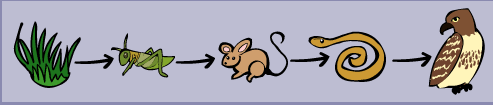
68.

Explain the flow of energy in this food chain (who passes energy to who).

a)

The hawk gives energy to the snake. The snake gives energy to the mouse. The mouse gives energy to the grasshopper who gives energy to the grass.

b)

The mouse gives energy to the hawk. The snake gives energy to the grasshopper. The grass gives energy to the snake.

c)

The grass gives energy to the grasshopper. The grasshopper gives energy to the mouse. The mouse gives energy to the snake who gives energy to the hawk.

69.
What does AREA do to a shape?
a)
surrounds it
b)
covers it
c)
outlines it
d)
draws lines on it
70.
What does PERIMETER do to a shape?
a)
surrounds it
b)
covers it
c)
draws lines in it
d)
colors it in
71.
How do you find the AREA of a rectangle?
a)
add all of the sides up
b)
multiply the length times width
c)
add the lengths and widths and then multiply them
d)
add the length and the width
72.
What is the AREA of a rectangle with a length of 7 feet and a width of 4 feet?
a)
22 feet
b)
22 square feet
c)
28 feet
d)
28 square feet
73.
What is the PERIMETER of a rectangle with a length of 7 feet and a width of 4 feet?
a)
22 feet
b)
22 square feet
c)
28 feet
d)
28 square feet
74.
If you are putting up a wall paper border in your bedroom, is this an example of AREA or PERIMETER?
a)
AREA
b)
PERIMETER
75.
What is the area of a rectangle with a length of 3 feet and a width of 9 feet?
a)
24 feet
b)
24 square feet
c)
27 feet 
d)
27 square feet
76.
Mr. M. just got a new puppy and wants to install a fence for his yard.  What does he need to find?
a)
AREA
b)
PERIMETER
77.
What is the perimeter of a rectangle with a length of 3 feet and a width of 9 feet?
a)
24 feet
b)
24 square feet
c)
27 feet
d)
27 square feet
78.
Mrs. Leahy wants to install new carpet in her living room.  The room is 21 feet long and 13 feet wide.  Which problem will tell her how much carpet she needs?
a)
21 + 13 + 21 + 13
b)
21 + 13
c)
42 x 26
d)
21 x 13
79.
Mrs. Smith has young golden retriever.  She doesn't want her to get away, so she is installing a fence.  The yard is 57 feet long and 78 feet wide.  Which problem shows how to find the amount of fence she needs?
a)
57 + 78
b)
57 x 78
c)
57 + 78 + 57 +78
d)
114 x 156
80.
Mr. Slack wants to paint the landing area of a cornhole board.  Which is this an example of?
a)
AREA
b)
PERIMETER
81.
Mrs. Johnson wants to change the bulletin board outside the library.  She wants to put up paw print border.  Which is this an example of?
a)
AREA
b)
PERIMETER
82.
Mr. Bart wants to know how many square feet of the Cafeteria he sweeps everyday.  Which is he going to find?
a)
AREA
b)
PERIMETER
83.

An organism that gets its energy by feeding on producers or animals that eat producers is called __________

a)

producer

b)

predator

c)

consumer

d)

decomposer

84.

An organism that uses energy from the sun to create its own food is called __________

a)

producer

b)

predator

c)

consumer

d)

decomposer

85.

An organism (fungus or bacteria) that decomposes (breaks down) organic material is called __________

a)

producer

b)

predator

c)

consumer

d)

decomposer

86.

An organism that eats only plants is called __________

a)

carnivore

b)

herbivore

c)

scavenger

d)

omnivore

87.

An organism that eats only animals is called __________

a)

carnivore

b)

herbivore

c)

scavenger

d)

omnivore

88.

An organism that eats both plants & animals is called ______

a)

carnivore

b)

herbivore

c)

scavenger

d)

omnivore

89.

An organism that feeds on dead materials is called _______

a)

carnivore

b)

herbivore

c)

scavenger

d)

omnivore

90.

A system of interlocking food chains in an ecosystem or ecological community is called _______

a)

food chain

b)

food web

c)

ecosystem

91.

A hierarchical series of organisms each dependent on the next as a source of food. It shows the energy flow in an ecosystem is called _______

a)

food chain

b)

food web

c)

ecosystem

92.

The natural home or environment of an animal, plant, or other organism is called _______

a)

ecosystem

b)

habitat

c)

predator

d)

prey

93.

Initial Energy Source; start of all food chains/webs is called _______

a)

sun

b)

habitat

c)

predator

d)

prey

94.
A path of energy that flows from one organism to the next (it flows from the sun to the producers to the primary consumers, then to the secondary consumers, to the tertiary consumers).
a)
Food Web
b)
Food Chain
c)
Consumers
d)
Decomposers
95.
A diagram of several connected food chains.
a)
Food Chain
b)
Primary Consumer
c)
Food Web
d)
Secondary Consumer
96.
The role that an organism plays in the habitat and lifestyle of a population.
a)
Interdependence
b)
Primary Consumer
c)
Adaptation
d)
Niche
97.
An animal that consumes only plants.
a)
Carnivore
b)
Herbivore
c)
Decomposer
d)
Omnivore 
98.
The process by which the characteristics of a species change over many generations in response to the environment.
a)
Adaptation 
b)
Interdependence 
c)
Niche
d)
Limiting Factors
99.
An organism that eats other living things to get energy;  an organism that does not produce its own food.
a)
Decomposer
b)
Producer
c)
Consumer
d)
Biotic
100.
An organism that makes its own food; an organism that does not consume other plants or animals.
a)
Producer
b)
Consumer
c)
Decomposer
d)
Habitat
101.
Which organism is a decomposer?
a)
grass
b)
mouse
c)
mushroom
d)
caterpillar
102.
What do the arrows show in a food chain picture?
a)
They always point to the smallest animals.
b)
They point to the animal that tastes the best.
c)
They always point to the producers.
d)
They point in the direction that energy is flowing.
103.
What is the value of the 5 in the following number....2,578,910
a)
5 million
b)
5 thousand
c)
50 thousand
d)
500 thousand
104.
The answer to a multiplication problem is called....
a)
sum
b)
product
c)
quotient
d)
difference
105.
the bottom number in a fraction is called.... 
a)
denominator
b)
fraction
c)
divisor
d)
numerator
106.
What shape is shown?
a)
pentagon
b)
triangle
c)
hexagon
d)
quadriangle
107.
What is 1/7 + 5/7?
a)
4/7
b)
6/14
c)
5/49
d)
6/7
108.
what type of lines are shown in picture?
a)
parallel
b)
perpendicular
c)
intersecting
d)
non linear
109.
What do we call the answer to a subtraction problem?
a)
sum
b)
product
c)
quotient
d)
difference
110.
Sara planted 4 rows of flowers with 6 flowers in each row. Ben planted 3 rows of flowers with 4 flowers in each row. How many more flowers did Sarah plant than Ben?
a)
12
b)
10
c)
3
d)
36
111.
A unit for measuring area.
a)
area
b)
square unit
112.
Find the PERIMETER of this figure.
a)
20 square feet
b)
20 cm
c)
25 square feet
d)
15 cm
113.
What is the PERIMETER of this rectangle?
a)
28 sq. yd.
b)
14 yd.
c)
8 sq. yd.
d)
22 yd.
114.
Find the Area.
a)
12
b)
18
c)
28
d)
34
115.
What is the perimeter of the fence?
a)
25
b)
30
c)
35
d)
40
116.
What is the perimeter?
a)
3 ft. 
b)
6 ft. 
c)
12 ft. 
d)
18 ft. 
117.
Find the perimeter
a)
25 m
b)
35 m
c)
50 m
d)
100 m
118.
What is the perimeter of the rectangle?
a)
28 sq feet
b)
28 feet
c)
48 feet
d)
48 sq feet
119.
If I added, then did I find the area or the perimeter of the object?
a)
Perimeter
b)
Area
120.

If the same amount of time passes between lunch start times for 3rd and 4th grade as does between 2nd and 3rd grade, what time will the fourth grade lunch block begin?

a)

12:45

b)

12:55

c)

1:05

d)

1:15

121.

What is the area of this figure?

a)

16 sq.ft.

b)

32 sq. ft.

c)

48 sq. ft.

d)

64 sq. ft.

122.

According to the line plot, how many second graders were LESS than 50 inches tall?

a)

1 student

b)

3 students

c)

5 students

d)

0 students

123.

How much more water is needed to fill BOTH beakers to the top line?

a)

200 ml.

b)

400 ml.

c)

600 ml.

d)

800 ml.

124.

There are four sides around Mrs. Loye's garden. The distance around the entire garden is 72 feet. The measurements of three of the sides are 14, 16 and 20 feet. What is the measurement of the fourth side of her garden?

a)

12 feet

b)

14 feet

c)

18 feet

d)

22 feet

125.

Third graders voted for their favorite fruit. Which graph shows that 4 more students voted for pears than for peaches as their favorite fruit?

a)

Graph 1

b)

Graph 2

c)

Graph 3

d)

Graph 4

126.

Mr. Evans went to a concert that started at 8:30 PM. It ended at 11:00 PM. How long did the concert last?

a)

1 hour and 30 minutes

b)

2 hours

c)

2 hours and 30 minutes

d)

3 hours and 30 minutes

127.

What is the length of the missing side "x" in this rectangle?

a)

10 cm.

b)

11 cm.

c)

5 cm.

d)

15 cm.

128.

Mr. Vernon talked with 3rd graders about their test scores. He started at 12:00 and held four conferences. Each conference lasted 15 minutes. What time did Mr. Vernon finish?

a)

12:45 PM

b)

1:00 PM

c)

1:15 PM

d)

2:00 PM

129.

What is the area?

a)

28

b)

48

c)

50

d)

44

130.

Mrs. Drexler took her class outside at 10:30. They came inside 45 minutes later. What time did Mrs. Drexler's class come inside?

a)

11:00

b)

11:05

c)

11:15

d)

11:25

131.

Which of the following is true about finding the area and perimeter of a rectangle? (You may choose more than one.)

a)

To find perimeter, you add the lengths of all four sides.

b)

To find area, you multiply the length times the width.

c)

Area is always larger.

d)

Perimeter is always larger.

132.
What is the perimeter?
a)
30 units
b)
32 units
c)
24 units
d)
36 units
133.
The distance around an object is called the 
a)
area
b)
perimeter
134.
What is the perimeter of this figure?
a)
11 ft.
b)
10 ft.
c)
16 ft.
d)
18 ft.
135.
If I wanted to decorate the edge of a cake, that would be an example of:
a)
area
b)
perimeter
136.

Sue is building a fence around her yard to keep her puppy inside. The length of the fence is 24m and the width is 56m. How much fencing does Sue need to put around her yard?

a)

160m

b)

80m

c)

32m

d)

1,344m

137.

What is the perimeter of a classroom when the length is 12m and the width is 14m?

a)

26m

b)

52m

c)

2m

d)

168m

138.

The perimeter of a rectangular board is 58m. The length of the board is10m. What is the width of the board?

a)

136m

b)

48m

c)

24m

d)

19m

139.

The floor of Sue's rectangular bedroom is 15 feet long and 12 feet wide. What is the area of the floor in the bedroom?

a)

27 sq ft

b)

54 sq ft

c)

160 sq ft

d)

180 sq ft

140.

A rectangular table has an area of 42 square feet. The width is 3 ft. What is the length of the table?

a)

7 feet

b)

14 feet

c)

18 feet

d)

39 feet

141.
What is the greatest number of square units that will fit in the rectangle?
a)
30 square units
b)
14 square units
c)
21 square units
d)
10 square units
142.
What is the area of this shape?
a)
5 sq units
b)
6 sq units
c)
6 units
d)
10 units
143.
How do you find the area of a rectangle?
a)
Length + Length + Length + Length
b)
Length + Width
c)
Length x Width
d)
Width x Width
144.
Ben wanted to make a dog pen with an area of 36 square feet.  What could the sides of his dog pen be?
a)
3 x 6 ft
b)
9 x 9 ft
c)
9 x 4 ft
d)
6 x 5 ft
145.
A rectangle has one side that measures 6 feet and the other side measures 4 feet. Which of these cannot be used to find the area of the rectangle?
a)
6 + 4 + 6 + 4
b)
4 x 6
c)
6 x 4
146.
What is the difference between area and perimeter?
a)
Area measures the amount of square units inside and perimeter does too. 
b)
Area measures the outside distance of an object and perimeter measures space inside. 
c)
Area measures space inside a figure and perimeter measures outside distance of a figure.
d)
Area and perimeter both measure the distance outside of a figure.
147.
How do you find the perimeter of a shape?
a)
Multiply the length and the width together.
b)
Add two sides together.
c)
Add all the sides of the shape together.
d)
Subtract the two sides.
148.
What is the perimeter of this shape?
a)
40 sq. cm
b)
26 cm
c)
20 cm
d)
24 sq. cm
149.
Pick the answer that has the correct perimeter and area for the shape above.
a)
Perimeter: 20 cm Area: 20 sq. cm
b)
Perimeter: 32 cm Area: 25 sq. cm
c)
Perimeter: 25 sq. cm Area: 20 cm
d)
Perimeter: 20 cm Area: 25 sq. cm
150.
Can a shape have the same area but a different perimeter?
a)
yes
b)
no