
NEW
Font size
 Worksheets
Organisms & Environments
Total questions: 32
Worksheet time: 33mins

How many organisms are HERBIVORES?
1
2
3
4


If the grasshopper were to be removed completely from the food web, what organism would be most affected?
The squirrel
The shrew
The deer
The rabbit
Which of these best describe a short term environmental change?
Radioactive waste that changes the physical traits of the organisms.
A flood that occurs quickly and causes organisms to find new shelter.
Pollution in the Hudson river that affects subsequent generations.
Global warming that occurs slowly over time and changes the climate of the Earth.

If additional snakes are introduced into this ecosystem, there will most likely be an immediate decrease in the...
hawk population
rabbit population
wildflower population
grass population


Which of the following describes a consequence of overfishing our ocean ecosystem?
Removal of invasive species
Ocean food webs can become imbalanced
Increased dissolved oxygen concentration
Fishing vessels cause water to warm up

The most sustainable ecosystem would
Have low biodiversity
Have high biodiversity
Not experience change
Have no predators

The diagrams above show an ecosystem during different stages of ecological succession. Which stage would lichens be growing? Which stage shows a climax community?
Lichens: 3
Climax: 4
Lichens: 1
Climax: 2
Lichens: 3
Climax: 1
Lichens: 4
Climax: 3
Biodiversity refers to
How an organism interacts with it's environment
The variety of life on Earth
Nonrenewable resources
The rate of species decline
What is one difference between primary and secondary succession?
Primary is rapid and secondary is slow
Secondary begins with lichens and primary begins on newly exposed surfaces
Secondary begins on soil and primary begins on newly exposed surfaces
Primary modifies the environment and secondary does not
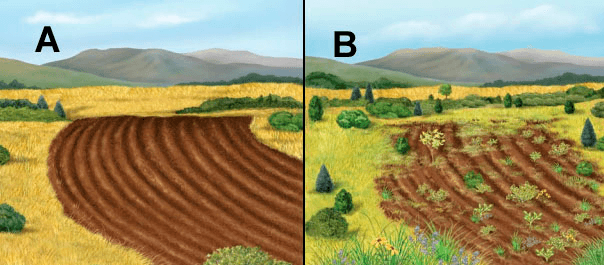
What type of succession is shown going from figure A to figure B?
Primary succession
Pioneer Species
Secondary succession
Climax community
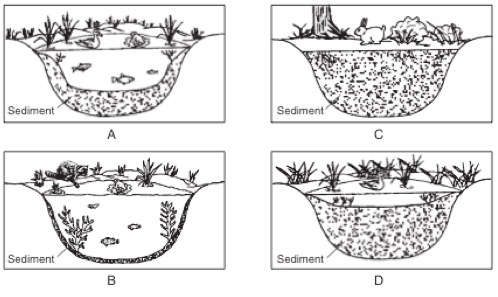
What is the correct order in this pond succession?
A, B, C, D
D, C, B, A
B, A, D, C
C, D, A, B

Eagles nest high in dead trees. All of the dead trees in an area are knocked down during a flash flood. Why does the number of eagles in the area decrease?
the eagles start nesting in live trees instead of dead trees
the eagles no longer have a good place to build nests
the eagles have more materials with which to build nests
the eagles start nesting on the ground instead of in dead trees

A scientist studied a population of deer in an area. One year later, half of the deer population had moved to another area. Identify and explain two factors that might have caused the deer to move.
Deer may move to another area after a fire because their shelter is destroyed and there is a lack of food to survive
Deer may move to another area during a drought to seek food and water
Deer may move to another area as sever weather may have caused damage to their shelters
All of the above are possible answers
Position that an organism occupies in an energy pyramid based on what it eats
Producer
Trophic level
Heterotroph
Consumer
Makes its own food
Herbivore
Carnivore
Heterotroph
Autotroph
Only eats plants
Herbivore
Carnivore
Omnivore
Decomposer
Eats other organisms
Producer
Decomposer
Consumer
Autotroph
Eats dead organisms and returns nutrients to soil
Autotroph
Decomposer
Biomass
Carnivore
What is the bottom layer of the an energy pyramid?
producer
tertiary consumer
Secondary consumer
primary consumer
What does an energy pyramid show?
Energy flow in a community
Longest lifespans
The stronger animal the higher it is on the pyramid


Natural selection is defined as
the changes in the characteristics within a population that lead to survival.
the process by which humans select the most desirable organisms in a population.
the changes that occur in a population that do not affect survival.
Which of the following is an example of natural selection?
Cricket frogs prefer to sleep during the day, while red-eyed tree frogs prefer to sleep during the night.
Pesticides are sprayed in a field, resulting in an increase in crop growth and a decrease in insect population.
Rabbits with a mutation for longer, thicker fur survive an unusually cold winter, while many normal rabbits do not survive.

