wayground logo

Free Printable Worksheets

NEW

Font size

S
M
L
XL
Worksheets

AP Bio Quarter Exam Reviewer

Total questions: 40

Worksheet time: 23mins

Name
Class
Date
1.
Where does glycolysis occur?
a)
Inner mitochondrial membrane
b)
Mitochondrial Matrix
c)
Cytosol
d)
At a ribosome
2.
What enzyme in the ETC is responsible for generating the ATP molecules?
a)
ATPase
b)
ATP synthase
c)
Hexokinase
d)
none of the above
3.
Where does ETC occur?
a)
Mitochondrial matrix
b)
Outer mitochondrial membrane
c)
Inner mitochondrial membrane
d)
Cytosol
4.
Two different species of bacteria are examined. Scientists find that species X always produces CO2 and H2O during cellular respiration. Species Y always produces ethyl alcohol and CO2. Which conclusion can be made from these observations?
a)
Only species Y is aerobic.
b)
Only species Y is anaerobic
c)
Both species X and Y are aerobic.
d)
Both species X and Y are anaerobic.
5.
Which molecules are made during the Krebs Cycle to power the electron transport chain?
a)
ATP and CO2
b)
ATP and NADH
c)
NADH and FADH2
d)
ADP, NADand FAD+
6.

Which of the following does not occur during photosystem II?

a)

splitting of water

b)

capturing of light energy

c)

releasing oxygen

d)

formation of carbohydrates

7.
Which of the following are products of the light reactions of photosynthesis that are utilized in the Calvin cycle?
a)
ATP and NADPH
b)
H2O and O2
c)
CO2 and glucose
d)
ADP, Pi, and NADP+
8.
A plant has a unique photosynthetic pigment. The leaves of this plant appear to be reddish yellow. What wavelengths of visible light are being absorbed by this pigment?
a)
green and yellow
b)
blue, green, and red
c)
green, blue, and yellow
d)
blue and violet
9.
If photosynthesizing green algae are provided with CO2 synthesized with heavy oxygen (18O), later analysis will show that all but one of the following compounds produced by the algae contain the 18O label. That one is
a)
O2.
b)
3–phosphoglycerate.
c)
glucose
d)
glyceraldehyde 3–phosphate (G3P).
10.
Why are C4 plants able to photosynthesize with no apparent photorespiration?
a)
they do not participate in the Calvin cycle
b)
they use PEP carboxylase to initially fix carbon dioxide
c)
they conserve water more efficiently
d)
they exclude oxygen from their tissues
11.
In mice, the homozygous mice are black and white. The heterozygous mice are gray. What pattern of inheritance is expressed in fur color in mice?
a)
complete dominance and recessiveness
b)
co-dominance
c)
incomplete dominance
d)
pleiotropy
12.
What is the genotype of the father?
a)
AA
b)
aa
c)
Aa
d)
AA or aa
13.
Is this trait (the shaded individuals) dominant or recessive?
a)
dominant
b)
recessive
14.
When experimenting with the growth of a plant, a scientist uses three (of the same type of) plants, two different fertilizers, equal light, and equal water. What type of variable is the fertilizer?
a)
Dependent
b)
Independent
c)
Control
d)
Compound
15.
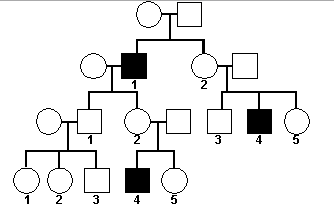
What type of heredity is shown in the pedigree?
(hint: check your notes - "modes of inheritance")
a)
Sex-Linked Dominant
b)
Sex-Linked Recessive
c)
Autosomal Dominant
d)
Autosomal Recessive 
16.
What are the nucleotides made of?
a)
Sugar, Phosphate, nitrogen base
b)
Phosphate, Adenine, nitrogen base
c)
Thymine, Adenine, Cytomine
d)
Phosphate, Nitrogen, Adenine
17.
Nitrogenous bases are joined by which type of bond?
a)
polar bonds
b)
ionic bonds
c)
covalent bonds
d)
hydrogen bonds
18.
DNA replication results in two DNA molecules,
a)
each one with two original strands
b)
each one with two new strands
c)
each one with one new strand and one original strand
d)
one with two new strands and the other with two original strands
19.

Which enzyme joins the Okazaki fragments in the lagging strand?

a)

Helicase

b)

DNA Polymerase

c)

Ligase

d)

Primase

20.
If the percentage of DNA is made of 30% Thymine, what is the correct percentage of Guanine?
a)
30
b)
15
c)
20
d)
60
21.

Which enzyme is responsible for adding the RNA primer to the template strand?

a)

Helicase

b)

DNA Polymerase

c)

Ligase

d)

Primase

22.
Mistakes in the replication process are called _____
a)
helicase
b)
excision repair
c)
mutations 
d)
RNA 
23.
The table shows the results of measuring the percentages of the four bases in the DNA of several different organisms. Some of the values are missing from the table. Based on Chargaff’s rule, the percentages of guanine bases in chicken DNA should be approximately what?
a)
28.8%
b)
19.9%
c)
21.5%
d)
13.4%
24.

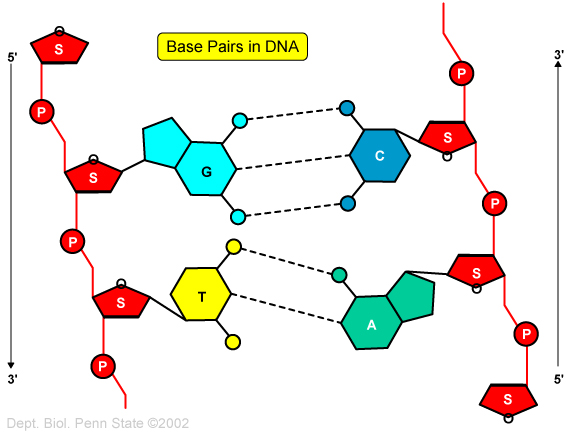
Name this structure.

a)

Deoxyribose sugar

b)

Amino Acid

c)

Nucleotide

d)

Double helix

25.

DNA has a slight ___________ charge.

a)

Positive

b)

Negative

26.

Gel Electrophoresis is a technique used to separate DNA fragments based on ________.

a)

Size

b)

Number of A's and G's

c)

Animal species

d)

Criminal suspects

27.

Which of the following is considered the "Central dogma of biology"?

a)

Evolution by natural selection leads to changes in population

b)

"DNA that is transcribed into RNA which is translated into protein" .

c)

Proteins have four levels of structure. The fourth level is when all 3D subunits come together to make a functional protein.

28.
RNA contains the sugar
a)
ribose
b)
deoxyribose
c)
glucose
d)
lactose
29.
Every three letters (example: ATC) in DNA codes for what??
a)
Amino Acid
b)
Nucleotide
c)
Lipid
d)
Carbohydrate
30.
One difference between DNA and RNA is that RNA....
a)
is double stranded 
b)
contains the base Thymine
c)
contains the base Uracil 
d)
contained the base Guanine
31.
What is the correct sequence?
a)
RNA --> DNA --> Protein
b)
Protein --> RNA --> DNA
c)
DNA --> RNA --> Protein
d)
DNA --> Protein --> RNA
32.
How many bases are in one codon?
a)
1
b)
2
c)
3
d)
4
33.
What is a peptide bond?
a)
Bond that holds two amino acids together.
b)
A bond that holds hydrogen and oxygen molecules together.
c)
A bond that holds the phosphate group of one nucleotide and a sugar of a neighboring nucleotide.
d)
A bond that is formed by the sharing of electrons.
34.
Where does transcription occur in eukaryotic cells?
a)
Nucleus
b)
Ribosome
c)
Cytoplasm
d)
Rough E.R.
35.
A certain gene codes for a polypeptide that is 120 amino acids long. Approximately how many nucleotides long is the mRNA that codes for this polypeptide likely to be?
a)
360
b)
480
c)
40
d)
30
36.
Which of the following does not occur in prokaryotic gene expression but does occur in eukaryotic gene expression?
a)
mRNA, tRNA, and rRNA are transcribed
b)
RNA polymerase binds to the promotor
c)
a poly-A tail is added to the ends of the mRNA
d)
Transcription can begin as soon as translation has begun even alittle
37.
Which of the following events in translation is the first to occur in eukaryotes?
a)
elongation of the polypeptide
b)
base pairing of activated methionine-tRNA to AUG of the messenger RNA
c)
binding of the larger ribosomal subunit to smaller ribosomal subunits
d)
the small subunit of the ribosome recognizing and attaching to the 5'cap
38.
What is an exon?
a)
section of mRNA that codes for protein
b)
section of mRNA that does not code for protein
c)
section of tRNA that codes for protein
d)
section of rRNA that codes for protein
39.

DNA can only be copied in the:

a)

eukaryotic cell

b)

5' to 3' direction

c)

3' to 5' direction

d)

reverse order

40.

Which enzyme is responsible for adding nucleotides?

a)

Ligase

b)

Helicase

c)

DNA polymerase I

d)

DNA polymerase III