wayground logo

Free Printable Worksheets

Font size

S
M
L
XL
Worksheets

Q2 Mini 2 Remediation Honors 2023

Total questions: 56

Worksheet time: 3600secs

Name
Class
Date
1.
Dropping off and Building new from pieces of rocks is 
a)
weathering
b)
erosion
c)
deposition
2.
Breaking rocks into smaller pieces is called
a)
weathering
b)
erosion
c)
deposition
3.
Wind BLOWING and MOVING sand is 
a)
Weathering
b)
Erosion
c)
Deposition
4.
Wind blows sand onto rocks and slowly breaks down the rock
a)
Mechanical Weathering
b)
Chemical Weathering
c)
Erosion
d)
Deposition
5.
Water gets into cracks of a rock, when the water freezes it breaks up the rock
a)
Mechanical Weathering
b)
Chemical Weathering
c)
Erosion
d)
Deposition
6.
Waves wash sand onto land until a beach is formed
a)
Mechanical Weathering
b)
Chemical Weathering
c)
Erosion
d)
Deposition
7.
A flash flood washes away the side of a river bank
a)
Mechanical Weathering
b)
Chemical Weathering
c)
Erosion
d)
Deposition
8.

Geologists have classified rocks into three major groups of rocks which are:

a)

inorganic, organic and chemical rocks

b)

igneous, sedimentary and metamorphic rocks

c)

metamorphic, chemical and non chemical rocks

d)

sedimentary, inorganic and igneous rocks

9.

Any rock that forms from another rock as a result of changes in heat or pressure (or both) is a:

a)

chemical rock

b)

igneous rock

c)

sedimentary rock

d)

metamorphic rock

10.

You find a deposit of organic limestone. In what type of rock setting did it probably form?

a)

the ocean

b)

a volcano

c)

a swamp

d)

sand dunes

11.

A rock that forms from many small fragments of other rocks is a(n)

a)

igneous rock

b)

metamorphic rock

c)

sedimentary rock

d)

extrusive rock

12.

The process by which metamorphic rock changes to igneous rock begins with

a)

melting

b)

erosion

c)

deposition

d)

crystallization

13.

If heat and pressure inside Earth cause the texture and crystal structure of a rock to change, what new material is formed?

a)

sedimentary rock

b)

metamorphic rock

c)

igneous rock

d)

chemical rock

14.
The three groups of rocks are classified by
a)
How they form
b)
Color
c)
Grain size
d)
Chemical Composition
15.
This rock was formed by smaller pieces of rock that settled at the bottom of a lake millions of years ago. What type of rock is this?
a)
Sedimentary
b)
Igneous
c)
Metamorphic
16.
What is letter D?
a)
Cont. Shelf
b)
Mid-Ocean Ridge
c)
Volcanic Island
d)
Seamount
17.

Boundary between two colliding plates, often associated with mountain building, ocean trenches and volcanic islands

a)

plate boundary

b)

magma

c)

divergent boundary

d)

convergent boundary

18.
The volcanoes on the Hawaiian Islands form due to which of the following?
a)
Divergent Boundary
b)
Hot Spot
c)
Subduction Boundary
d)
Transform Boundary
19.
Where are most volcanoes found?
a)
Southern Hemisphere
b)
Ring of Fire
c)
Mid-Atlantic Ridge
d)
Hot Spots
20.
An area of new land at the mouth of the river, formed from sediments carried by the river.
a)
sinkhole
b)
mouth
c)
delta
d)
glacier
21.
A large hole formed when the roof of a cave collapses.
a)
delta
b)
sinkhole
c)
canyon
d)
river
22.
Blowing sand that chips away at a rock's surface by breaking it into smaller pieces
a)
water erosion
b)
wind weathering
c)
depostion
d)
erosion
23.
The Grand Canyon was formed by 
a)
Wind
b)
Water Erosion
c)
Glaciers
d)
a sinkhole
24.
The sinking of regions of the crust to lower elevations, leading to the formation of basins where sediment can be deposited
a)
Rock Cycle
b)
Subsidence
c)
Uplift
d)
Rift Zone
25.
The rising of regions of the crust to higher elevations.  It causes the rate of erosion to increase
a)
Subsidence
b)
Deposition
c)
Rift Zone
d)
Uplift
26.

A hot spot is located at the boundary of a plate

a)

true

b)

false

27.

Which of the following will move with time ?

a)

a hot spot

b)

the plate the hot spot is over

c)

neither move

d)

both move

28.

What is a Hot spot?

a)

Is an area of Earth that sits over a mantle plume.

b)

A place where people can access internet.

c)

A large mountain that creates major landslides.

d)

A spot where a basketball player is good at shooting.

29.
Created by a divergent boundary.
a)
Rocky Mountains
b)
Mariana Trench
c)
Mid Atlantic ridge
30.
This is the deepest part of the ocean basin.
a)
continental shelf
b)
trench
c)
abyssal plain
d)
mid-ocean ridge
31.

Where do trenches form?

a)

Divergent

b)

Convergent

c)

Transform

d)

Hot Spots

32.
the breakdown or decomposition of rock that takes place when minerals change through chemical processes
a)
chemical weathering
b)
mechanical weathering
c)
erosion
d)
deposition
33.
Roots grow into cracks of a rock and pry them apart
a)
mechanical weathering
b)
chemical weathering
c)
erosion
d)
deposition
34.
oxidation produces rust on some rocks containing iron
a)
chemical weathering
b)
mechanical weathering
c)
erosion
d)
deposition
35.
Which of the following supports the theory of seafloor spreading?
a)
Correlation of rock layers
b)
Crustal Age
c)
Magnetic Reversal
d)
Continuous Mountain Chains
36.
Rocks at the mid ocean ridges...
a)
are the oldest rock on the earth.
b)
are older than continental rock.
c)
are younger than continental rock.
37.
The study of the Earth's magnetic record
a)
ridge push
b)
convection
c)
paleomagnetism
d)
subduction
38.

Paleomagnetism was used to confirm sea floor spreading because it showed

a)

Patterns or polar reversals in the seafloor that was identical on either side of the mid ocean ridge

b)

The magnetic north pole was at one time in the Atlantic Ocean

c)

Cosmic radiation being deflected by the Earth’s magnetic field lead to fracturing the continents

d)

The oldest rock on the ocean floor is closest to the mid ocean ridge
39.
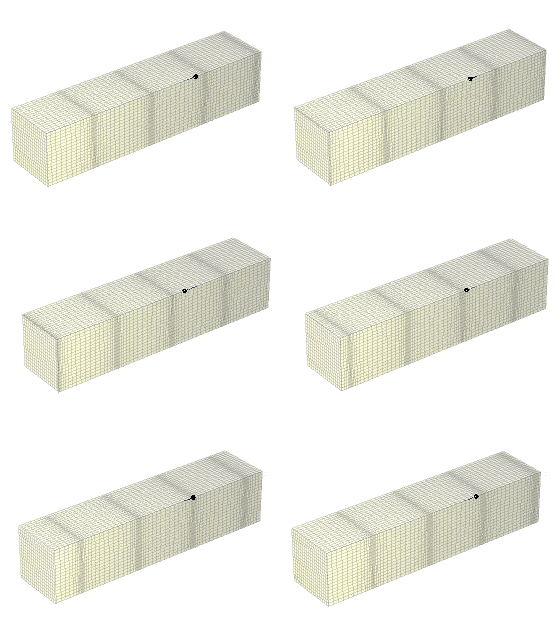
Which body wave is pictured?
a)
P-Wave
b)
S-Wave
c)
Rayleigh Wave
d)
Love Wave
40.
P Waves travel through...
a)
Solids
b)
Liquids
c)
Both
41.
S Waves travel through...
a)
Soilds
b)
Liquids
c)
Both
42.

P waves travel (check the 2 that are correct)

a)

longitudinally

b)

up and down

c)

through solids only

d)

twice as fast as S waves

43.

What is a sinkhole?

a)

A hole formed when limestone is dissolved (WATER) and ERODED causing the land above to collapse.

b)

A pile of sediment and rocks that has been eroded then DEPOSITED by a glacier (ICE)

c)

the sudden movement of rock and soil down a slope caused by GRAVITY, heavy rains (WATER), cutting down trees, construction on steep slopes, and/or earthquakes.

d)

Pollution (sulfuric acid) from factories dissolves in precipitation; a cause of CHEMICAL weathering when the acid eats away at rocks and buildings.

44.

Why are sinkholes common in Florida?

a)

Florida is a peninsula. Sinkholes are commonly formed on peninsulas because a peninsula is surrounded by water.

b)

Florida has a lot of swamps with animals that burrow into the sandy soil making holes and tunnels that collapse.


c)

Florida's underlying rock is limestone. Limestone dissolves easily, forming caverns which can then collapse and form a sinkhole.


d)

Florida has a lot of oil underground. When the oil is removed, there is nothing left to hold up the soil

45.

How does acid rain cause weathering?

a)

through abrasion

b)

though oxidation

c)

by dissolving rock

d)

by carrying rock away

46.

Check all of the statements that are correct about Florida's landscape.

a)

It is likely to find sinkholes in Florida because it sits on a bed of limestone that can be chemically weathered away.

b)

Florida has dunes, marshes and swamps.

c)

Florida's lakes were formed by melting glaciers 100,000 years ago.

d)

Florida has low-lying wetlands such as the Everglades.

47.
A rock formed from fragments of other rocks is a(n)
a)
Metamorphic Rock
b)
Sedimentary Rock
c)
Extrusive Rock
d)
Igneous Rock
48.
If heat and pressure inside the Earth cause a rock to melt, the material that formed would be
a)
Metamorphic
b)
Magma
c)
Sedimentary
d)
Igneous
49.
Which type of rock is made by small bits of rock, mud, or sand compacted and cemented together?
a)
Coal
b)
igneous
c)
metamorphic
d)
sedimentary
50.

Which type of rock is made from lava or magma cooling?

a)

igneous

b)

sedimentary

c)

metamorphic

51.
Which type of rock is made from a rock being changed by heat and pressure?
a)
Smooshed Rock
b)
igneous
c)
metamorphic
d)
sedimentary
52.
Which type of rock is heated and pressurised but does NOT melt?
a)
igneous
b)
hard rock
c)
metamorphic
d)
sedimentary
53.

Tiny bits of weathered rock or once living plants or animals are called

a)

Sediment

b)

basalt

c)

mineral

d)

coal

54.

When the force of gravity pulls a lithospheric plate downward and away from a ridge pushing it toward a trench.

a)

Sea Floor Spreading

b)

Subduction

c)

Ridge Push

d)

Slab Pull

55.
Which theory of plate movement occurs at the mid ocean ridge?
a)
convection
b)
ridge push
c)
slab pull
56.
Which theory of plate movement occurs at the mid ocean ridge?
a)
convection
b)
ridge push
c)
slab pull