
 Worksheets
Practice Log 11-2 Makeup
Total questions: 20
Worksheet time: 36mins
Name
Class
Date
1.
If two charges repel each other, the two charges must be
a)
Positive and neutra
b)
Positive and negative
c)
positive and neutral
d)
negative and negative
2.
An object becomes charged when the atoms in the object gain or lose
a)
electrons
b)
protons
c)
neutrons
d)
all of the above
3.
If you rub a glass rod with a piece of silk, the rod becomes positively charged. This means that
a)
friction destroyed electrons in the rod.
b)
the silk has become negatively charged.
c)
protons have moved to the rod.
d)
glass attracts more protons.
4.
If you bring a charged object near an electrically neutral surface without allowing the object to touch the surface, the charges in the surface are rearranged by
a)
friction.
b)
convection.
c)
induction.
d)
conduction.
5.
Charging by ____ occurs when electrons are transferred from one object to another by direct contact.
a)
reduction
b)
induction
c)
conduction
d)
friction
6.

When you pull a cotton sweater off your skin, electrons are transferred from the ___________________ (cotton, skin) to the __________________ (cotton, skin). As a result, your body acquires a ___________ (+ , -) charge and the cotton sweater acquires a ___________ (+ , -) charge.
a)
skin, cotton, +, -
b)
cotton, skin, +, -
c)
skin , cotton, -, +
d)
cotton, skin, -, +
7.

Which ranking is correct?
a)
A < B
b)
J < H < I
c)
F < G < E
d)
D < C
8.
Which part of Coulomb's Law is always squared?
a)
distance
b)
charge
c)
Coulomb's constant
d)
force
9.
Which is NOT an insulator.
a)
Wool
b)
Plastic
c)
Copper
d)
Glass
10.
Materials which can conduct electricity better than insulator,but not as well as conductors. This is the definition of
a)
diode
b)
semiconductor
c)
conductor
d)
insulator
e)
superconductor
11.
the total charge in an isolated system is constant
a)
law of conservation of charge
b)
induction
c)
electric curent
d)
direct current
12.

What is the name of this device that is used to detect charges?
a)
beaker
b)
electroscope
c)
van de graff generator
d)
chargometer
13.
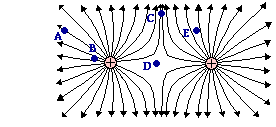
Which of the following labeled points is in the region with the strongest force of electric charge
a)
A
b)
B
c)
C
d)
D
14.

Consider the electric field lines shown in the diagram below. From the diagram, it is apparent that object A is ____ and object B is ____.
a)
+,+
b)
+,-
c)
-,+
d)
-,-
15.
What happens to the force between two charged objects when you double the distance between them?
a)
2X
b)
1/2X
c)
4X
d)
1/4X
16.
What happens to the force between two charged objects if you double the distance between them and double the magnitude of one charge?
a)
4X
b)
6X
c)
1/2X
d)
1/6X
17.
If each of the charges doubles, what happens to the force?
a)
Quadruples
b)
Doubles
c)
Stays the same
d)
Reduced by half
18.
If the distance doubles, what happens to the force?
a)
Reduced by half
b)
Reduced by 1/4
c)
Stays the same
d)
Quadruples
19.
Approximately how much force would be generated by two charged objects held 2 m apart, if q1 has a charge of 3.0 C and q2 has a charge of 4.0 C?
a)
0.5 N
b)
1.5 N
c)
3 N
d)
6 N
20.
Which is the value of the constant in Coulomb's equation?
a)
k = 9·10-9
b)
k = 9.8
c)
k = 6.67·10-11
d)
k = 9 ·109
100 %

