
 Worksheets
Cover Lesson Physic GCSE Revision
Total questions: 201
Worksheet time: 4hrs 30mins
What is the Equation for Weight?
Weight = Mass x Gravitational Field Strength
Weight = Mass / Gravitational Field Strength
Weight = Gravitational Field Strength / Mass
What is the Equation for Work Done?
Work Done = Force x Distance
Work Done = Force / Distance
Work Done = Distance / Force
What is the Equation for Force applied to a Spring?
Force applied to a Spring = Spring Constant x Extension
Force applied to a Spring = Spring Constant / Extension
Force applied to a Spring = Extension / Spring Constant
What is the Equation for a Moment of a Force?
Moment of a Force = Force x Distance
Moment of a Force = Force / Distance
Moment of a Force = Distance / Force
What is the Equation for Pressure?
Pressure = Force x Area of Surface
Pressure = Force / Area of Surface
Pressure = Area of Surface / Force
What is the Equation for Acceleration?
Acceleration = Change in Velocity x Time
Acceleration = Change in Velocity / Time
Acceleration = Time / Change in Velocity
What is the Equation for Resultant Force?
Resultant Force = Mass x Acceleration
Resultant Force = Mass / Acceleration
Resultant Force = Acceleration / Mass
What is the Equation for Momentum?
Momentum = Mass x Velocity
Momentum = Mass / Velocity
Momentum = Velocity / Mass
What is the Equation for Kinetic Energy?
Kinetic Energy = 0.5 x Mass x Speed²
Kinetic Energy = 0.5 x Mass² x Speed
Kinetic Energy = 0.5 x Mass² / Speed
What are Equations for Gravitational Potential Energy?
Gravitational Potential Energy = Mass x Gravitational Field Strength x Height
Gravitational Potential Energy = Weight x Height
Gravitational Potential Energy = Mass x Gravitational Field Strength / Height
Gravitational Potential Energy = Weight / Height
Which are the Equations for Power?
Power = Energy Transferred / Time
Power = Work Done / Time
Power = Energy Transferred x Time
Power = Work Done x Time
What is the Equation for Wave Speed?
Wave Speed = Wave Length x Frequency
Wave Speed = Wave Length / Frequency
Wave Speed = Frequency / Wave Length
What is the Equation for Charge Flow?
Charge Flow = Current x Time
Charge Flow = Current / Time
Charge Flow = Time / Current
What is another Equation for Power?
Power = Potential Difference x Current
Power = Potential Difference / Current
Power = Current / Potential Difference
What is another Equation for Power?
Power = Current² x Resistance
Power = Resistance² x Current
Power = Resistance² / Current
What are the Equations for Energy Transferred?
Energy Transferred = Power x Time
Energy Transferred = Power / Time
Energy Transferred = Charge Flow x Potential Difference
Energy Transferred = Charge Flow / Potential Difference
When an object is ....
What other information is needed to calculate the useful work done in lifting the bricks?


In which situation is it IMPOSSIBLE for the object to be in equilibrium?
Which one of the following is true about energy?
Energy is destroyed due to frictional forces
Energy is the measure of the ability to do work
More energy is available when there is more power
Energy and power measure the same thing
Which of the following shows the formula for efficiency in %?
Efficiency = total energy / useful energy x 100
Efficiency = input energy / output energy
Efficiency = total energy / output energy x 100
Efficiency = useful energy / total energy x 100
What is the correct unit for momentum?
ms-1
kgms-1
Ns-1
J
Power is defined as
The rate at which velocity changes
The rate at which work is done
The energy of a moving body
The work done by a moving body
Which of the following is NOT true about momentum:
Momentum is always conserved in collisions
Momentum has the symbol p and units kgms-1
Momentum is a scalar quantity
The change in momentum and impulse are the same quantity
Why do cars have crumple zones?
To make them easier to fix after a crash
To reduce the collision time whilst crumpling and hence increase the force on the passengers
To increase the collision time whilst crumpling and hence decrease the force on the passengers
To reduce the speed in a collision
What energy transformations are happening when a cat falls out of a tree and hits the ground?
Gravitational potential -> kinetic energy -> sound / heat / kinetic
Kinetic -> gravitational > sound / heat / kinetic
Gravitational -> spring
Kinetic -> heat/sound
When an object moves at a constant velocity
There must be a force making it move
It must be accelerating
It must have balanced forces acting on it
It could be changing direction
Which of these is an example of Newton's 1st Law
A bus suddenly stops and you fall forward
You push a stationary box and it starts accelerating
You pull on a rope and someone pulls back on the rope with the same force
A ball collides with a wall and bounces back
You run around Sandell oval 10 times, starting where you finish. Which of the following is false?
Your displacement is 0m
Your speed is >0ms-1
The gravitational force was acting on you the whole time
Your velocity is >0ms-1
Which would be the hardest to stop moving?
A bike travelling at 50kmh-1
A car travelling at 50kmh-1
A truck travelling at 50kmh-1
A truck travelling at 50ms-1
Which of the following only shows SI units
m, s, g, N
cm, s, g, N
km, s, kg, N
m, s, kg, N

Velocity is defined as __________
Speed and inertia
Speed and direction
Distance and direction
Direction and inertia

Acceleration is the rate of change in ___________.
Speed
Distance
Velocity
Displacement
What is the equation for determining the acceleration of an object moving in a straight line?
Final speed - initial speed divided by time
Final speed - initial speed multiplied by time
Final speed + initial speed divided by time
Final speed + initial speed multiplied by time

_______ is the force that slows an object in free fall.
Gravity
Friction
Air resistance
None of the above
What kind of quantity has both a magnitude and a direction?
Scalar
Vector
Direction
Time
Which of the following is NOT a scalar quantity?
Time
Distance
Displacement
Speed
Distance and direction of an object's change in position from a starting point is called _______.
Displacement
Distance
Motion
Reference point


If an object is not moving the forces acting upon it are _____________
Unbalanced
Weak
Balanced
Incomplete
_____ is a push or pull that causes a change in motion
Friction
Gravity
Mass
Force
_______ is the tendency of an object to resist a change in its motion.
Acceleration
Inertia
Mass
Force
Instantaneous speed is _________
The speed of an object at a particular time
The average speed of an object
The change in speed of an object
The total displacement of an object

"For every action, there is an equal and opposite reaction" is the definition of which law?
Newton's 1st Law
Newton's 2nd Law
Newton's 3rd Law
None of these

"Force = Mass x Acceleration" is the definition of which law?
Newton's 1st Law
Newton's 2nd Law
Newton's 3rd Law
None of these

"An object in motion (or at rest) will to stay in motion (or at rest) until an outside force acts upon it" is the definition of which law?
Newton's 1st Law
Newton's 2nd Law
Newton's 3rd Law
None of these

What is speed?
How far you go
How much distance is covered over a period of time
How fast you accelerate
The change in the location of a object
The definition of terminal velocity is ___________
The smallest velocity that an object can possess when falling through air
The velocity that an object possess in absence of air resistance
The velocity that an object possess when it reaches the ground
The highest velocity that an object can possess when falling through air

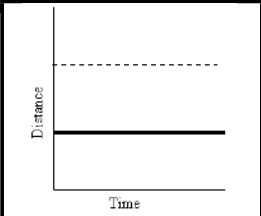
What does this graph represent?
Constant Speed
Acceleration
Decceleration
Not moving
What is the most ionising form of radiation?
Gamma
Alpha
Beta
They are all the same
What is beta radiation formed of?
Helium nucleus
Electron
Proton
Neutron
What is one medical use for gamma radiation besides treatment?
Diagnosing diseases
Steralising equipment
Steralising nurses for surgery
Measurements for small equipment
What is the store of energy when someone lifts a weight from the ground to the top of a desk?
Gravitational Potential
Kinetic
Elastic Potential
Gravity
What is the unit of power?
Joules
Newtons
Watts
Volts
What makes a material a good insulator for keeping water hot?
Good conductor of electricity
Good conductor of heat
Poor conductor of electricity
Poor conductor of heat
What are the units for specific heat capacity?
oC
kg/oC
J
J/kg/oC

What is this circuit symbol for?
Thermistor
Variable resistor
Fuse
Resistor
What is the frequency of mains electricity?
45V
100Hz
50Hz
5Hz
What happens to the resistance of a wire as the length is increased?
It increases
It decreases
No change
Depends on what the wire is made of
Which state of matter has the highest density?
Gas
Liquid
Solid
What is the change in state from solid to liquid called?
Melting
Freezing
Condensation
Sublimation
The temperature of an ideal gas is a measure of the molecules’ average:
Velocity
Momentum
Kinetic Energy
Frequency of Collisions

If the substance is in state B and is cooled down and undergoes a phase change, which of the following occurs to the substance?
It stays as state B.
It changes to state C.
It changes to a liquid.
It changes to state A.

The current in a resistor is measured as 2.00 A. Which of the following correctly identifies the absolute uncertainty and the percentage uncertainty in the current?
A
B
C
D

An Ohm’s law experiment was conducted and the results plotted as the graph in Figure 2.
Which of the following shows the resistance of the resistor used in the experiment when the current I=I1 ?
The slope of the line at the point V1I1
The slope of the line from 0,0 to the point V1I1
I1V1
V1I1

Two 20 Ω resistors are connected as shown in Figure 3.
1 Ω
10 Ω
15 Ω
50 Ω
A particular nuclear reaction produces 100 MJ of energy. Calculate the loss of mass in kg during the reaction.
Δm=c2ΔE
12.33 ×10⁻⁹ kg
1.11 ×10⁻⁹ kg
2.071 ×10⁻⁹ kg
9.0913 ×10⁻⁹ kg

0-5s
5-10s
10-15s
15-20s
A ball tossed vertically upward rises, reaches its highest point and then falls back to its starting point. During this time the acceleration of the ball is always:
in the direction of motion.
opposite its velocity.
directed upward.
directed downward.
A boy pulls a 50 kg crate horizontally with a force of 450 N and the friction force on the crate is 250 N. The acceleration of the crate is:
2ms−2
4ms−2
9ms−2
1ms−2
A ball is projected into the air with 200 J of kinetic energy that is transformed to gravitational potential energy at the top of its trajectory. When it returns to its original level after encountering air resistance, its kinetic energy is:
0 J
less than 200 J but not 0 J
200 J
more than 200 J
A car starts from rest and reaches a velocity of 15 m s–1 in 5 seconds. Calculate how far the car travelled in this time.
21 m
41.72 m
12.34 m
37.5 m
Calculate the magnitude of the momentum of the following moving objects:
1.5 tonne car moving at 15 ms−1 ( 1 tonne = 1000 kg)
225000 kg m s−1
562000 kg m s−1
127000 kg m s−1
987000 kg m s−1

Students experimenting with an unknown transparent substance used a light box to produce a ray of light. They shone the ray onto the unknown substance at various angles and measured the angles of refraction. Use their results in Table 1 to find the refractive index of the substance.
A
B
C
A ball is thrown vertically upward at 30 m s–1. Calculate, its maximum height and the time taken to reach this height
45.9m / 3.06s
30.12m / 2.12s
39.7m / 4.12s
48.2m / 3.409s
Two blocks of masses 2 kg (A) and 4 kg (B) respectively rest on a smooth horizontal surface and are connected by a taut string of negligible mass. A force of 18 N is applied to the 4 kg mass. Calculate the tension in the string between the blocks
12N
8N
6N
5N
Construct a balanced equation for the alpha decay of Po-214.


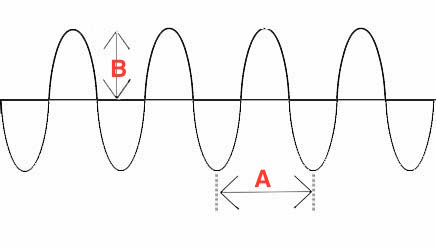
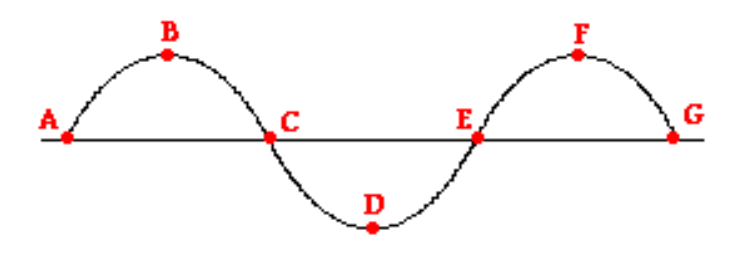
What property of this wave is represented by the letter "A"
amplitude
crest
trough
wavelength
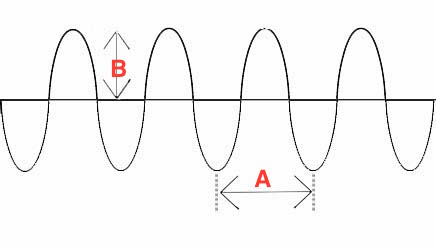

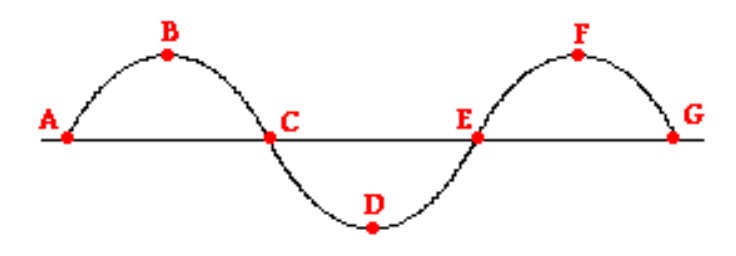
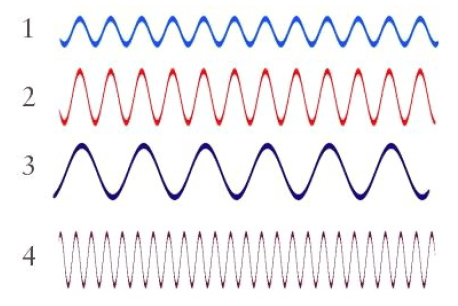
Which wave in the diagram has the highest frequency?
1
2
3
4
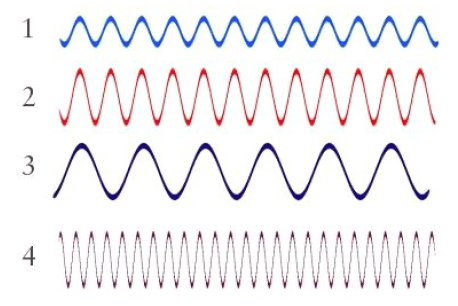
Which wave in the diagram has the longest wavelength?
1
2
3
4
What is the term describing regular disturbances that carry energy through matter or space?
crest
energy
wave
trough
Through which material does sound travel the fastest?
solid
liquid
gases
vacuum
What is the term when a wave strikes and object and bounces off (example echo).
medium
refraction
reflection
interference
What is the term describing when a wave bends, as it passes through at an angle, from one medium to another. (example: pencil in a glass of water)
medium
refraction
reflection
interference


Mobile phones use _____________ waves for the signal to link to the mobile network.
Microwaves
Gamma
XRays
Radio


The angle of incidence is _________ the angle of reflection

For Electromagnetic waves (EM waves). As frequency increases, the ___________ decreases.
amplitude
wavelength
brightness
sound
What is the correct order for the electromagnetic spectrum? (select two)
Radio, Micro, UV, Visible, IR, X-ray, Gamma
Gamma, X-ray, UV, Visible, IR, Micro, Radio
Radio, Micro, IR, Visible, UV, X-ray, Gamma
Gamma, X-ray, IR, Visible, UV, Micro, Radio
What range of wavelength does the EM spectrum cover?(from radio waves to gamma rays)
1015 to 10-4
104 to 10-15
108 to 10-8
10 to 10-32
What is the same as Work Done?
Power
Energy Transferred
Energy Lost from G.P.E Store = Energy Gained in the Kinetic Energy Store
True
False
What is Specific Heat Capacity?
Amount of Energy needed to raise 1Kg of a substance by 1 C
Amount of Energy needed for 1Kg of a substance to change state
Which is the definition of Power?
Rate of Energy Transfer
Rate of doing Work
What is Conduction?
The process where Vibrating Particles Transfer Energy to Neighbouring Particles
The process where energetic particles Move Away from Hotter to Cooler Regions
What is Convection?
The process where Vibrating Particles Transfer Energy to Neighbouring Particles
The process where energetic particles Move Away from Hotter to Cooler Regions
Which one is Lubrication?
Is used to lower Friction so objects flow easily
Is used to prevent Thermal Energy Loss
Which one is Insulation?
Is used to lower Friction so objects flow easily
Is used to prevent Thermal Energy Loss
Which one is True?
The greater the Resistance the Smaller the Current
The greater the Resistance the Greater the Current
Which one is a Battery?


Which one is a Fuse?
Which one is a Filament bulb?
Which one is a LED?
Which one is a Switch?
Which one is a Resistor?


Which one is a Variable Resistor?
Which one is a Diode?
Which one is a LDR?
Which one is a Thermistor?
Which one is the Graph for an Ohmic Conductor?


Which one is the Graph for an Filament Lamp?
Which one is the Graph for an Diode?
Which one is a LDR?
It senses Light. The brighter the light the lower the resistance.
It senses Temperature. The hotter the temperature the lower the resistance.
Which one is a Thermistor?
It senses Light. The brighter the light the lower the resistance.
It senses Temperature. The hotter the temperature the lower the resistance.
Which one is a series circuit?
All components were connected in a line end to end. If one of the components break the whole circuit breaks.
Each component is connected separately. If one is disconnected the others aren't affected.
Which one is a parallel circuit?
All components were connected in a line end to end. If one of the components break the whole circuit breaks.
Each component is connected separately. If one is disconnected the others aren't affected.
Which one is a series circuit?
Potential Difference is Shared
Potential Difference is the same for each component
Which one is a parallel circuit?
Potential Difference is Shared
Potential Difference is the same for each component
Which one is a parallel circuit?
Current is the same everywhere
Current is shared between branches
Which one is a series circuit?
Current is the same everywhere
Current is shared between branches
Which one is a series circuit?
Resistance adds up
Resistors reduce the total resistance
Which one is a parallel circuit?
Resistance adds up
Resistors reduce the total resistance
Select all the features of the UK Mains Supply
AC
DC
230 V
50Hz
50 V
Which one is a Live Wire?
Brown. Provides the alternating potential difference
Blue. Completes the circuit and carries away current
Green and Yellow. Only carries current when there is a fault
Which one is a Neutral Wire?
Brown. Provides the alternating potential difference
Blue. Completes the circuit and carries away current
Green and Yellow. Only carries current when there is a fault
Which one is an Earth Wire?
Brown. Provides the alternating potential difference
Blue. Completes the circuit and carries away current
Green and Yellow. Only carries current when there is a fault
Which does the national grid use?
High Potential Difference
High Current
Low Potential Difference
Low Current
What is the build up of static caused by?
Friction
Electrostatic Fields
What is Specific Latent Heat?
Amount of Energy needed to raise 1Kg of a substance by 1 C
Amount of Energy needed for 1Kg of a substance to change state
What is the first step in developing the modern day model of an atom?
John Dalton published his ideas about atoms. He thought that all matter was made of tiny particles called atoms, which he imagined as tiny spheres that could not be divided.
J J Thomson carried out experiments and discovered the electron. He made the plum pudding model of the atom. In this model, the atom is a ball of positive charge with negative electrons embedded in it.
Ernest Rutherford did the alpha scattering experiment through which he discovered that the mass of an atom is concentrated at its centre and the nucleus is positively charged. He called it the nuclear model.
Niels Bohr did calculations that led him to suggest that electrons orbit the nucleus in shells. The shells are at certain distances from the nucleus.
James Chadwick found evidence for the existence of particles in the nucleus with mass but no charge. These particles are called neutrons.
What is the first step in developing the modern day model of an atom?
John Dalton published his ideas about atoms. He thought that all matter was made of tiny particles called atoms, which he imagined as tiny spheres that could not be divided.
J J Thomson carried out experiments and discovered the electron. He made the plum pudding model of the atom. In this model, the atom is a ball of positive charge with negative electrons embedded in it.
Ernest Rutherford did the alpha scattering experiment through which he discovered that the mass of an atom is concentrated at its centre and the nucleus is positively charged. He called it the nuclear model.
Niels Bohr did calculations that led him to suggest that electrons orbit the nucleus in shells. The shells are at certain distances from the nucleus.
James Chadwick found evidence for the existence of particles in the nucleus with mass but no charge. These particles are called neutrons.
What is the first step in developing the modern day model of an atom?
John Dalton published his ideas about atoms. He thought that all matter was made of tiny particles called atoms, which he imagined as tiny spheres that could not be divided.
J J Thomson carried out experiments and discovered the electron. He made the plum pudding model of the atom. In this model, the atom is a ball of positive charge with negative electrons embedded in it.
Ernest Rutherford did the alpha scattering experiment through which he discovered that the mass of an atom is concentrated at its centre and the nucleus is positively charged. He called it the nuclear model.
Niels Bohr did calculations that led him to suggest that electrons orbit the nucleus in shells. The shells are at certain distances from the nucleus.
James Chadwick found evidence for the existence of particles in the nucleus with mass but no charge. These particles are called neutrons.
What is the first step in developing the modern day model of an atom?
John Dalton published his ideas about atoms. He thought that all matter was made of tiny particles called atoms, which he imagined as tiny spheres that could not be divided.
J J Thomson carried out experiments and discovered the electron. He made the plum pudding model of the atom. In this model, the atom is a ball of positive charge with negative electrons embedded in it.
Ernest Rutherford did the alpha scattering experiment through which he discovered that the mass of an atom is concentrated at its centre and the nucleus is positively charged. He called it the nuclear model.
Niels Bohr did calculations that led him to suggest that electrons orbit the nucleus in shells. The shells are at certain distances from the nucleus.
James Chadwick found evidence for the existence of particles in the nucleus with mass but no charge. These particles are called neutrons.
What is the first step in developing the modern day model of an atom?
John Dalton published his ideas about atoms. He thought that all matter was made of tiny particles called atoms, which he imagined as tiny spheres that could not be divided.
J J Thomson carried out experiments and discovered the electron. He made the plum pudding model of the atom. In this model, the atom is a ball of positive charge with negative electrons embedded in it.
Ernest Rutherford did the alpha scattering experiment through which he discovered that the mass of an atom is concentrated at its centre and the nucleus is positively charged. He called it the nuclear model.
Niels Bohr did calculations that led him to suggest that electrons orbit the nucleus in shells. The shells are at certain distances from the nucleus.
James Chadwick found evidence for the existence of particles in the nucleus with mass but no charge. These particles are called neutrons.
Which is an alpha particle?
Helium nucleus. They don't penetrate very far. Can be absorbed by a sheet of paper. They are strongly ionising
Fast moving electron. Moderately ionising and penetrate moderately far. Stopped by aluminium sheet
Wave of electromagnetic radiation. Penetrate Far into materials and are weakly ionising. Can be absorbed by Thick lead or concrete
Which is a beta particle?
Helium nucleus. They don't penetrate very far. Can be absorbed by a sheet of paper. They are strongly ionising
Fast moving electron. Moderately ionising and penetrate moderately far. Stopped by aluminium sheet
Wave of electromagnetic radiation. Penetrate Far into materials and are weakly ionising. Can be absorbed by Thick lead or concrete
Which is a gamma ray?
Helium nucleus. They don't penetrate very far. Can be absorbed by a sheet of paper. They are strongly ionising
Fast moving electron. Moderately ionising and penetrate moderately far. Stopped by aluminium sheet
Wave of electromagnetic radiation. Penetrate Far into materials and are weakly ionising. Can be absorbed by Thick lead or concrete
Which is not a store of energy
Chemical
Gravitational Potential
Electrical current
Kinetic
What is the equation for density
Mass/Volume
Volume/Mass
Weight
mass * Volume
Useful energy is
the amount of energy lost by a motor
the amount of energy transferred from a car engine
the energy transferred for the main purpose of a device
heat energy
Describe the energy transfers when a bow and arrow is fired upwards
chemical to kinetic to nuclear to gravitational potential
Elastic to kinetic to gravitational potential to kinetic to thermal energy of the surroundings
Kinetic to Gravitational to chemical
Elastic potential to kinetic to gravitational potential to elastic
Describe the energy transfers when a bow and arrow is fired upwards
chemical to kinetic to nuclear to gravitational potential
Elastic to kinetic to gravitational potential to kinetic to thermal energy of the surroundings
Kinetic to Gravitational to chemical
Elastic potential to kinetic to gravitational potential to elastic
what does conservation of energy mean
It should be looked after
It cannot be created or destroyed
It is created and destroyed
What is the definition of work done?
force / distance
Energy transferred to or from a system
distance / force
A car slows down as work is done by the brakes to overcome friction. This means the kinetic energy is transferred to
Gravitational potential
Thermal energy stores of the car
thermal energy stores of the surroundings
thermal energy stores of both the brakes and surroundings
Gravitational Potential energy =
m * g * h
m * F
0.5 * m * v^2
9.81
If a 15 kg block is lifted by 7 metres how much has its Gravitational potential energy store increased?
105 J
1030 J
105 N
1030 N
Elastic potential can be worked out using:
E = 0.5 * k * e^2
What do e and k stand for
k spring constant
e Extension
k spring constant
e length
k length
e spring constant
k mass
e velocity
Percentage Efficiency =
Useful output / total input
(Useful output / total input) *100
total input / useful output
(total input / useful output) / 100
Watt is the unit of power
True
False
what has more kinetic energy, a stone of mass 1 kg travelling at 100m/s or a boulder of mass 100kg travelling at 1m/s
The stone
The boulder
They are both the same
Neither
What will emit the most infrared radiation
A hot silver object
A hot black object
A cold silver object
A cold black object
Specific heat capacity is
energy
the energy required to change the state of an object
The energy required to heat 1kg of material by 1 degree
Mass * energy * temperature change
how much energy is required to heat 3kg of water by 10 degrees (Specific heat capacity of water is 4200 J/kg/degree
42000
30
126000
12600
Which is not a state of matter
Solid
Liquid
Gas
Texas
What is internal energy
The kinetic + potential energy of particles in a material
kinetic energy of particles
Thermal Energy of particles
Potential energy of the particles
which type of heat transfer can only happen in solids
convection
conduction
Radiation
fire
Why does the temperature of an object not increase as it changes state
It actually does increase
Because nothing can be hotter than 100 degrees
Because the energy is being used to pull particles apart not make them move faster
Because the particles are moving faster
specific latent heat is
The energy required to boil water
The energy required to lift a hot air balloon
The energy required to change the state of 1kg of a material
Energy required to perfectly toast a marshmallow
When a container gets smaller which is not a reason the pressure increases
There are more collisions with the walls of the container
The particles move faster
The force pushing outwards on the container increases
Each collision with the wall exerts a force
What happens to an objects mass when it changes state
It stays the same
It decreases
It increases

