wayground logo

Free Printable Worksheets

Font size

S
M
L
XL
Worksheets

Transformation Geometry

Total questions: 83

Worksheet time: 21hrs 45mins

Name
Class
Date
1.
Translations, reflections and rotations are all known as ________________________.
a)
Geometry
b)
Transformations
c)
Congruent
2.
What transformation is happening to the red triangle to get to the blue triangle?
a)
Translation
b)
Rotation
c)
Reflection
d)
Dilation
3.
The following is a ...
a)
Translation
b)
Dilation
c)
Rotation
d)
Reflection
4.
Determine where X' would be if you translated X 3 units to the left and 9 units down.
a)
(-4, 4)
b)
(-10, 2)
c)
(-4, -5)
d)
(-1, 5)
5.
A turn is also called a ___________.
a)
Translation
b)
Reflection
c)
Rotation
d)
Transformation
6.
Which answer shows a reflection across the x-axis?
a)
d
b)
c
c)
b
d)
a
7.
What is a reflection?
a)
When you turn an object around a point.
b)
When you slide an object form one place to another.
c)
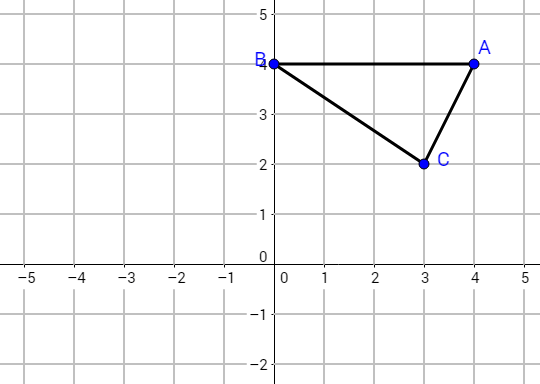
When you flip or mirror an object across a line.
d)
When you resize an object.
8.
Is the picture being reflected in the y-axis or x-axis?
a)
y-axis
b)
x-axis
9.
What is a translation?
a)
When you turn an object around a point.
b)
When you slide an object from one place to another.
c)
When you flip or mirror an object across a line.
d)
When you resize an object.
10.
What is a translation?
a)
When you turn an object around a point.
b)
When you slide an object from one place to another.
c)
When you flip or mirror an object across a line.
d)
When you resize an object.
11.
Reflect a figure over the y-axis- 
a)
Change the x-coordinate
b)
Change the y-coordinate
12.
Reflect a figure over the x-axis- 
a)
Change the x-coordinate
b)
Change the y-coordiate
13.
Identify the transformation from ABC to A'B'C'.
a)
(x+8, y+4)
b)
(x-8, y-4)
c)
(x+4, y+8)
d)
(x-4, y-8)
14.
Identify the transformation from A to D.
a)
90o Clockwise Rotation
b)
180o Rotation
c)
270o Clockwise Rotation
d)
360o Rotation
15.
Identify the transformation.
a)
Reflection across y axis
b)
Reflection across x-axis
c)
180 Rotation
d)
Translation 2 units down
16.
If (3,5)--->(7,10)  then the rule for the translation is:
a)
(x+4,y-5)
b)
(x+4,y+5)
c)
(x-4,y+5)
d)

(x,y)
17.
A scale factor is
a)
a number you divide by to get the new size
b)
How big something is.
c)
A number you multiply by to get the new size
d)
What you use for a reflection
18.
Congruent geometric figures have the:
a)
Same size
b)
Sides Equal
c)
Same Size and Same Shape
d)
Angles Equal
19.
The point that is to be transformed is called the:
a)
Pre-Image
b)
Image
c)
Post-Image
d)
Triangle
20.
Label the transformation being shown.
a)
translation
b)
transformation
c)
reflection
d)
rotation
21.
Which of the following demonstrates a translation?
a)
A
b)
C
c)
B
d)
D
22.
Is the picture being reflected in the y-axis or x-axis?
a)
y-axis
b)
x-axis
23.
What is this picture an example of? 
a)
An angle
b)
A cat vertex 
c)
Rotation 
d)
Dilation
24.
Reflections over the x-axis change the ____-__________. 
a)
y-coordinate
b)
x-coordinate
c)
y-axis
d)
x-axis 
25.
Describe the transformation shown in the graph.
a)
Reflect over x-axis
b)
Reflect over y-axis
c)
Rotate 180 degrees
d)
Translate 4 units right
26.
Name the transformation.
a)
Translation
b)
Reflection
c)
Rotation
27.
The rule for rotation of 180 degrees is  
(x, y) --> _
a)
(-y, x)
b)
(-x, -y)
c)
(y, -x)
d)
(-y, -x)
28.
Describe the transformation shown in the graph.
a)
Reflect over x-axis
b)
Reflect over y-axis
c)
Rotate 270 degrees CCW
d)
Rotate 90 degress CCW
29.
(5, 7) is reflected over the line y=x, what is the new point?
a)
(-5, 7)
b)
(7, 5)
c)
(5, -7)
d)
(-5, -7)
30.
Describe the transformation shown in the graph.
a)
Reflect over x-axis
b)
Reflect over y-axis
c)
Rotate 90 degrees CCW
d)
Rotate 270 degrees CCW
31.
Describe the transformation shown in the graph.
a)
Reflect over x-axis
b)
Reflect over y-axis
c)
Rotate 180 degrees
d)
Rotate 270 degrees CCW
32.
Describe the transformation shown in the graph.
a)
Rotate 90 degrees CCW
b)
Translate 3 left and 4 down
c)
Translate 1 left and 2 down
d)
Reflect over y-axis
33.
Describe the transformation shown on the graph.
a)
Reflect over x-axis
b)
Reflect over y-axis
c)
Rotate 180 degrees
d)
Rotate 90 degrees CCW
34.
Describe the transformation shown on the graph.
a)
Reflect over x-axis
b)
Reflect over y-axis
c)
Rotate 180 degrees
d)
Rotate 90 degrees CCW
35.
Describe the transformation shown in the graph.
a)
Translate 4 left and 1 up
b)
Translate 1 left and 4 up
c)
Rotate 180 degrees
d)
Reflect over the x-axis
36.
What transformation rule involves addition or subtraction?
a)
Translation
b)
Rotation
c)
Reflection
d)
Dilation
37.
What transformation rule switched the position of x and y values?
a)
Rotation
b)
Reflection
c)
Dilation
d)
Translation
38.
What changes when a reflection happens over the x axis?
a)
y is opposite
b)
x is opposite
c)
x and y change places
d)
x and y are both negative
39.
What happens in the rule for a 180 degree rotation?
a)
x is negative
b)
y is negative
c)
x and y are both negative
d)
x and y trade places
40.
What transformation rule involves multiplication?
a)
Transformation
b)
Reflection
c)
Rotation
d)
Dilation
41.
What changes when a reflection happens over the y axis?
a)
y is opposite
b)
x is opposite
c)
x and y are both negative
d)
x and y change places
42.
Is the picture being reflected in the y-axis or x-axis?
a)
y-axis
b)
x-axis
43.
Is the picture being reflected in the y-axis or x-axis?
a)
y-axis
b)
x-axis
44.
Reflections over the x-axis change the ____-__________. 
a)
y-coordinate
b)
x-coordinate
c)
y-axis
d)
x-axis 
45.
Which shapes has the most corners?
a)
star
b)
triangle
c)
circle
d)
square
46.

A reflection across the x-axis maps the point (4,-5) to the point

a)

(-4,-5)

b)

(-5,4)

c)

(4,5)

d)

(-5,-4)

47.

A reflection across the y-axis maps the point (4,-5) to the point

a)

(-4,-5)

b)

(-5,4)

c)

(4,5)

d)

(-5,-4)

48.

Which of the following ordered pair rules represents a reflection across the y-axis? Select all that apply.

a)

(2,3)→(-2,-3)

b)

(4,1)→(4,-1)

c)

(6,-2)→(-6,-2)

d)

(-3,7)→(3,7)

e)

(5,8)→(8,5)

49.

Which of the following is the image of the point (4,-6) after a reflection across the x-axis followed by a reflection across the y-axis?

a)

(4,6)

b)

(-4,6)

c)

(-4,-6)

d)

(4,-6)

50.

The point (2,-3) is reflected across the x-axis. The image is then reflected across the line y = 4. What are the coordinates of the final image?

a)

(2,3)

b)

(-2,3)

c)

(2,7)

d)

(2,5)

51.
a)

True

b)

False

52.

For dilation, the resulting figure is similar to the pre-image.

a)
b)

True

c)

False

53.

For a horizontal stretch, the resulting figure is similar to the pre-image.

a)

True

b)

False

54.

For vertical/horizontal stretch, the resulting figure is distorted.

a)

True

b)

False

55.

Translation 2 units to the right.

S(3,1)

a)

S'(-3,1)

b)

S'(5,1)

c)

S'(3,3)

d)

S'(0,1)

56.

Dilation with a scale factor of 2.

L'(4,12)

a)

L(8,24)

b)

L(6,14)

c)

L(2,6)

d)

L(2,10)

57.

Vertical stretch with a factor of 4 and horizontal stretch with a factor of 3 .

D'(15,8)

a)

D(2,5)

b)

D(5,2)

c)

D(8,5)

d)

D(5,8)

58.

Two perpendicular lines have the same slope.

a)

True

b)

False

59.

A matrix is a rectangular array of rows and columns used to organize data.

a)

True

b)

False

60.

A vector has magnitude and direction.

a)

True

b)

False

61.

Non-rigid transformations preserve both size and shape.

a)

True

b)

False

62.

In order to have a vertical/horizontal stretch, the scale factor has to be between 0 and 1.

a)

True

b)

False

63.

Which of these scale factors will result in a horizontal compression

a)

4

b)

9

c)

11/7

d)

67/89

64.

An artist wants to create an image of these footprints using transformations on a grid. The artist will use the point centered in the big toe to anchor each footprint. What transformations are used to take footprint 1 to footprint 2? Select all that apply.

a)

Rotation

b)

Translation

c)

Reflection

65.

In glide reflection, translation has to be done last.

a)

True

b)

False

66.

Identify the transformation from ABCD to A'B'C'D'.

a)

Translation

b)

Reflection across the x-axis

c)

Reflection across the y-axis

d)

90o counter clockwise rotation

67.
Identify the transformation from ABC to A'B'C'.
a)
90o clockwise rotation
b)
90o counter clockwise rotation
c)
Reflection across the y-axis
d)
Reflection across the x-axis
68.
How is Quadrilateral EFGH translated to E'F'G'H'?
a)
6 down
b)
6 down, 1 right
c)
6 down, 3 left
d)
8 down, 1 right
69.

How is the blue triangle rotated to the red triangle?

a)

90 clockwise

b)

90 counterclockwise

c)

180 clockwise

d)

180 counterclockwise

70.

What is this picture an example of?

a)

Translation

b)

Reflection

c)

Rotation

d)

Dilation

71.

Identify the transformation performed

a)

Translation

b)

Reflection

c)

Rotation

d)

Dilation

72.

Identify the transformation performed

a)

Translation

b)

Reflection

c)

Rotation

d)

Dilation

73.

Triangle A is rotated 90° clockwise with the origin as the center of rotation to create a new figure. Which triangle shows the new location?

a)

A

b)

B

c)

C

d)

D

74.

Triangle A is rotated 90° clockwise with the origin as the center of rotation to create a new figure. Which triangle shows the new location?

a)

A

b)

B

c)

C

d)

D

75.

Determine where X' would be if you translated the figure -3 units to the horizontally and -9 units vertically.

a)

(-4, 4)

b)

(-10, 2)

c)

(-4, -5)

d)

(-1, 5)

76.
If you were to rotate ABCD 90° counterclockwise about the origin, what would the coordinate of A' be?
a)
(-5, 5)
b)
(-3, 5)
c)
(-5, 3)
d)
(-3, 3)
77.
Triangle C is rotated 180° clockwise with the origin as the center of rotation to create a new figure. Which triangle shows the new location?
a)
A
b)
B
c)
C
d)
D
78.
The point (8, 12) was dilated to become point (2, 3). What was the scale factor?
a)
½
b)
¼
c)
4
d)
2
79.

When you dilate the figure by a scale factor of 3, what is the location of B'?

a)

(12,0)

b)

(12,12)

c)

(4,3)

d)

(0,12)

80.

Translated figures are always __________________.

a)

Congruent

b)

Bigger

c)

Smaller

d)

Rotated

81.

A transformation that “turns” a figure about a fixed point is a _____________________.

a)

rotation

b)

translation

c)

reflection

d)

dilation

82.

A reflection ____________________.

a)

turns a figure around a point.

b)

slides an object form one place to another.

c)

flips or mirrors an object across a line.

d)

changes the size of an object.

83.

A type of transformation where a geometric figure slides horizontally, vertically, or both.

a)

dilation

b)

translation

c)

rotation

d)

reflection