Wayground logo

Free Printable Worksheets

Font size

S
M
L
XL
Worksheets

2.3 Transpiration

Total questions: 23

Worksheet time: 16mins

Name
Class
Date
1.

What cycle is Transpiration a part of?

a)

Life Cycle

b)

Water Cycle

c)

Carbon Cycle

d)

Phosphorus Cycle

2.

Transpiration is a part of____________?

a)

Condensation

b)

Sublimation

c)

Evaporation

d)

Precipitation

3.

What is absorbed by the plant by it's roots, and transpiration takes place as the water exits the ________?

a)

Leaves

b)

Stem

c)

Branch

d)

Roots

4.

What is the effect of increasing light intensity in transpiration?

a)

It decreases transpiration rates

b)

It increases transpiration rates

c)

It doesn't impact the rate of transpiration

5.

Which of the following indicates the pathway of water through a plant?

a)

Stomata=>Root hair cell=>Xylem

b)

Root hair cell=>Xylem=>Stomata

c)

Xylem=>Stomata=>Root hair cell

6.
How is water transported from stems to leaves?
a)
xylem
b)
phloem
c)
stems
d)
roots
7.

Which statement describes the phloem transport system of plants?

a)

It transports sugar and is lignified

b)

It transports sugar and is not lignified

c)

It transports water and is lignified

8.

Select all of the environmental factors that would increase transpiration.

a)

Increased humidity

b)

Increased wind speed

c)

Increased temperature

d)

Decreased surface area

9.

Choose the two statements that indicate what would be happening in the plant when stomata are open.

a)

Guard cells are turgid

b)

Guard cells are plasmolysed

c)

Transpiration increase

d)

Transpiration decrease

10.

Which statement correctly identifies the substance and direction it is transported in the xylem?

a)

Water, only upwards

b)

Glucose, only upwards

c)

Water, up and down the plant

d)

Glucose, up and down the plant

11.

Which statement correctly identifies the substance and direction it is transported in the phloem?

a)

Water, only upwards

b)

Water, up and down the plant

c)

Sucrose, only upwards

d)

Sucrose, up and down the plant

12.
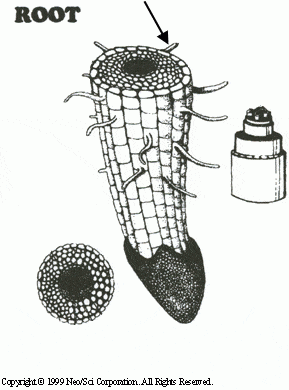
What is the name of the part of the root that allows water and minerals to enter?
a)
root hairs
b)
epidermis
c)
phloem
d)
phyla
13.
Which is NOT a function of roots?
a)
Take in water
b)
Take in nutrients
c)
Anchor plant to ground
d)
Make food
14.
Pores called __________ allow plants to exchange gases for respiration and photosynthesis. 
a)
stomata
b)
guard cells
c)
palisade mesophyll
d)
cuticles
15.
Transpiration is
a)
the movement of water through a plant from the roots up the stem
b)
the loss of water from the leaves of a plant by the process of evaporation
c)
the flow of water into plant roots by osmosis from the soil
d)
the process of minerals and sugars moving through plant veins
16.
What is the effect of increasing leaf area on transpiration?
a)
It increases transpiration rate
b)
It decreases transpiration rate
17.
What is the effect of increasing wind speed on transpiration?
a)
It increases transpiration rate
b)
It decreases transpiration rate
18.
What is the effect of increasing temperature on transpiration?
a)
It increases transpiration rate
b)
It decreases transpiration rate
19.
What is the effect of increasing light intensity on transpiration?
a)
It increases transpiration rate
b)
It decreases transpiration rate
20.

Which process are the xylem tubes part of?

a)

Translocation

b)

Transpiration

21.
Which factor had the greatest impact on the rate of transpiration compared to the control?
a)
wind
b)
humidity
c)
light 
d)
darkness
22.
A scientist is studying the effects of fertilizer on the rate of transpiration in tomato plants. Which of the following correctly describes the dependent variable for this experiment?
a)
time
b)
height of tomato plants
c)
amount of fertilizer
d)
rate of transpiration
23.
What part of the cell opens and closes the stomata?
a)
guard cells
b)
mitochondria
c)
chloroplast
d)
vacuole