wayground logo

Free Printable Worksheets

NEW

Font size

S
M
L
XL
Worksheets

PS Unit 3 Test Review

Total questions: 65

Worksheet time: 44mins

Name
Class
Date
1.

Subatomic particles with a negative charge

a)

Electrons

b)

Neutrons

c)

Protons

d)

Quarks

2.

Subatomic particles found on the outermost shell & responsible for the atom's reactivity

a)

neutrons

b)

valence electrons

c)

isotopes

d)

ions

3.
Subatomic particles with a positive charge
a)
neutrons
b)
atomic mass
c)
protons
d)
isotopes
4.
Value representing the number of protons in an element
a)
Atomic Mass
b)
Mass Number
c)
Valence Electrons
d)
Atomic Number
5.
Subatomic particles that are neutral in charge
a)
Neutrons
b)
Protons
c)
Nucleus 
d)
Electrons
6.
Atoms of the same element with a different number of neutrons
a)
Ion
b)
Gluons
c)
Isotope
d)
Quarks
7.
A charged atom
a)
Ion
b)
Isotope
c)
Electron Cloud
d)
Quark
8.
The smallest particle of an element that shows all the properties of that element.
a)
Subatomic Particles
b)
Atom
c)
Quarks
d)
Gluons
9.
Where electrons are likely to be found as they travel around the nucleus
a)
Nucleus
b)
Electron Cloud
c)
Within a Proton
d)
Within a Neutron
10.
A tiny but very dense, positively charged portion of the atom that holds most of the atomic mass
a)
Electron Shells
b)
Orbitals
c)
Electron Cloud
d)
Nucleus
11.
Arrangement of elements organized by atomic number
a)
Electron Cloud 
b)
Periodic Table 
c)
Electron Configuration
d)
None of these
12.
Calculation used to find the number of neutrons in an atom
a)
Atomic Mass - Atomic Number
b)
Atomic Number - Atomic Mass
c)
Atomic Mass - Electrons
d)
none of these
13.
The number in the upper corner of an element tile (7 for nitrogen) is called _____
a)
the proton number
b)
the atomic number
c)
the electron number
d)
the mass number
14.
For a given element, the atomic number indicates the number of _____
a)
protons in the nucleus
b)
neutron in the nucleus
c)
electrons in the atom
d)
nucleons in the atom
15.
How many Neutrons are in one atom of Lithium?
a)
6.941
b)
7
c)
3
d)
4
16.
How many Protons are in one atom of Lithium?
a)
3
b)
6
c)
7
d)
6.941
17.
How many Electrons are in one atom of Lithium?
a)
3
b)
6
c)
7
d)
6.941
18.
How many Protons+Neutrons are in one atom of Lithium?
a)
6.941
b)
7
c)
3
d)
6
19.
What is the name of this element?
a)
Lithium
b)
Boron
c)
Carbon
d)
Neon
20.
Identify this atom.
a)
Lithium
b)
Boron
c)
Carbon
d)
Neon
21.
How many valence electrons?
a)
2
b)
3
c)
5
d)
10
22.
What's a valence electron?
a)
electrons in the second energy level
b)
electrons in the outermost energy level
c)
the atomic number
d)
electrons in the first level
23.

The innermost energy level has a maximum of how many electrons?

a)

1

b)

2

c)

6

d)

8

24.
an element will always have the same number of 
a)
neutrons
b)
protons
c)
isotopes
d)
atoms
25.
How are electrons arranged in an atom?
a)
In groups of five
b)
In energy levels
c)
By color
d)
By shape
26.
In the modern periodic table elements are arranged by:
a)
atomic mass
b)
atomic number
c)
valence electrons
d)
number of isotopes
27.
Most of the mass of an atom is found it its _____.
a)
electron cloud
b)
nucleus
c)
atomic number
d)
empty space
28.
Each column in the periodic table is called a 
a)
period
b)
group
c)
cluster
d)
unit
29.
Elements which are shiny, conduct electricity and heat are called
a)
metal
b)
nonmetal
c)
metalloid
d)
nonexistent
30.
The atoms along the staircase are called 
a)
metals
b)
nonmetals
c)
metalloids
d)
noble gases
31.

The horizontal (side to side) rows in the Periodic Table are called

a)

groups

b)

families

c)

periods

d)

atomic numbers

32.

found in group one of the periodic table; highly reactive

a)

Non-metals

b)

Transition Metals

c)

alkali metals

d)

metalloids

33.
Atoms with similar properties are most likely located...
a)
in the same period.
b)
in the same group.
c)
in different periods.
d)
to the right and left of each other.
34.
Who first developed the Periodic Table?
a)
Mendeleev
b)
Mosely
c)
Mendella
d)
Murphy
35.

What is group name of the most reactive metals?

a)

Noble gases

b)

Halogens

c)

Alkali metals

d)

Alkaline earth metals

36.

Why are halogens so reactive?

a)

They want to get rid of their only valance electron

b)

They only need one more electron

c)

They are non reactive, they have a full shell

37.
How did Mendeleev arrange the elements?
a)
alphabetical 
b)
density
c)
melting point
d)
atomic mass
38.
A rule that states that repeating chemical and physical properties of elements change periodically with the atomic number of the elements is the _________.
a)
periodic law
b)
alkaline-earth metals
c)
actinide
d)
group rule
39.
All of the actinides are ___________.
a)
stable
b)
radioactive
c)
shiny
d)
named after scientists
40.
Most of the elements on the periodic table are classified as _____.
a)
Metals
b)
Nonmetals
c)
Metalloids
d)
Periods
41.
This class of elements are sometimes called "semiconductors."
a)
Metals
b)
Nonmetals
c)
Metalloids
d)
Groups
42.

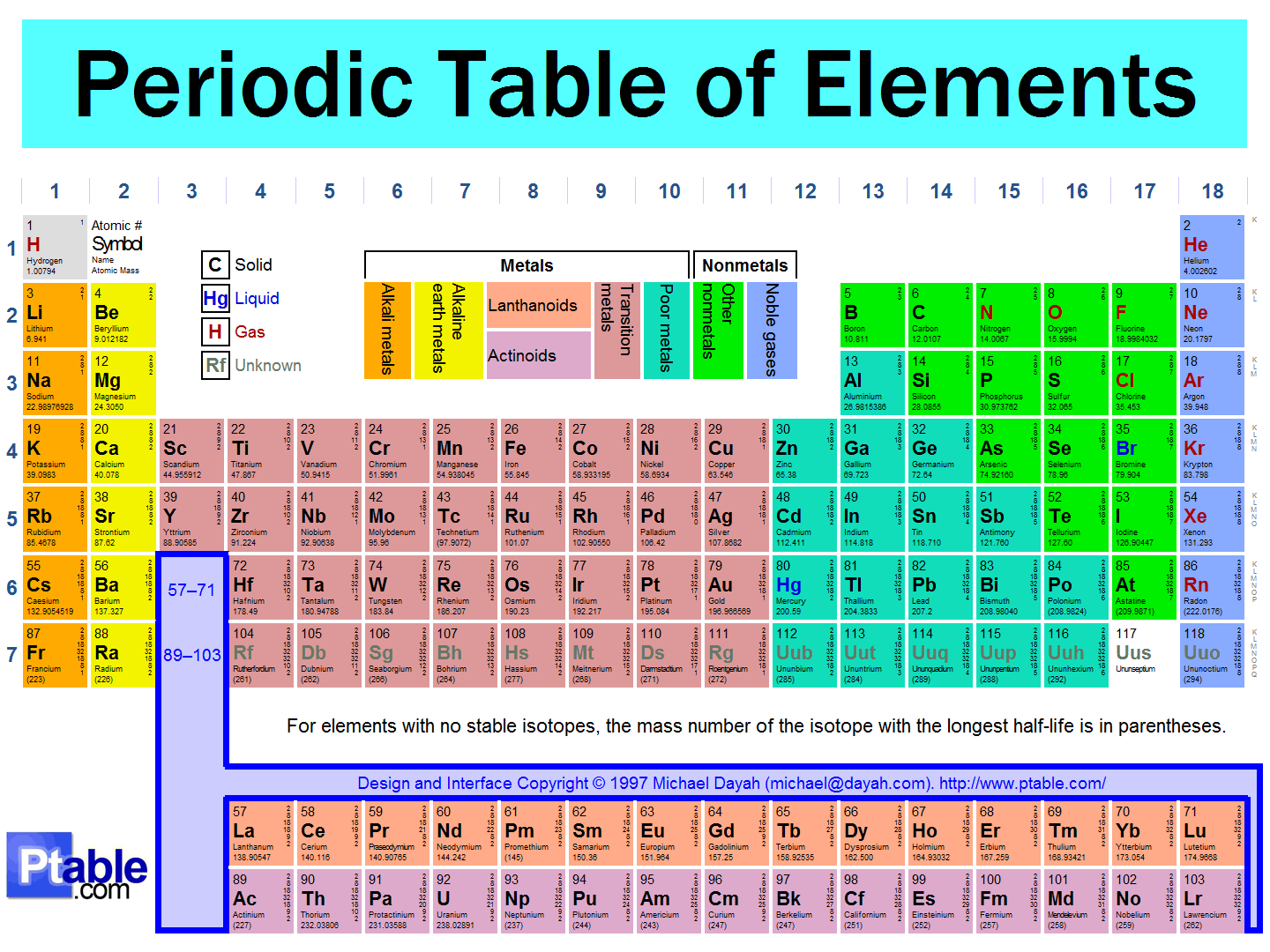
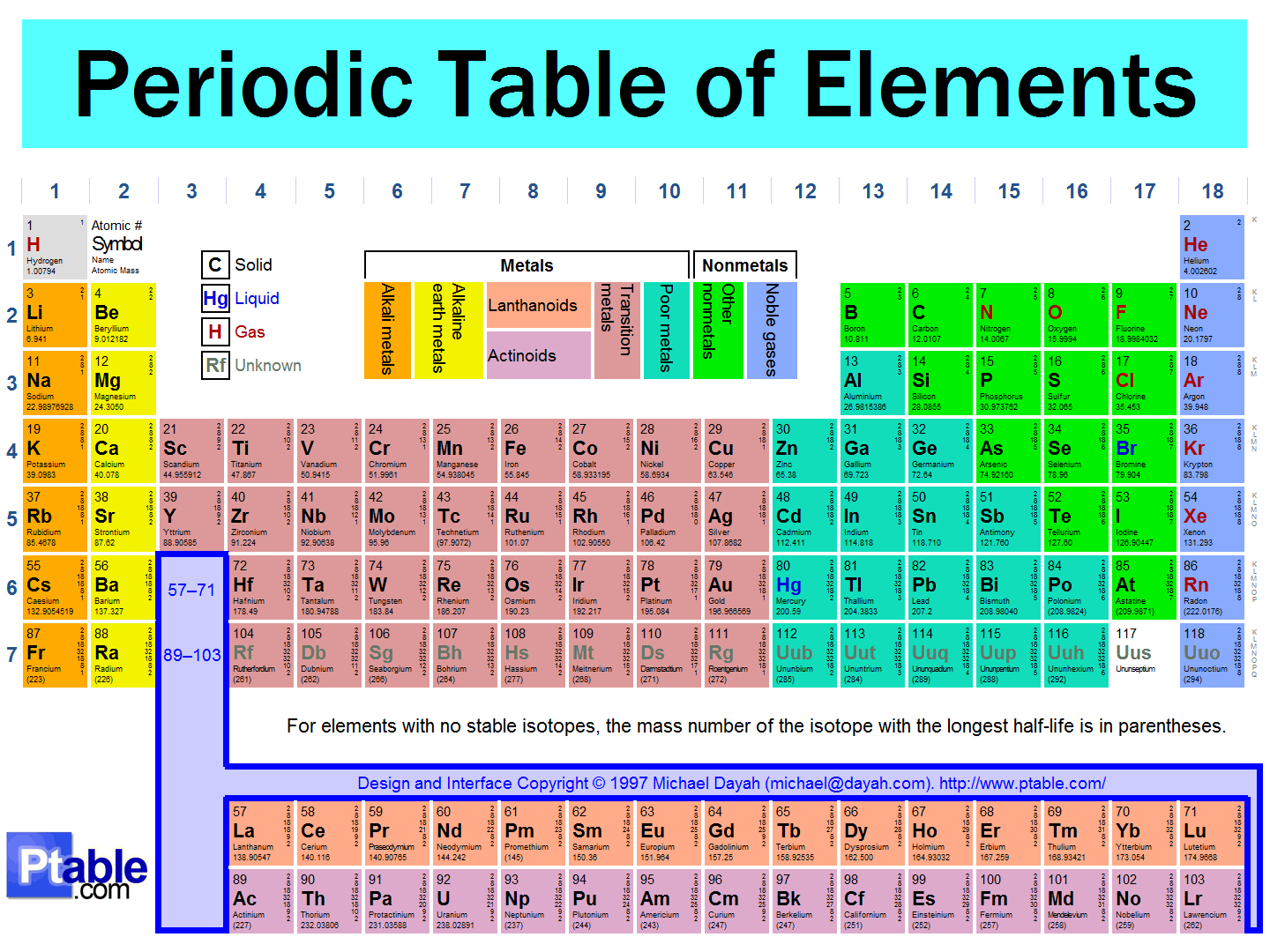
Which color on the image of the periodic table corresponds with the halogens.

a)

red

b)

black

c)

blue

d)

orange

43.

Which color on the image of the periodic table corresponds with the lanthanides.

a)

red

b)

black

c)

blue

d)

orange

44.

Which color on the image of the periodic table corresponds with the noble gases.

a)

red

b)

black

c)

blue

d)

orange

45.

Which color on the image of the periodic table corresponds with the transition metals.

a)

red

b)

black

c)

blue

d)

orange

46.

Which color on the image of the periodic table corresponds with the metalloids.

a)

bright yellow

b)

gold

c)

teal

d)

light blue

47.

Which color on the image of the periodic table corresponds with the alkaline earth metals.

a)

yellow

b)

dark yellow

c)

blue/green

d)

teal

48.

Most metals share four common physical characteristics. Which of the options is not one of the four?

a)

Luster

b)

Conductivity

c)

Ductility

d)

Malleability

e)

Reactivity

49.

Which family of elements does not combine with other elements unless under special conditions in a laboratory?

a)

Noble gases

b)

Halogens

c)

Metalloids

d)

Alkaline earth metals

e)

Actinides

50.

Places in the electron cloud where electrons are most likely to be.

a)

energy level

b)

orbital

c)

ring

d)

layer

51.

Protons must equal

a)

all of these

b)

mass number

c)

neutrons

d)

electrons

52.

What has the same mass as a proton?

a)

electron

b)

nucleus

c)

neutron

d)

quark

53.

Electrons behave like

a)

particles and waves

b)

energy and light

c)

wind and light

d)

energy and waves

54.

How do electrons move up in energy levels?

a)

absorbing energy

b)

losing energy

c)

gaining electrons

d)

losing electrons

55.

Which energy level has the least energy?

a)

farthest from the nucleus

b)

closest to the nucleus

c)

level 8

d)

the fullest level

56.

How many groups are on the periodic table?

a)

7

b)

10

c)

18

d)

22

57.

Groups are also called

a)

families

b)

rows

c)

periods

d)

classes

58.

When did scientists first start organizing elements?

a)

1600's

b)

1700's

c)

1800's

d)

1900's

59.

Why were their blanks of Mendeleev's table?

a)

for elements not discovered yet

b)

for things he did not know

c)

to allow for mistakes

60.

Hammering into sheets

a)

ductile

b)

malleable

c)

reactive

d)

conductive

61.

To draw into long thing shapes.

a)

ductile

b)

malleable

c)

reactive

d)

conductive

62.
Where are the nonmetals located on the periodic table?
a)
top left corner
b)
bottom left corner
c)
top right corner
d)
bottom left corner
63.

What group is Iron located in (alkali, halogen etc.)

a)

Transition Metals

b)

Semi-Metals

c)

Noble Gasses

d)

Alkaline Earth Metals

64.

Hydrogen is a:

a)

Alkali metal

b)

Metalloid

c)

Non-metal

d)

Noble gas

65.

The model of an atom that uses dots surrounding the atomic symbol to represent valence electrons is called the:

a)

Bohr Model

b)

Lewis Dot Structure

c)

Rutherford Model

d)

Thomson Model