Wayground logo

Free Printable Worksheets

Font size

S
M
L
XL
Worksheets

Lesson 3 Patterns of Circulation in the Ocean

Total questions: 33

Worksheet time: 35mins

Name
Class
Date
1.

The measure of the amount of dissolved salt in a given amount of water is called _____.

a)

solubility

b)

salinity

c)

density

d)

proximity

2.

When temperature decreases, the density of liquid water _________________.

a)

increases

b)

decreases

c)

stays the same

3.

The curving of moving objects from a straight path due to the Earth's rotation is called

a)

a continental deflection.

b)

the Coriolis effect.

c)

a pressurized deflection.

d)

a rotational deflection.

4.
Surface currents are a result of
a)
Global Wind Patterns
b)
Earth's Rotation
c)
Density
d)
All of the above
5.
Deep Ocean currents are a result of
a)
Global Wind Patterns
b)
Earth's Rotation
c)
Density
d)
All of the above
6.
As you go deeper in the ocean, the water is colder and less salty.
a)
True
b)
False
7.
Warm ocean currents generally come from
a)
The North Pole
b)
The South Pole
c)
The Equator
d)
Both A and B
8.
Cold ocean currents generally come from
a)
The North Pole 
b)
The South Pole
c)
The Equator
d)
Both A and B
9.
Two types of water currents are
a)
local and global
b)
sea and land
c)
surface and deep
d)
warm and cold
10.
The Coriolis Effect is caused by
a)
Earth rotating around the sun
b)
Earth rotating on its axis
c)
The tides
d)
Gravity
11.
What happens to a current when it comes in contact with a continent or landmass?
a)
It continues over the continent
b)
It stops
c)
It changes direction
d)
It is absorbed by the land
12.

A scientist wants to track contaminant movement in the Gulf Stream. The Gulf Stream is a warm water current in the North Atlantic Ocean and is part of the North Atlantic gyre. The gyre is influenced by the Coriolis effect. To follow the contaminant after it exits the Gulf Stream, the scientist needs to know characteristics of the North Atlantic gyre. Which of these best describes a movement of the North Atlantic gyre the scientist needs to know?

a)

linear movement due south

b)

linear movement due west

c)

counterclockwise movement

d)

clockwise movement

e)

No water movement

13.

Which factors affect global ocean currents?

a)

temperature, glacial ice melt, salinity

b)

Density, buoyancy, sediment

c)

Waves, temperature, wind

14.

______ causes deep ocean currents

a)

The Coriolis Effect

b)

gravity

c)

wind

d)

density differences

15.

The __________ is a surface current that flows along the eastern US and brings warm water to Europe.

a)

California Current

b)

Gulf Current

c)

North American Gyre

d)

Arctic Current

16.
Due to the Coriolis Effect, water in the northern hemisphere moves
a)
clockwise
b)
counter clockwise
c)
both
d)
neither
17.

The weather phenomenon that occurs every 2-7 years and brings warmer temps and moisture to the USA

a)

El Nino

b)

La Nina

c)

Gyre

d)

Hurricane

18.
What is the major cause of surface currents?
a)
dolphins
b)
wind
c)
hurricanes
d)
tides
19.
Why does cold water sink in a convection current?
a)
Less dense
b)
more dense
c)
Less humid
d)
More humid
20.
Why does heat rise in a convection current?
a)
less dense
b)
more dense
c)
more humid
d)
less humid
21.
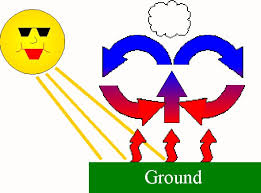
Is the picture representing a land breeze or sea breeze?
a)
Land breeze
b)
Sea breeze
22.
Air moves from _______ pressure to _______ pressure.
a)
Low, High
b)
High, Low
c)
Warm, Cold
d)
Cold, Warm
23.
Water in the ocean is always
a)
Moving
b)
Still
c)
Warming up
d)
Cooling down
24.
What causes wind to blow?
a)
Animal movement
b)
Similar air temperatures
c)
A giant blowing out candles
d)
Differences in air temperature
25.

Two types of ocean currents are

a)

local and global

b)

sea and land

c)

surface and deep

d)

warm and cold

26.

Temperature and salinity differences in ocean water cause:

a)

Mid-ocean ridges

b)

Deep Currents

c)

Surface Currents

d)

High tide and low tide

27.
As salinity  increases
a)
Density increases
b)
Density decreases
28.
The warm, strong current off the coast of Florida is the 
a)
Gulf Stream
b)
California Current
c)
North Equatorial Current
d)
Brazil Current
29.
Currents release heat energy and this can affect an area's
a)
Oxygen
b)
Climate
c)
Upwelling
d)
Sunlight
30.
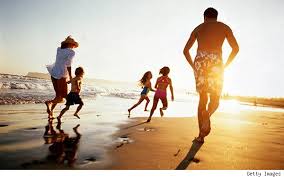
The sun shines down on this family as the play on the beach.
a)
conduction
b)
convection
c)
radiation
31.
Walking on the warm sand sand with your bare feet.
a)
conduction
b)
convection
c)
radiation
32.
Warm air rises and the cool air sinks.
a)
conduction
b)
convection
c)
radiation
33.
In this experiment, the WARM red dye and the COLD blue dye was placed in the water at the same time. The warm red dye rose to the top while the cold blue dye sank to the bottom.
a)
conduction
b)
convection
c)
radiation