wayground logo

Free Printable Worksheets

NEW

Font size

S
M
L
XL
Worksheets

Unit 7 Biodiversity Review

Total questions: 40

Worksheet time: 1hrs 7mins

Name
Class
Date
1.
Which catastrophic event will most likely have the effect of returning an ecosystem to primary succession?
a)
A tornado
b)
A volcanic eruption
c)
A flood
d)
A drought
2.
Natural disasters such as flooding and tornadoes are linked to ________________.
a)
primary
b)
secondary
c)
old field
d)
ecosystem
3.
What type of succession is shown going from figure A to figure B?
a)
primary succession
b)
eutrophication
c)
secondary succession
d)
intermediate
4.
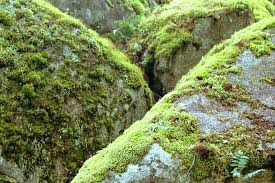
The picture shows what type of succession?
a)
primary
b)
secondary
c)
tertiary
d)
quadanary
5.
After a forest fire, an ecosystem would start regrowth through -
a)
primary succession
b)
secondary succession
c)
climax community
d)
limiting factors
6.
What is formed during primary succession that doesn't need to be formed during secondary succession?
a)
pioneer species
b)
soil
c)
climax community
d)
lichens
7.

What are examples of pioneer species in a primary succession?

a)

Bushes and Shrubs

b)

Oak trees

c)

Mossess and Lichens

d)

A rose Bush

8.
How do lichens contribute to primary succession?
a)
Lichens decompose organic matter from animals and plants
b)
Lichens begin to break down rock to form soil
c)
Lichens are nitrogen fixing bacteria
d)
Lichens convert carbohydrates into fossil fuels.
9.

After a volcanic eruption, lava covers the land. What is the order that plants grow to repopulate the area?

a)

Lichens → Shrubs → Grasses → Trees

b)

Lichens → tree → shrubs→Grasses

c)

Grasses → Lichens → Shrubs → Trees

d)

Lichens → Grasses → Shrubs → Trees

10.

Which of these is an example of a climax community?

a)
b)
c)
d)
11.
Biodiversity refers to
a)
extinct species
b)
the variety of species on Earth
c)
nonrenewable resources
d)
the rate of species decline
12.
Sustainability refers to
a)
how many species are present in an ecosystem
b)
when a species goes extinct
c)
how long a species lives
d)
the ability to maintain ecological process over long periods of time.
13.
The higher the biodiversity, the more sustainable an ecosystem is.
a)
True
b)
False
14.
Humans are not affected by the biodiversity of ecosystems.
a)
True
b)
False
15.

What two factors would make biodiversity increase?

a)

Tornadoes and hurricanes

b)

Large amount of producers and water

c)

More predators and competition

d)

The water cycle and ocean warming

16.

What is true about sustainability?

a)

Having a small number of species increases biodiversity

b)

Sustainability is how organisms change over time

c)

Sustainability is how much rainfall and sunlight an ecosystem receives

d)

The more different types of species you have (biodiversity) the better an ecosystem can sustain itself

17.
Which biome has a climate that is extremely cold and dry?
a)
forest
b)
tundra
c)
grassland
d)
freshwater
18.
Which biome usually contains orchids, ferns, and other plants that live on the branches of trees?
a)
tundra
b)
temperate deciduous rainforest
c)
rainforest
d)
marine
19.
The freshwater biome includes all of the following EXCEPT
a)
lakes
b)
ponds
c)
oceans
d)
streams
20.
The greatest variety of species of living organisms is found in a(an)
a)
rainforest 
b)
taiga
c)
desert
d)
freshwater
21.
The ocean ecosystem has a high sustainability because of -
a)
strong, persistent currents
b)
predator/prey relationships
c)
green plants growing on the bottom
d)
the large variety of different organisms
22.
An abandoned garden has been cleared of all vegetation and only a layer of nutrient-poor soil remains. Which of the following will most likely be observed in the garden area first?
a)
Squirrels building nests in trees
b)
Weeds sprouting out of the soil
c)
Butterflies competing for flower nectar
d)
Beetles feeding on leaves of shrubs
23.
In which biome would you find animals with adaptations for a climate with very little precipitation?
a)
Rainforest
b)
Taiga
c)
Tundra
d)
Desert
24.
Biotic includes living and formerly living things. 
a)
True
b)
False
25.
Temperature, light, air, water, soil, and climate are all __________ parts of the environment.
a)
biotic
b)
abiotic
c)
living
d)
biome
26.

The ______________ biome has 4 distinct seasons; it is also where we live.

a)

taiga

b)

deciduous forest

c)

rainforest

d)

dessert

27.

Which of the following would cause biodiversity to DECREASE?

a)

Water

b)

Forest Fires

c)

Sunlight

d)

Producers

28.

What is false about biodiversity

a)

More biodiversity makes it least likely for a species to survive a disturbance such as a Tsunami

b)

More biodiversity allows species to survive a disturbance such as a hurricane

c)

As biodiversity increases sustainability increases

d)

Genetic biodiversity is what makes us look and act different

29.

When biodiversity increases

a)

Sustainability decreases

b)

Sustainability remains the same

c)

Sustainability also increases

d)

Sustainability becomes greater by 2

30.

When biodiversity decreases

a)

Sustainability also decreases

b)

Sustainability remains the same

c)

Sustainability increases

d)

Sustainability is not impacted

31.
What is the purpose of a dichotomous key?
a)
to find a common ancestor
b)
to show the evolution of organisms
c)
to show relationships between organisms
d)
to identify organisms
32.
What step do we always start with when using dichotomous keys?
a)
1
b)
2
c)
3
d)
4
33.
When using a dichotomous key to identify organisms, what do we look at?
a)
physical features
b)
weather patterns
c)
environment
d)
diet
34.
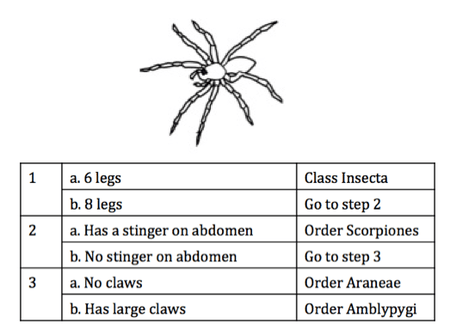
An illustration and a dichotomous key are given. What is the correct classification for this organism?
a)
Class Insecta
b)
Order Amblygygi
c)
Order Araneae
d)
Order Scorpiones
35.
A table of arachnid and insect characteristics is shown. Which characteristic could be used to distinguish between
arachnids and insects?
a)
Jointed legs
b)
Body segments
c)
Presence of eyes
d)
Presence of antennae
36.
A dichotomous key for trees is provided. Hikers found a tree that has large brown cones and single sharp needles. What species of tree have the hikers found?
a)
Juniper
b)
Pine
c)
Spruce
d)
Fir
37.
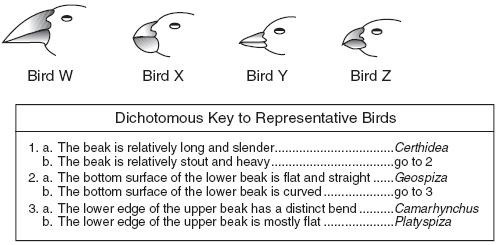
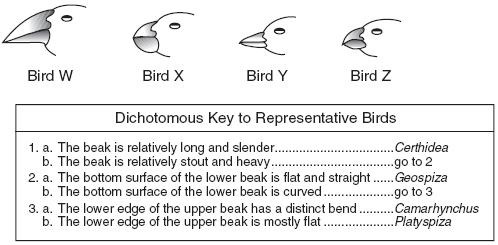
What is the name of bird W?
a)
Certhidea
b)
Geospiza
c)
Camarhynchus
d)
Platyspiza
38.
What is the name of bird Z?
a)
Certhidea
b)
Geospiza
c)
Camarhynchus
d)
Platyspiza
39.

Which shark is the picture of?

a)

Cow Shark

b)

Great White Shark

c)

Hammerhead Shark

d)

Saw Shark

40.

What species of tree is the fruit from?

a)

Fraxinus americana

b)

Franinux negundo

c)

Acer platanoides

d)

Acer negundo