
 Worksheets
Physical Optics
Total questions: 30
Worksheet time: 27mins
To demonstrate the phenomenon of interference, we require two sources
Of the same frequency and having a constant phase difference
Of nearly the same frequency
Of the same frequency
Of different wavelengths
For Young's double slit experiment, the fifth dark fringe is equivalent to:
m=4 maximum
m=5 maximum
m=4 minimum
m=5 minimum
'Every points on the wave front of light are the sources of smaller waves called wavelets.' This is the statement of
Yusnizi
Planck
Huygen
Young
Which diagram best represents the shape and direction of a series of wave fronts after they have passed through a small opening in a barrier?
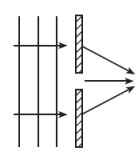
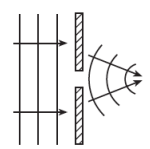
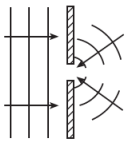
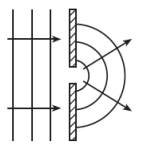

What type of interference is represented in this diagram?
Constructive
Destructive

What type of interference is represented in the diagram?
Constructive
Destructive
Which of the following will decrease the spacing of Young's double slit fringes
decreasing the wavelength of the waves
moving the screen further away
decreasing the distance between the slits
Using narrower slits
It is shone through a double slit spacing 0.2mm onto a screen 2m away.
The fringe spacing is?
Two light sources are said to be coherent if they
are of the same frequency.
are of the same frequency, and maintain a constant phase difference.
are of the same amplitude, and maintain a constant phase difference.
are of the same frequency and amplitude.
In Young's Double slit experiment, two adjacent bright fringes are 0.5 cm apart. The distance between two dark fringes ______.
is less than 0.5 cm
is greater than 0.5 cm
is exactly 0.5 cm
is dependent on which order is observed.
What does one observe on the screen in a Young's experiment if white light illuminates the double slit instead of light of a single wavelength?
A white central fringe and no other fringes
A dark central fringe and a series of alternating white and dark fringes on each side of the center
A white central fringe and a series of colored and dark fringes on each side of the center
A continuous band of colors with no dark fringes anywhere
Which one is true about destructive interference:
Produce bright fringes
Produce dark fringes
Produce a single wave of greater amplitude (add together)
Have a one full wavelength path difference


The top bright fringe order is?
Fourth order minimum
Third order minimum
Fourth order maximum
Third order maximum
If the distance of the slit separation is doubled, the fringe width is:
halved
doubled
no change
If the space between the double slit and the screen is then filled with water, what happen to the interference pattern?
fringes remain unchange
fringes disappear
fringe increases
fringes decrease
Which of the following statements is untrue when applied to Young's double slit pattern
The fringes are equally spaced
A bright fringe occurs when the waves arrive in phase
The sources must be coherent
The centre fringe is the brightest
To demonstrate the phenomenon of interference, we require two sources
Of the same frequency and having a constant phase difference
Of nearly the same frequency
Of the same frequency
Of different wavelengths
diffraction is waves bending because of
edges of a slit or thin object
speed of wave changes
dark matter
gravity
A yellow light of wavelength 500 nm is shone through a diffraction grating with 400 lines/mm. At what angle to the straight through direction is the 2nd order fringe in degrees?
12
24
53
There is no 2nd order
A red light of wavelength 650 nm is used with a diffraction grating with 500 lines per mm. Determine the maximum diffraction maxima seen on the screen.
1
3
5
7
The nature of the wavefront for a point source of light is _____
Spherical wanefront
Plane wavefront
The characteristics of wave which does not change after refraction is
Wavelength
Velocity
Frequency
For Young's double slit interference distance of nth dark fringe from the center of the screen is
dnλD
Dnλd
(n+21) dλD
(n+21) Dλd
For diffraction at a single Slit, the angular position for nth minimum is
θ=nλ
θ= anλ
θ= (n+21)aλ
θ= λna

