Wayground logo

Free Printable Worksheets

Font size

S
M
L
XL
Worksheets

Astronomy: Chapter 1

Total questions: 86

Worksheet time: 1hrs 26mins

Name
Class
Date
1.
When we watch the nighttime sky, we find that
a)
the stars and constellations remain fixed in our sky, not rising or setting in a time as short as one night because they are so far away.
b)
most stars and constellations slowly rise in the east and set in the west.
c)
most stars and constellations slowly rise in the west and set in the east.
d)
all stars and constellations reach their highest point in the sky at midnight.
2.
What is the phase of the Moon during a total lunar eclipse?
a)
New
b)
Full
c)
Gibbous
d)
First quarter
3.
The nightly motion of objects across our sky from horizon to horizon is caused by
a)
the motion of the solar system around the Galaxy.
b)
the revolution of the Earth around the Sun.
c)
the rotation of the whole celestial sphere of stars around the fixed Earth.
d)
the rotation of the Earth on its axis.
4.
A person standing in the Moon's penumbra will see
a)
a total lunar eclipse.
b)
a partial lunar eclipse.
c)
a total solar eclipse.
d)
a partial solar eclipse.
5.
How does the Moon rotate in order to keep one face pointed toward the Earth at all times?
a)
It rotates once per year.
b)
It rotates once per month.
c)
It does not rotate at all.
d)
It rotates once per day.
6.
Are the constellations seasonal?
a)
No, if you wait long enough, you can see all of the constellations on any clear night of the year.
b)
Yes, on a summer night all the constellations you can see are different from those you can see on a winter night.
c)
Yes, on a summer night many of the constellations you can see are different from those you can see on a winter night. But there are some constellations you can see all year long.
d)
Yes. As the year progresses, the constellations change their positions with respect to each other. So every night brings a different mixtue of summer and winter constellations.
7.
About how many days does it take to moon to go through a complete cycle?
a)
7 days
b)
365 days
c)
29 days
d)
20 days
8.
When the visible (lit) portion of the moon is increasing, the moon is:
a)
waning
b)
full
c)
waxing
d)
new
9.
Changes in the moon's appearance are
a)
phases
b)
eclipses
c)
stages
d)
cycle
10.
Why do we always see the same side of the moon from Earth?
a)
because the phases change
b)
because it rotates and revolves at the same rate
c)
because half of the moon always receives sunlight
d)
The moon changes positions
11.
Mrs. Smith says "the moon looks larger than the stars!" What explains this?
a)
The moons soaks up the star's light
b)
The moon is larger than Earth
c)
The moon is larger than stars
d)
the moon is closer to Earth than stars
12.
Define Full Moon
a)
None of moon is visible
b)
Half moon phase is visible
c)
Complete moon face is visible
d)
Less Than half of moon is visible
13.
Define New Moon
a)
None of moon is visible from Earth
b)
All of moon visible from Earth
c)
Moon is 1/2 visible from Earth
d)
Moon is more than Half Visible from Earth
14.
Name the moon phase
a)
Waxing Gibbous
b)
Waxing Crescent
c)
Waning Crescent
d)
Waning Gibbous
15.
Differences in the moon's and sun's pull on different sides of the Earth cause _________.
a)
gravity
b)
lunar phases
c)
tides
d)
dabbing
16.
The bulge of water on the side of the Earth closest to the moon produces ___________.
a)
high tide
b)
low tide
c)
neap tide
d)
spring tide
17.
Tides are the cycle of rising and falling ocean water that repeats automatically every
a)
24 hours
b)
12.5 hours
c)
25 hours
d)
6.25 hours
18.
A neap tide is a tide with the greatest difference between low and high tides
a)
true
b)
false
19.
Neap tides occur once a month. 
a)
True
b)
False
20.
Tides are caused mainly by the differences in how much gravity from the moon and the sun pulls on different parts of the Earth. 
a)
True
b)
False
21.
What is the phase of the Moon during a total lunar eclipse?
a)
New
b)
Full
c)
Gibbous
d)
First quarter
22.
The tilt angle of the Earth's spin axis to the direction perpendicular to the ecliptic (known as the ecliptic pole)
a)
is 90 degrees and fixed.
b)
varies rapidly through the year from 23.5 degrees to -23.5 degrees.
c)
is 23.5 degrees and fixed.
d)
is 0 degrees and fixed because this defines the ecliptic plane.
23.
Which of the following is not true about a total solar eclipse?
a)
It can be viewed once a year from every spot on earth
b)
It is dangerous to look at without the proper device
c)
When it happens, the moon blocks all of the sun except the corona
d)
You must be within the moon's umbra to see it
24.
a)
solar eclipse
b)
lunar eclipse
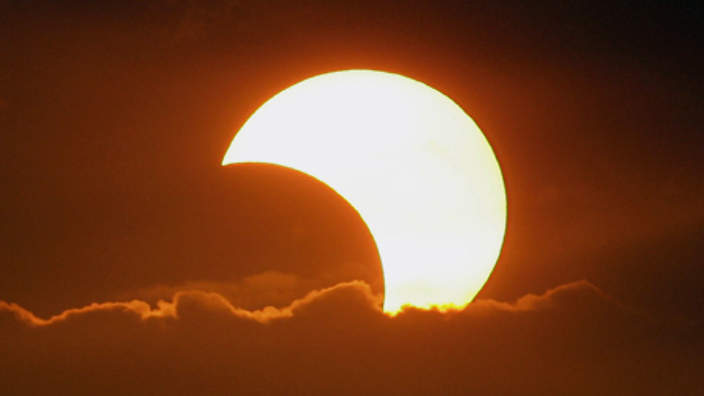
25.
This image is an example of
a)
Lunar Eclipse
b)
Full Moon
c)
New Moon
d)
Solar Eclipse
26.
In order to have an eclipse, the Moon, Sun and Earth have to be?
a)
Below each other
b)
Above each other
c)
In alignment
27.
What is the darkest inner part of the shadow cone called, where a total eclipse can be viewed.
a)
Total
b)
Umbra
c)
Penumbra
28.
a)
solar eclipse
b)
lunar eclipse
29.
True or False: You must wear your eclipse goggles at all times except during totality due to safety reasons.
a)
True
b)
False
30.
What is the order during a lunar eclipse
a)
sun, moon, earth
b)
sun, earth, moon
31.
Why do globes lean sideways?
a)
To allow them to spin easier.
b)
To demonstrate the tilt of Earth's axis.
c)
To demonstrate the effects of gravity.
d)
To demonstrate day and night.
32.
What causes the seasons to change?
a)
The warming and cooling of Earth's core.
b)
The distance from the sun.
c)
Earth's tilt in relation to the sun.
d)
Earth's rotation on its axis.
33.
What causes the seasons to change?
a)
The warming and cooling of Earth's core.
b)
The distance from the sun.
c)
Earth's tilt in relation to the sun.
d)
Earth's rotation on its axis.
34.
What happens when the area in which you live tilts away from the sun?
a)
It is summer.
b)
It is spring.
c)
It is winter.
d)
It is fall.
35.
Why does the area around the equator stay the same temperature all year?
a)
The equator rotates slower than the poles.
b)
The equator remains the same distance from the sun.
c)
The equator always receives direct sunlight.
d)
The equator has 18 hour days.
36.
One rotation of Earth is equal to
a)
a day.
b)
a year.
37.
What is Earth's annual motion around the sun called?
a)
Rotation
b)
Revolution
38.
How long does Earth take to make a complete rotation?
a)
365 days
b)
24 hours
39.
If Earth rotated slower, we would have...
a)
shorter days.
b)
longer days.
c)
shorter years.
d)
longer years.
40.
What would seasons be like if Earth's axis were straight up and down?
a)
Seasons would be the same.
b)
Seasons would be more extreme.
c)
There would be no seasons.
41.
Which movement of Earth causes day and night?
a)
rotation
b)
revolution
42.
A[n] ______________ tide occurs when the sun is at right angles to the line between Earth and the moon. 
a)
high
b)
neap
c)
low
d)
spring
43.
Differences in the moon's and sun's pull on different sides of the Earth cause _________.
a)
gravity
b)
lunar phases
c)
tides
d)
dabbing
44.
A[n] ___________ tide occurs when the sun, Earth, and the moon are nearly in a line. 
a)
spring
b)
high
c)
low
d)
neap
45.
Tides are the cycle of rising and falling ocean water that repeats automatically every
a)
24 hours
b)
12.5 hours
c)
25 hours
d)
6.25 hours
46.
A neap tide is a tide with the greatest difference between low and high tides
a)
true
b)
false
47.

Wha type of tide would this arrangement of earth-moon-sun create?

a)

full moon tide

b)

new moon tide

c)

neap tide

d)

spring tide

48.
What type of tides would this arrangement of earth-moon-sun create?
a)
neap tide
b)
spring tide
c)
new moon tide
d)
full moon tide
49.

What is the study of the moon, stars, and other objects in space?

a)

Science

b)

Astronomy

c)

Physics

d)

Lunar Studies

50.

Around March 21 & September 23, the earth experiences a/an...

a)

Equinox

b)

Solstice

51.

The spinning of the earth on its axis is called...

a)

Revolution

b)

Rotation

c)

Orbit

52.

What is another word for "shapes of the moon?"

a)

Waxing

b)

Waning

c)

Phases

d)

Full Moon

53.

Around December 21 and June 21, the earth experiences a...

a)

Solstice

b)

Equinox

54.

What is it called when one object is moving around another?

a)

Rotation

b)

Orbit

c)

Revolution

55.

What are the round pits on the moon called?

a)

Craters

b)

Holes

c)

Mountains

56.

What are the three features on the moon Galileo Galilei discovered using his telescope? (Select all that apply.)

a)

Highlands

b)

Marias

c)

Meteoroids

d)

Craters

57.

What is the imaginary line that passes through North & South poles?

a)

Latitude

b)

Longitude

c)

Axis

d)

Equator

58.

A shadow on another object that normally gets the sun's light is called an...

a)

Eclipse

b)

Umbra

c)

Equinox

d)

Orbit

59.

People in the ____________ only experience a partial eclipse.

a)

Umbra

b)

Penumbra

60.

What are the dark, flat areas of the moon called?

a)

Maria

b)

Highlands

c)

Craters

61.

The path in which the earth revolves around the sun is called its...

a)

Revolution

b)

Rotation

c)

Orbit

d)

Solar System

62.

The measurement of the distance from the equator is called_____________ and is measured in degrees North & South.

a)

Longitude

b)

Equator Line

c)

Latitude

d)

Axis

63.

Who was John F. Kennedy?

a)

An important mayor

b)

The man who navigated the first trip to the moon

c)

The man who inspired people about space

d)

The president who inspired the first mission to the moon

64.

Who was the first person to step foot on the moon?

a)

Buzz Aldrin

b)

Neil Armstrong

65.

Which is NOT a phase of the moon?

a)

Third Quarter

b)

New Moon

c)

Full Moon

d)

Oreo Cookie

66.

In a waxing moon, you can see more of the lit side. True or False?

a)

True

b)

False

67.

One month equals one revolution of the earth around the sun. True or False?

a)

True

b)

False

68.

Which is NOT a name for one of our seasons?

a)

Summer Solstice

b)

Autumnal Equinox

c)

Winder Equinox

d)

Vernal Equinox

69.

The seasons on the northern hemisphere are opposite of the seasons on the southern hemisphere. True or False?

a)

True

b)

False

70.

The same side of the moon does not always face earth. True or False?

a)

True

b)

False

71.

In what year did humans first land on the moon?

a)

1972

b)

1968

c)

1969

d)

1956

72.

What is the rise and fall of water on earth due to earth's gravity?

a)

Waterfalls

b)

Tides

c)

Oceans

d)

Moonquakes

73.

The collision-ring theory seems best to describe how

a)

craters were formed

b)

highlands were formed

c)

the moon was formed

d)

maria were formed

74.

At 3,476 kilometers, the moon's diameter is slightly less than the distance across

a)

Texas

b)

France

c)

Russia

d)

the United States

75.

Craters were caused by the impact of

a)

meteoroids

b)

meteors

c)

meters

d)

meteorites

76.

The moon is ______________ and airless, and has an irregular surface.

a)

humid

b)

dry

c)

wet

d)

saturated

77.

Maria have relatively __________________________ craters

a)

large numbers of

b)

mostly

c)

few

d)

no

78.

The highlands cover ______________ of the moon's surface.

a)

most

b)

none

c)

little

d)

all

79.

The moon has ________ liquid water.

a)

60%

b)

100%

c)

some

d)

no

80.

The moon has a(n) _______________________ surface.

a)

irregular

b)

smooth

c)

liquid

d)

slimy

81.

The moon is smaller and ___________________ than Earth.

a)

more dense

b)

less dense

c)

has more weight

d)

faster

82.

Who was the first person to show details on the moon's surface?

a)

Copernicus

b)

Brahe

c)

Ptolemy

d)

Galileo

83.

How is the moon warmed?

a)

from the Earth's energy

b)

from the energy in sunlight

c)

from spinning so fast

d)

from bonfires the martians are setting

84.

Why do temperatures on the moon vary so much more than on Earth?

a)

The moon has a dark side we never see.

b)

The moon rotates too slowly to have a consistent temperature.

c)

The moon has no atmosphere.

d)

The moon has no gravity.

85.

The diameter of Earth is _____ times as great as the diameter of the moon.

a)

4

b)

5

c)

8

d)

10

86.

The mass of the moon is ___________________ as the mass of Earth.

a)

one hundredth

b)

one twentieth

c)

one fifth

d)

one eightieth