
Font size
 Worksheets
Unit 7: Plate Tectonics
Total questions: 44
Worksheet time: 3hrs 56mins


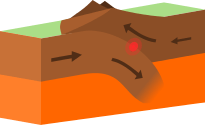
Which of the following is the name of the ancient supercontinent formed 280 Million Years ago.
Pangea
Gondwanda
Laurasia
Neverland
Which piece(s) of evidence did Wegener use to try and prove the theory of continental drift?
The shape of the continents
Similar fossils found on separate continents
Tree fossils found in odd places
All of the above
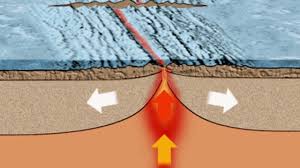
In sea-floor spreading, molten material rises from the mantle and erupts
along the edges of all the continents.
along mid-ocean ridges.
in deep-ocean trenches.
at the north and south poles.

Most geologists think that the movement of Earth’s plates is caused by _______
convection.
continental drift.
subduction.
conduction.
The geological theory of _______ states that pieces of Earth’s lithosphere are in constant, slow motion.
subduction
plate tectonics
deep-ocean trenches
sea-floor spreading

The place where two plates come together is known as a _______
transform boundary.
divergent boundary.
convergent boundary.
rift valley.

Below is a picture of sea-floor spreading. How are the ocean crusts moving?
Converging
Diverging
Sliding
No movement
How is it possible for new crust to be formed without increasing the surface area of the Earth?

When Wegener found that the fossils of the same types of plants and animals were found on continents separated by oceans in made him thing that
plants & animals could cross large oceans.
they were put their by wizards.
the land was all joined together in the past.
Only the fossils of animals that could swim were found on continents separated by large oceans.
True
False
What do we call the moving of large pieces of rock across Earth's surface?
plate traffic
plate erosion
plate tectonics
plate bumpers
What is the process of magma pushing up through a mid-ocean ridge, forming new crust, and pushing continents apart called?
seafloor spreading
seafloor growing
volcanic volleyball

TRUE or FALSE
North America and Europe are moving closer together.
TRUE
FALSE
Ocean crust is made of _______ and is _______ dense than continental crust.
basalt, less
basalt, more
granite, less
granite, more
Most tectonic plates have both oceanic and continental crust. How are they different?
Oceanic is thinner and less dense than continental.
Continental is thinner than more dense than oceanic.
Continental is thicker and less dense than oceanic.
Oceanic is thicker and more dense than continental.

The theory that pieces of Earth’s lithosphere are in constant motion.
Theory of Gravity
Theory of Continental Drift
Theory of Plate Tectonics

Rift valleys are caused at this type of plate boundary.
Divergent Boundary
Transform Boundary
Convergent (Collision) Boundary
Convergent (Subduction) Boundary

Earthquakes can be caused by only 1 type of plate boundary.
True
False
The Himalayas were created along a _______________ convergent boundary.
continent-continent
ocean-continent
ocean-ocean
ocean-mountain
The place where tectonic plates meet are called
mid-ocean trenches
volcanoes
earthquakes
boundaries
All of the following occur along tectonic plate boundaries EXCEPT
earthquakes
volcanoes
mid-ocean ridges
hurricanes
The features that form at a plate boundary depend on
the temperature of the plate
what kind of plate boundary it is
the continent the plate is closest to
the depth of the ocean above that plate
In a divergent boundary, plates pull away from each other. This allows cracks to form in the lithosphere. Melted rock can rise through these cracks. When the melted rock cools and hardens, it
becomes new lithosphere.
becomes a mountain range.
sinks back into the mantle.
freezes.
Which of the following is NOT a type of convergent boundary?
Continent-Continent Boundary
Continent-Ocean Boundary
Ocean-Ocean Boundary
Ocean-Mountain Boundary
Dense oceanic lithosphere sinks underneath the continental lithosphere in a process called
convection
conduction
subduction
radiation
Subduction can cause a chain of volcanic mountains to form along a plate boundary. An example of this is
the Himalayas
the Andes
the Appalachian Mountains
Mt. Everest
A transform boundary forms where plates slide past each other __________.
vertically
horizontally
in a diagonal direction
rapidly
During subduction, oceanic lithosphere at the edge of a plate _________.
sinks, pulling the rest of the plate along with it.
floats, causing the mantle beneath it to turn into new lithosphere.
moves closer to the north or south pole, depending upon its magnetic properties.
changes from a solid to a liquid.

What new technology enables scientists to track tectonic plate movement?
the new Iphone
a new smartwatch
GPS tracking
the new rover going to Mars called Perserverance

Letter B in the diagram shows a subduction zone. Why is the oceanic crust subducted?
it is less dense
it is more dense
it is heavier because the ocean is pushing it down
none of the above

When tectonic plates move away from each other, what type of land form will be created?
islands
mid ocean ridges
ocean trenches
all of the above

When a continental plate collides with another continental plate what type of land form will be created?
mid ocean ridges
mountain ranges
islands
deep see trenches

When oceanic plate and continental plate collide, what type of land forms will be created?
mid ocean ridges
ocean trenches
islands
volcanic mountains

What evidence did Alfred Wegener use to prove the Theory of Continental Drift?
he used the moon's rotation and revolution as evidence
he looked at the clouds and noticed continental drift
he looked at the fossils, land forms and how continents fit together like puzzle pieces
he studied the weather patterns for Africa and South America

The German meteorologist who came up with the continental drift theory is?
Albert Einstein
Marie Currie
Alfred Wegener
Isaac Newton
Which picture below represents a convection current?
GPS



