Wayground logo

Free Printable Worksheets

Font size

S
M
L
XL
Worksheets

Optics Basics

Total questions: 36

Worksheet time: 18mins

Name
Class
Date
1.

refraction is waves bending because of

a)

edges of a slit or thin object

b)

speed of wave changes

c)

dark matter

d)

gravity

2.

which type of lens

a)

opaque

b)

convex

c)

concave

d)

plano

3.

which type of lens

a)

concave

b)

convex

c)

opaque

d)

plano

4.

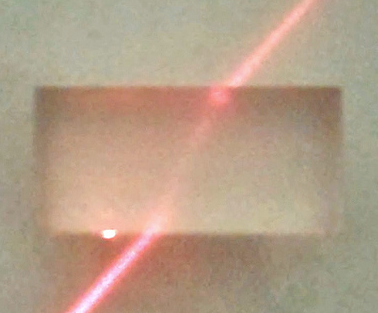
this is an example of

a)

refraction

b)

diffraction

c)

infraction

d)

reflection

5.

what type of mirror is this

a)

concave

b)

convex

c)

translucent

d)

plano

6.

what type of mirror is this

a)

concave

b)

convex

c)

translucent

d)

plano

7.

a convex lens does what to rays

a)

diverges

b)

converges

c)

implodes

d)

merges

8.

a convex mirror does what to rays

a)

diverges

b)

converges

c)

implodes

d)

merges

9.

which mirror ALWAYS shows things right side up

a)

convex

b)

concave

c)

diverging

d)

converging

10.

do we really see things upside down

a)

yes

b)

no, it's a myth

11.
According to the Law of reflection, a light ray striking a mirror
a)
continues moving through the mirror in the same direction
b)
moves into the mirror at a slightly different angle
c)
bounces off the mirror toward the direction it came from
d)
bounces off the mirror at the same angle it hits.
12.
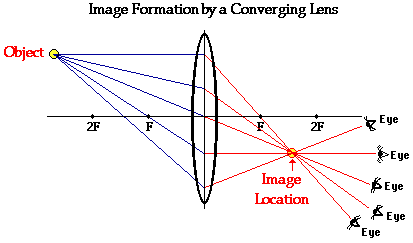
What type of image does this lens form?
a)
Virtual image
b)
Real Image
c)
No Image
13.
Compared to the object in front the lens, its image is.....
a)
inverted and smaller
b)
inverted and larger
c)
not inverted and smaller
d)
not inverted and larger
14.
If I were to stand in front of a flat mirror 5m away how many would I appear on the flat mirror
a)
10m
b)
5m
c)
0m
d)
1m/s
15.

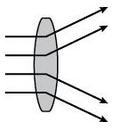
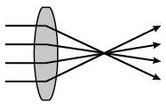
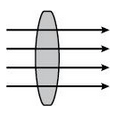
Which figure represents the path light takes through a converging lens?
a)
b)
c)
d)
16.

The angle of incidence is equal to the angle of reflection

a)

Law of Reflection

b)

Law of Light

c)

Incidence Ray

d)

The Normal

17.

The picture shows which type of reflection?

a)

Specular

b)

X-ray

c)

Diffuse

d)

Normal

18.

The ray of light that strikes a mirror

a)

Reflected Ray

b)

Incidence Ray

c)

Angle of Incidence

d)

Angle of Reflection

19.

The ray that bounces off the mirror.

a)

Angle of Reflection

b)

Incidience Ray

c)

Reflected Ray

d)

Angle of Reflection

20.

The angle between the incident ray and the normal. (X on the diagram)

a)

Angle of X-Ray

b)

Angle of Reflection

c)

Angle of Incidence

d)

Angle of Normal

21.

The angle between the reflected ray and the normal (labelled Y on the diagram).

a)

Angle of Incidence

b)

Angle of Reflection

c)

Angle of Normal

d)

Angle of Light

22.

An imaginary line that is drawn at a right angle (90 degrees) to a mirror (Green line)

a)

Reflection Ray

b)

Normal

c)

Incidence Ray

d)

Light Ray

23.

The picture shows which type of reflection?

a)

Diffuse

b)

X-ray

c)

Normal

d)

Specular

24.

If the angle of incidence in the diagram is 80°, the angle of reflection will be:

a)

10°

b)

100°

c)

90°

d)

80°

25.
The illustration shows a light ray striking an object.
In the illustration, the light ray striking the object is-
a)
absorbed
b)
stopped
c)
reflected
d)
refracted
26.

True or False: This diagram shows the correct position of the mirrors so that the light hits the target

a)

True

b)

False

27.

Given that the angle of incidence = 30 degrees


Which is the correct diagam?

a)

A

b)

B

c)

C

d)

D

28.
Which of the following has the greatest amount of energy
a)
Red Light
b)
UV 
c)
Microwave
d)
X-Ray
29.
Which of the following are examples of light
a)
Radio 
b)
Gamma
c)
Green
d)
All of the above
30.
This is an example of...
a)
Reflection
b)
Refraction
c)
Polarization
d)
Spectrum
31.
A convex lens is a __________ device.
a)
Convergent
b)
Divergent
c)
Reflective
d)
None of the above
32.
A Concave lens is a __________ device.
a)
Convergent
b)
Divergent
c)
Reflective
d)
None of the above
33.
A Convex mirror is a __________ device.
a)
Convergent
b)
Divergent
c)
Polarizing
d)
None of the above
34.
A Concave mirror is a __________ device.
a)
Convergent
b)
Divergent
c)
Polarizing
d)
None of the above
35.
_____ is a lens that is thicker in the middle.
a)
Convex
b)
Concave
36.
_____ is a lens that is thinner in the middle..
a)
Convex
b)
Concave