wayground logo

Free Printable Worksheets

NEW

Font size

S
M
L
XL
Worksheets

Algebra 2, Units 1-6

Total questions: 74

Worksheet time: 6hrs 57mins

Name
Class
Date
1.

Factor:

x2 + 11x + 24

a)

(x + 6)(x + 4)

b)

(x + 12)(x + 2)

c)

(x - 8)(x - 3)

d)

(x + 8)(x + 3)

2.
Factor:
x2 - 10x + 24
a)
(x - 6)(x - 4)
b)
(x + 6)(x + 4)
c)
(x - 12)(x + 2)
d)
(x - 8)(x - 3)
3.
Factor:
x2 - 10x - 24
a)
(x + 12)(x - 2)
b)
(x - 6)(x - 4)
c)
(x - 12)(x + 2)
d)
(x +6)(x - 4)
4.
Factor:
x2 - 14x + 24
a)
(x - 8)(x - 3)
b)
(x - 12)(x - 2)
c)
(x - 6)(x - 4)
d)
(x - 24)(x - 1)
5.
Factor x2 + 9x + 20
a)
(x + 2)(x + 10)
b)
(x + 3)(x + 4)
c)
(x + 4)(x + 5)
d)
(x + 4)(x + 6)
6.
Factor x2 + 12x + 20
a)
(x + 2)(x + 10)
b)
(x + 3)(x + 4)
c)
(x + 4)(x + 5)
d)
(x + 4)(x + 6)
7.

Even Multiplicities have which of the following effects on the x-axis?

a)

touches and bounces back

b)

wiggle

c)

crosses the x-axis

8.
f(x)=(x+4)(x-3)(x-2)
List the zeros for this function.
a)
x = -4, x = 3, x = -2
b)
x = -4, x = 3, x = 2 
c)
x = -4, x = -3, x = 2
d)
x = 4, x = 3, x = 2
9.
Select polynomial whose zeros and degree are given.
Zeros: – 5(multiplicity of 3), 9(multiplicity of 2), – 2, 4.
a)
(x + 5)3(x - 9)2(x + 2)(x - 4)
b)
(x + 5)3(x - 9)2(x + 2)7(x - 4)7
c)
(x + 5)3(x - 9)2(x + 2)
d)
(x + 5)(x - 9)(x + 2)(x - 4)
10.
The polynomial
f(x) = 5x4 + 2x3 + 2x − 7 can have, at most, how many solutions?
a)
5
b)
4
c)
3
d)
2
11.
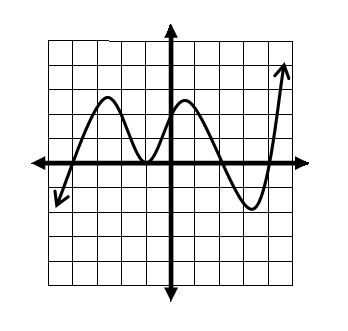
What is the equation in factored form of this graph?
a)
f(x) = (x-4)(x-1)2(x+2)(x+4)
b)
f(x) = (x-4)(x+1)2(x+2)(x+4)
c)
f(x) = (x-4)(x-1)2(x-2)(x+4)
d)
f(x) = (x+4)(x+1)2(x-2)(x-4)
12.
Which of the following equations models the function?
a)
f(x) = -(x - 2)(x + 1)2
b)
f(x) = -1/3x(x - 2)2(x + 1)
c)
f(x) = 1/3x(x + 2)(x - 1)
d)
f(x) = 3(x - 2)(x + 1)2
13.

Determine the end behavior of the graph of

f(x) = -4x4 - 3x3 + 2x

a)

As x →∞, f(x) →∞.

As x→-∞, f(x) →-∞.

b)

As x →∞, f(x) →∞.

As x→-∞, f(x) →∞.

c)

As x →∞, f(x) →-∞.

As x→-∞, f(x) →∞.

d)

As x →∞, f(x) →-∞.

As x→-∞, f(x) →-∞.

14.
What value(s) make the expression undefined?
a)
x = - 3 and x = 4
b)
x = 3 and x = - 4
c)
x = 3 only
d)
x = - 4 only
15.
Simplify the expression
a)
(2a + 4b) / 12b2
b)
(2a - 4b) / 12b2 
c)
(a - b) / 6b2
d)
(a + 2b) / 6b2 
16.
Simplify the expression
a)
(12n2 + 28n + 4) / (2n-5)(n+2)
b)
(12n2 - 28n + 4) / (2n-5)(n+2)
c)
(8n) / (3n + 3)
d)
(12n2 + 2n -3) / (2n-5)(n+2)
17.
Find the least common denominator of the expression
a)
18
b)
6x
c)
3xy
d)
6xy
18.
Multiply
a)
A.
b)
B.
c)
C.
d)
D.
19.
Divide
a)
A
b)
B
c)
C
d)
D
20.
a)
x ≠ 5,  x ≠ 3
b)
x ≠ -5,  x ≠ -3
c)
x ≠ 4,  x ≠ 3
d)
x ≠ -4,  x ≠ -3
21.
a)
A
b)
B
c)
C
d)
D
22.
a)
A
b)
B
c)
C
d)
D
23.
If the blue graph is f(x) (the original function) and the red graph is the transformation, what is the equation of the red graph?
a)
-f(x)
b)
f(-x)
c)
f-1(x)
d)
f(2x)
24.
Which transformation will occur if f(x) = x2 is replaced with 1/2⋅f(x)?
a)
Vertical Compression by a factor of 1/2
b)
Vertical Stretch by a factor of 1/2
c)
Vertical translation up by 2 units.
d)
Reflection across the x-axis.
25.
a)

y=(14)x2y=-\left(\frac{1}{4}\right)^x-2

b)

y=4x2y=4^x-2

c)

y=4x2y=-4^x-2

d)

y=(14)x2y=\left(\frac{1}{4}\right)^x-2

26.

Which of the following is NOT a part of the transformations for the function? f(x)=23(2x1)+3f\left(x\right)=2\sqrt{3\left(2x-1\right)}+3  

a)

Vertical Stretch by a factor of 2

b)

Horizontal Shift Right 1/2 units

c)

Horizontal Stretch by a factor of 2

d)

Vertical Shift Up 3 units

27.

Given the function, which of the following correctly describes the transformations?

a)

reflection over the x-axis, vertical stretch by 3, horizontal shift left 1 and vertical shift down 5

b)

reflection over the y-axis, vertical stretch by 1/3, horizontal shift left 1 and vertical shift down 5

c)

reflection over the x-axis, vertical compression by 1/3, horizontal shift left 1 and vertical shift down 5

d)

reflection over the x-axis, vertical stretch by 1/3, horizontal shift right 1 and vertical shift down 5

28.
a)
16
b)
4
c)
508/3
d)
116/9
29.

Solve for x.

a)

-13

b)

4

c)

19

d)

Extraneous root

30.
Solve
a)
2
b)
-27/7
c)
-32/7
d)
27/7
31.
Solve.
a)
no solution
b)
6
c)
3
d)
4
32.

Which of the following is the inverse function for ? f(x) = x2+ 14f\left(x\right)\ =\ \frac{x^2+\ 1}{4}  

a)

 f1(x) = (4x + 1)2f^{-1}\left(x\right)\ =\ \left(4x\ +\ 1\right)^2  

b)

 f1(x) = 4x + 1f^{-1}\left(x\right)\ =\ \sqrt{4x}\ +\ 1  

c)

 f1(x) = 4x  1f^{-1}\left(x\right)\ =\ \sqrt{4x\ -\ 1}  

d)

 f1(x) = 2x+ 1f^{-1}\left(x\right)\ =\ 2\sqrt{x}+\ 1  

33.

Rewrite  253225^{\frac{3}{2}}  as a radical expression.

a)

 252\sqrt{25^2}  

b)

 (253)2\left(\sqrt{25^3}\right)^2  

c)

 253\sqrt{25^3}  

d)

 22532\sqrt{25^3}  

34.

What is the inverse of the function f(x) = 4x + 6?

a)

f1(x)f^{-1}\left(x\right) = x + 64\frac{x\ +\ 6}{\text{4}}

b)

f1(x) = x - 64f^{-1}\left(x\right)\ =\ \frac{\text{x - 6}}{\text{4}}

c)

y = 4x + 6

d)

f1(x) = x - 46f^{-1}\left(x\right)\ =\ \frac{\text{x - 4}}{\text{6}}

35.
Simplify
a)
12√2/2
b)
6
c)
6√2
d)
Can't Simplify
36.
a)
yz6  ⋅ ∛xy2z2
b)
yz6  ⋅ ∛xyz
c)
y2z10 ⋅ ∛xy2z2
d)
y2z10 ⋅ ∛xy
37.

Solve.

a)

x = 4, 36

b)

x = 36

c)

x = 12, 18

d)

x = -4, 36

38.

Which graph is the inverse of the graph shown?

a)
b)
c)
d)
39.

Which is the value of the expression above for all real numbers a such that a does not equal 0?

a)
b)
c)

1

d)
40.
Solve for b:
363b = 216b+4
a)
6
b)
1
c)
4
d)
-4
41.
Use multiple log properties to write as a single log:
log2x -  5log2y
a)
log2(x/y5)
b)
log2(xy5)
c)
log2(x/y)5
d)
log2(x/5y)
42.
Condense
a)
logxyz3
b)
log(xy/z3)
c)
logx+logy+logz3
d)
logx3y3z3
43.
Expand
a)
6log8v-2log8u
b)
6log8u-2log8v
c)
3log8u-2log8v
d)
6log8u+2log8v
44.
Expand
a)
4log4u - 16log4v
b)
4logu + 16logv
c)
4logu - 4logv
d)
4logu / 16logv
45.
log2(x + 2) + log2x  = 3
a)
-4, 2
b)
-2, 4
c)
2
d)
1
46.
Log with a base "e" (loge) is the same thing as...
a)
"e"
b)
Natural Logarithm (LN)
c)
Common Logarithm (Log)
d)
Natural Log, base "e"
LNe
47.
Solve: 98-x = 27x-3
a)
x = 5
b)
x = -5
c)
x = 1/5
d)
x = -1/5
48.
813-x = (1/3)5x-6
a)
6
b)
-6
c)
9/2
d)
3/2
49.
Simplify:
√10 ⋅ √45
a)
3√50
b)
8√2
c)
√450
d)
15√2
50.
√45x⁴y⁷
a)
3x²y³√5
b)
9x²y³√5y
c)
3x²y³√5y
d)
3x⁴y⁷
51.
Simplify:
6√2 ⋅5√14
a)
32√7
b)
60√7
c)
2√7
d)
30√7
52.
2√5 - √5 + 4√5 + √3
a)
6√5 + √3
b)
5√5 + √3
c)
6√5
d)
6√3
53.
The next two terms of the sequence 4,7,10,13 are
a)
16 and 19
b)
15 and 19
c)
16 and 18
d)
15 and 18
54.

The next two terms of the sequence 12,17,22,27 are

a)

28 and 33

b)

29 and 34

c)

32 and 37

d)

30 and 35

55.

Find the next three terms in the sequence: -33, -24, -15, -6, ...

a)

-1, 7, 15

b)

-5, 2, 9

c)

3, 12, 21

d)

-65, -73, -81

56.
Write the equation for this line: 
a)
f(n)=n+5
b)
f(n)=5n+5
c)
f(n)=5n
d)
f(n)=n
57.

What is the pattern for this sequence?

97, 86, 75, 64, ...

a)

+8

b)

+11

c)

-11

d)

-8

58.

What is the pattern for this sequence?

3, 7, 11, 15, ...

a)

+6

b)

+5

c)

+4

d)

+2

59.
How many real solutions does x2-8x+16 = 0 have?
a)
0
b)
1
c)
2
d)
infinitely many
60.

The sum of 3 complex numbers is 20 + 5i. If the sum of 2 of the numbers is -15 + 7i, what is the third number?

a)

17

b)

33

c)

34 + 8i

d)

35 + 12i

e)

35 - 2i

61.
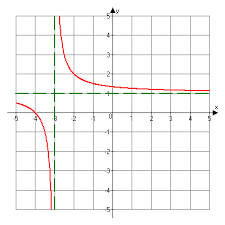
What are the asymptotes?
a)
x = -3        y = 1  
b)
x = 3         y = 1
c)
x = -3        y = -1
d)
x = 3         y = -1
62.
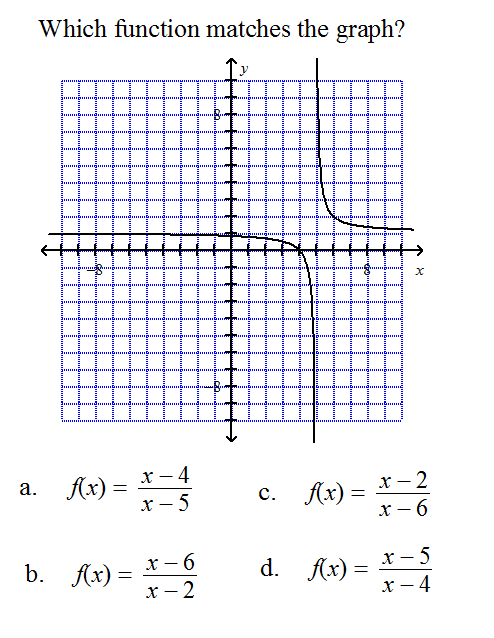
what is the equation that best matches the graph?
a)
A
b)
B
c)
C
d)
D
63.
What is/are the vertical asymptote(s)?
a)
There are no vertical asymptotes
b)
x=5
c)
x=-5
d)
x=-1/2
64.
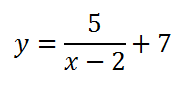
What is the horizontal asymptote? 
a)
x = 2
b)
x = 7
c)
y = 2
d)
y = 7
65.

What creates a hole (PORD) in the graph of a rational function?

a)

Crossing the x-axis

b)

An absence of dirt.

c)

Crossing a vertical asymptote.

d)

A factor that is eliminated.

66.

Determine whether the graph of the function has a vertical asymptote or a removeable discontinuity at x = -1.

a)

Vertical Asymptote

b)

Discontinuity

c)

Hump Day

d)

Infinite

67.
Which asymptote(s) are determined by looking at the denominator?
a)
vertical
b)
horizontal
c)
slant
d)
none
68.
What is the X-Intercept?
a)
x= 0
b)
x= 4
c)
x= 5
d)
x= -5
69.
What are the asymptotes?
a)
x=1, x= 2, y =1, y= 2
b)
x= 2, x=-2, y = 1
c)
x=2 y =-1
d)
x=1 y =2, y =-2
70.

What is the Vertical Asymptote(s)?

a)

x= -4

b)

x= -4,5

c)

x= -5,5

d)

x= 4

71.

Select the graph that show the corresponding vertical & horizontal asymptotes to this function

a)
b)
c)
d)
72.

Select the graph that show the corresponding vertical & horizontal asymptotes to this function

a)
b)
c)
d)
73.

Select the graph that show the corresponding vertical & horizontal asymptotes to this function

a)
b)
c)
d)
74.

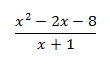
What are the coordinates of the PORD, if one exists.

a)

(-1, -2)

b)

(-1, ½)

c)

(-1, 0)

d)

there isn't one