wayground logo

Free Printable Worksheets

Font size

S
M
L
XL
Worksheets

Review #3

Total questions: 200

Worksheet time: 2hrs 19mins

Name
Class
Date
1.

The Kansas-Nebraska Act concerned which issue?

a)

the expansions of slavery into new territories

b)

the sale of federal lands to slave owners

c)

the right of Northerners to own slaves

d)

the return of slaves who had escaped from the South

2.

Which of these was a direct consequence of the Civil War?

a)

the extension of voting rights to African American men.

b)

the use of popular sovereignty to decide the issue of slavery

c)

the addition of new states to the Union

d)

the disintegration of the Whig Party

3.

The 14th Amendment was proposed by Congress in response to which of the following?

a)

the emergence of white resistance to the civil rights movement

b)

the passage of the Black Codes in the South

c)

the rise of violence against emancipated slaves

d)

the attempts of Democrats to limit the voting rights of African Americans

4.

Which of the following was a pull factor that drew African Americans north during the Great Migration?

a)

the sale of inexpensive land by the federal government

b)

the construction of low-cost government housing in growing cities

c)

the absence of segregation and racial discrimination outside the South

d)

the availability of good jobs in the North and the West

5.

This political cartoon is a criticism of which practice in the 19th century?

a)

industrialism

b)

laissez-faire capitalism

c)

monopolization

d)

vertical integration

6.

The Gentleman’s Agreement between President Theodore Roosevelt and Japan resulted in a decrease of which of these?

a)

Japanese immigration to the US

b)

Japanese troops stationed in Manchuria

c)

tariffs between Japan and the US

d)

U.S. and Japanese fleets in the Pacific Ocean

7.

This time period in US History lasted from 1890-1915 and included the Spanish American War, the annexation of Puerto Rico, and Cuban independence from Spain.

a)

Imperialism

b)

The Gilded Age

c)

WWI

d)

Western Expansion

8.

Why does the cartoon depict Roosevelt carrying his "big stick" through the Caribbean?

a)

Roosevelt felt that the United States had a moral responsibility to protect citizens from civil unrest in Caribbean nations.

b)

Roosevelt wanted to seize control of resources available in the Caribbean to promote U.S. business interests.

c)

Roosevelt believed that a strong military presence in the Caribbean was needed to protect the United States from attack by Latin American nations.

d)

Roosevelt believed that an aggressive foreign policy was needed to prevent Caribbean nations from incurring major debts with European nations.

9.

Which of the following describes a reason for U.S. involvement in WWI?

a)

U.S. leaders feared that Germany might gain too much control and negatively affect American security and trade.

b)

U.S .leaders argued that the stage of war might shift from European soil to territory in the United States.

c)

U.S citizens worried that the Central Powers might be swayed to adopt a non-democratic form of government.

d)

U.S. citizens were persuaded by German propaganda that placed Britain and France's cruelty on display.

10.

This time period consisted of social activism and political reform across the United States, and lasted from 1901-1914.

a)

Imperialism

b)

The Gilded Age

c)

The Roaring Twenties

d)

The Progressive Era

11.

Which entrepreneur had a significant impact on the cosmetics industry?

a)

Harriet Beecher Stowe

b)

Madame C.J. Walker

c)

Emily Dickinson

d)

Sojourner Truth

12.

Which of the following was the main reason that the federal government created a method for Native Americans to become U.S. citizens?

a)

to reduce the amount of money spent supporting Native Americans

b)

to encourage Native Americans to assimilate into mainstream society

c)

to undermine the legal basis of the treaties made with Native American tribes

d)

to guarantee that Native Americans enjoyed constitutionally protected civil rights

13.

This time period in U.S History consisted of the struggle to end racism in the United States.

a)

Civil Rights Era

b)

Civil War Era

c)

Progressive Era

d)

Reconstruction Era

14.

What was the main purpose of the Interstate Commerce Act of 1887?

a)

to ensure the spread of manufacturing across the frontier

b)

to remove import taxes for goods shipped from one state to another

c)

to prevent railroads from charging farmers and merchants high shipping rates

d)

to protect American agriculture and industry from foreign competition

15.

Which of the following was a goal of the Dawes Act of 1877?

a)

Push Native Americans to adopt an agricultural lifestyle

b)

Lure Native Americans to migrate to the frontier

c)

Entice Native Americans to move to urban areas

d)

Give Native Americans jobs in the federal bureaucracy

16.

This made the production of steel more efficient and affordable.

a)

Combustion Engine

b)

Horizontal Integration

c)

Vertical Integration

d)

Bessemer Process

17.

The invention of the by Henry Ford allowed manufacturing production to be more efficient allowing for different factories to produce more profits.

a)

Car

b)

Assembly Line

c)

Bessemer Process

d)

Combustible Engine

18.

Which statement describes the role played by the U.S. journalists during the Spanish-American war?

a)

Journalists exaggerated events to build support for the war, giving the president and Congress little chance to resolve the conflict diplomatically.

b)

Journalists ignored the signs of impending war until it was too late to inform the public of the government’s intentions to declare war on Spain.

c)

Journalists focused on bad news rather than good news in order to criticize the decisions made by the president and military leaders

d)

Journalists provided frequent reports of the fighting, allowing the public to follow a foreign war closely for the first time.

19.

What was the main purpose of this poster?

a)

to encourage young men to enlist in the army

b)

to demonstrate the reason for entering the war

c)

to generate financial support for the war effort

d)

to create public distrust of Germans

20.

Passage of which of these represented a shift from the foreign policy that dominated American politics between the two world wars?

a)

the Wagner Act

b)

the Espionage Act

c)

the Lend-Lease Act

d)

the Taft-Hartley Act

21.
What was the result of the attack at Pearl Harbor?
a)
An American declaration of war on Japan
b)
The complete destruction of the US Navy
c)
Renewed efforts in Europe to rid the region of Hitler's dominance
d)
Continued American isolationism
22.
Why did the federal government encourage American citizens to buy war bonds during WW1 and WW2?
a)
To help finance the war
b)
To ration food and other goods
c)
To improved the banking industry
d)
To ensure wage increases in industry
23.
The Red Scare was prompted by:
a)
Westward expansion due to increased immigration
b)
The rise of communism and socialism in the United States
c)
The annexation of Hawaii following military actions by the U.S. Navy
d)
US involvement in Latin America
24.
Which BEST describes the Harlem Renaissance?
a)
A time when the architecture of Harlem was copied by other cities
b)
A time when the past success of Harlem was highlighted
c)
A time when jazz music lost its popularity
d)
A time when the literary works of African-Americans flourished.
25.
Hoovervilles can BEST be described as:
a)
Shantytowns where displaced people lived during the Great Depression
b)
Small cities named in honor of President Hoover
c)
Parts of a larger reform bill to improve housing in America
d)
Bank notes issued during the Depression in place of stock
26.
ALL of the following contributed to American involvement in WW1 EXCEPT:
a)
Isolationism
b)
Anti-German Propaganda
c)
Submarine Warfare
d)
The Zimmerman Telegram
27.
Which event sparked the Spanish-American War?
a)
The sinking of the USS Maine
b)
Roosevelt's Corollary to the Monroe Doctrine
c)
The building of the Panama Canal
d)
The Platt Amendment
28.
The intent of the Chinese Exclusion Act of 1882 was:
a)
To deny workers from China membership in labor unions
b)
To exclude Chinese workers on RRs
c)
To restrict immigration from China
d)
To forbid military involvement in China
29.
What right was granted by ratification of the 19th Amendment?
a)
The right of the people to elect U.S. Senators
b)
The right to due process
c)
A woman's right to vote
d)
The right of workers to form unions
30.
Muckrakers, like Ida Tarbell, hoped to:
a)
Oversee the Tennessee Valley Authority
b)
Stop ratification of the 18th Amendment
c)
Expose abuses in business and corruption in politics
d)
Improve methods of mass production
31.
What was the significance of Levittown?
a)
It showed the need for a working GI Bill
b)
It sparked the growth of the American suburbs
c)
It was the center of the American industry
d)
It was the site of the Kennedy-Nixon debates
32.
Why did President Johnson introduce his Great Society initiative?
a)
To reduce the need for labor unions in American industry
b)
To establish social benefits for all Americans
c)
To work toward reducing the tax burden on corporations
d)
To establish legislation that would help poverty-stricken Americans
33.
What did the Communist takeover in China and the Korean War give rise to in America?
a)
The Space Race
b)
Communism
c)
McCarthyism
d)
The Marshall Plan
34.
What prompted the Cuban Missile Crisis?
a)
The Tet Offensive
b)
The Cuban Revolution
c)
The discovery of Soviet missiles in Cuba
d)
The interest in overthrowing Fidel Castro
35.
What resulted from the outrage caused by the publication of Upton Sinclair's book The Jungle?
a)
The book was banned from libraries
b)
There was a backlash against labor unions
c)
There were further restrictions placed on civil liberties
d)
The federal government began regulating the meat packing industry
36.
What was the purpose of the Gettysburg Address, delivered by President Lincoln on November 19, 1863?
a)
To punish the South
b)
To honor fallen soldiers
c)
To propose the 13th Amendment
d)
To call for the South's surrender
37.
In what way was the Lewis and Clark Expedition a key element in Manifest Destiny?
a)
The Louisiana Purchase established a boundary for southern migration
b)
Westward expansion stalled until the Homestead Act in 1862
c)
The US viewed westward expansion as God's will for their nationa
d)
Jefferson sought to restrict settlement within the Lousiana Territory
38.
Who was:
•President from 1913-1921 •Advocate for women’s suffrage •President during WWI •Proposed Fourteen Points as a basis for post-war peace •Supported U.S. membership in League of Nations; U.S. failed to join
a)
President Wilson
b)
President Truman
c)
President Taft
d)
President Roosevelt
39.
Who was:
•President from 1945-1953•Used atomic weapons against Japan to bring WWII to an end •Assisted in the founding of the United Nations •Executed policy to contain communism
a)
President Wilson
b)
President Truman
c)
President Roosevelt
d)
President Obama
40.
Who was:
•President from 1932-1945 (elected to 4 terms) •Pulled country out of Great Depression with New Deal •Declared war on Japan after bombing of Pearl Harbor – U.S.entered WWII •Worked closely with Winston Churchill during WWII
a)
President Woodrow Wilson
b)
President Harry Truman
c)
President Howard Taft
d)
President Franklin Roosevelt
41.
Who was:
•Commander of U.S. army in the Pacific during WWII •Commander of U.S. forces in Korean Conflict •Disagreement with Truman over use of nuclear weapons in North Korea and China •Public criticism of Truman led to his removal
a)
General Chester Nimitz
b)
General George Patton
c)
General Douglas MacArthur
d)
General John Pershing
42.

During the 1920s, controversies over the Scopes Trial, national prohibition, and the behavior of flappers were all signs of disagreements over

a)

the benefits of new technology

b)

the return to normalcy

c)

causes of the Great Depression

d)

traditional values and changing lifestyles

43.

During World War II, posters of Rosie the Riveter were used to

a)

promote women's suffrage

b)

recruit women into wartime industries

c)

support higher education for women

d)

encourage women to serve in the armed forces

44.

Why did women in the West receive suffrage first?

a)

they were respected as frontier women

b)

they read newspapers frequently

c)

they were more educated

d)

they worked next to men in factories

45.

What was the major result of Prohibition in the United States during the 1920s?

a)

increase in organized crime

b)

restriction of immigration

c)

growth of communism

d)

destruction of family values

46.

In 1944, Congress enacted the GI Bill of Rights in order to

a)

ban racial segregation in the armed forces

b)

create government jobs for returning soldiers

c)

provide economic aid to veterans

d)

reduce military expenditures

47.

During World War II, the federal government used rationing to

a)

increase imports of scarce products

b)

provide more resources for the military

c)

increase educational benefits for veterans

d)

hold down prices of military weapons

48.

Someone who believed women should have the right to vote in the 1800s would have most likely supported

a)

Jacksonian Democracy

b)

women's suffrage

c)

disfranchising women

d)

temperance

49.

Television shows, advertising, and a number of "scientific" books suggested that women should fulfill what roles during the 1950s?

a)

wife and mother

b)

wife, mother, and worker

c)

wife and career woman

d)

single career woman

50.

Which of the following people might have been labeled a "flapper"?

a)

a finance capitalist of the early 20th century

b)

an immigrant drafted into the Union army

c)

a progressive woman of the 1920s

d)

a politician speaking out against US involvement in World War I

51.

Which early 1900s reformer opened Hull House as a settlement house?

a)

Jane Addams

b)

Jacob Riis

c)

Upton Sinclair

d)

Susan B. Anthony

52.

What was the intent of the 14th Amendment?

a)

guarantee rights to former slaves

b)

end the occupation of Union troops in the South

c)

outlaw slavery

d)

give black men the right to vote

53.

The migration of African Americans to the North during and following World War I was mainly a result of the

a)

efforts of the Civil Rights Movement

b)

availability of new factory jobs

c)

success of military desegregation

d)

impact of affirmative action programs

54.

The Emancipation Proclamation was an important document because it

a)

granted equal protection under the law

b)

ended slavery

c)

provided a more noble reason to fight in the Civil War

d)

gave blacks the right to vote

55.

Why did Congressional Republicans oppose Abraham Lincoln's Reconstruction plan?

a)

it granted too many rights to formerly enslaved persons

b)

it offered to forgive former Confederate leaders who would swear allegiance to the US

c)

it demanded payments from the South that would have damaged its economy

d)

it postponed readmission of southern states into the Union for many years

56.

W.E.B. DuBois believed that African Americans should attempt to gain equality in the United States by

a)

demanding full and immediate participation in American society

b)

setting up a separate nation within the United States

c)

taking over leadership if all political parties

d)

entering vocational training programs in separate schools

57.

After victory in the Civil War, Abraham Lincoln wanted to

a)

place harsh penalties on the southern states

b)

add Canada as a new territory in the United States

c)

ease tensions with Great Britain

d)

allow the southern states to enter back into the Union quickly

58.

The cartoon above appeared during which period?

a)

Reconstruction

b)

the Great Depression

c)

the Harlem Renaissance

d)

colonial America

59.

Which of the following African Americans founded the Tuskegee Institute, believed that segregation was acceptable, and believed that African Americans would win the respect of white if they learned a trade and gained economic independence?

a)

Dr. Martin Luther King Jr.

b)

Booker T. Washington

c)

Frederick Douglass

d)

W.E.B. DuBois

60.

Which of the following would have been the role of the Freedmen's Bureau?

a)

to help southern soldiers readjust to life after the war

b)

providing education to Union soldiers after the war

c)

providing money to help rebuild the South's postwar economy

d)

providing assistance, services, and relief to emancipated slaves

61.

Which of the following resulted from Jim Crow Laws?

a)

Japanese Americans experienced unfair treatment during World War II

b)

African Americans could finally attend white schools

c)

women gained the right to vote

d)

African Americans could not eat at the same restaurants as whites

62.

Wilson's Fourteen Points were based on...

a)

American optimism that the U.S. could lead the international community and peacefully resolve international disputes.

b)

various theories of collective security and international organization.

c)

tendencies toward American isolationism.

d)

Congress's enthusiasm to join the League of Nations.

63.

The cartoon seen here was probably drawn by someone who felt that the United States

a)

should not enter World War I

b)

should join the League of Nations

c)

was taking advantage of smaller nations

d)

should not join the League of Nations because it might be pulled into other nation's disputes

64.
This agreement was outside the League. It enabled Germany to repair its economy and pay reparations, thus helping Britain and France, who could then pay back loans to the USA.
a)
The Washington Conference 1921 - 22
b)
Treaty of Rapallo
c)
Dawes Plan 1924
d)
Kellogg-Briand Pact 1928
65.
This agreement was outside the League. This Pact outlawed war. Initially 15 countries, and eventually 68 countries, agreed never again to use war as foreign policy.
a)
Locarno Pacts 1925
b)
Treaty of Rapallo
c)
Dawes Plan 1924
d)
Kellogg-Briand Pact 1928
66.

FOREIGN POLICY: 1928- This outlawed war as a tool of foreign policy. it denounced war, called for a limitation of arms, and prohibited the use of war as an "instrument of national policy".

a)

Neutrality acts

b)

Kellogg- Briand Pact

c)

Dawes Plan

67.
laws passed to limit U.S. involvement in future wars; based on the belief that loans and trade had drawn the nation into World War I
a)
Cash-and-Carry
b)
Lend-Lease Act
c)
Selective Training and Service Act
d)
Neutrality Acts
68.
Presidential scandal that occurred when a member of Harding's Ohio Gang leased oil rich government land in Wyoming
a)
Teapot Dome Scandal
b)
Court-Packing Scandal
c)
Iran-Hostage Crisis
d)
Gulf War
69.
FDR's attempt to gain more control over the Federal government by adding additional judges to the Supreme Court (to gain support for New Deal Leg.)
a)
Teapot Dome Scandal
b)
Watergate 
c)
Court-Packing Scandal
d)
Manhattan Project
70.
Scandal that led to the resignation of President Nixon, following his attempt to cover up involvement in spying on the Democratic National HQ.
a)
Watergate
b)
Iran-Hostage Crisis
c)
Berlin Wall
d)
Island Hopping
71.
Allied effort to supply West Berlin with supplies after it was cut off from the West by the USSR
a)
Berlin Wall
b)
Berlin Airlift
c)
Battle for Britian
d)
NAFTA
72.
Depression Era shantytowns that were sarcastically named after President blamed.
a)
Hoovervilles
b)
Roosevelt Rooms
c)
Oklahoma
d)
Buchanhans Barrios
73.
African American poet of the Harlem Renaissance.
a)
WEB DuBios
b)
Langston Hughes
c)
Jacob Riis
d)
Upton Sinclair
74.
Act passed by the US government that moved Native Americans to reservations and attempted to "Americanize" them.
a)
Dawes Act
b)
Homestead Act
c)
Wagner Act
d)
Volstead Act
75.
International governing body that was founded after WWI, failed because the United States did not join.
a)
United Nations
b)
League of Nations
c)
NATO
d)
Warsaw Pact
76.
Buying with the intent to sell (Cause of the Great Depression)
a)
Speculation
b)
Buying of the Margin
c)
High Tarriffs
d)
Over reliance on credit
77.
Super duper secret project to develop the Atomic Bomb, lead by Einstein and Oppenheimer. 
a)
Project X
b)
Project Runway
c)
Manhattan Project
d)
The Projects
78.
After the US entered World War II, the following people were placed in internment camps because of "military necessity."
a)
Mexican-Americans
b)
Japanese-Americans
c)
African-Americans
d)
German-Americans
79.
Witch-hunt that was part of the second red scare was named after Senator
a)
Joseph McCarthy
b)
Douglas MacAurthur
c)
Harry S Truman
d)
Henry Cabot Lodge
80.
The richest man in the history of the world, built his wealth by horizontally integrating his oil company.
a)
Andrew Carnegie
b)
JP Morgan
c)
Henry Ford
d)
John D. Rockefeller
81.
New Immigrants to the US in the early 1900s came from what region?
a)
Southern and Eastern Europe
b)
South Eastern Asia
c)
Northern and Central Europe
d)
Latin America
82.
Trial of the century, saw the battle of Creationism (Traditional Values) v. Evolution (Science and Modernity).
a)
Scopes Monkey
b)
Chinese Exclusion
c)
Jim Crow
d)
Speakeasy
83.
Passed during World War I, intended to keep people from sharing war secrets.  This legislation also limited people's 1st Amendment rights.
a)
Espionage Act
b)
Perdition Act
c)
Temperance Act
d)
Clayton-Antitrust Act
84.
Organizations, such as Tammany Hall, that provided infrastructure and resources for poor immigrants in exchange for votes and political power.
a)
Political Machine
b)
Civil Rights Movement
c)
Populist Party
d)
Communism
85.
What was Ellis Island?
a)
An amusement park
b)
An immigration center in New Jersey
c)
An immigration center in New York
d)
The first capital of the United States
86.
Social Darwinism promoted the idea that..
a)
people in lower classes were not capable of economic success
b)
immigration weakened national unity
c)
the government should take responsibility for the well-being of people
d)
poverty could be eradicated through increased economic regulation
87.
The U.S. declared war on Spain after
a)
the Maine exploded in Havana Harbor
b)
an attempted assasination of President Cleveland
c)
the Spanish invaded Puerto Rico
d)
the failed rebellion of José Martí
88.
Who was the President during the building of the Canal and was the 1st to leave America?
a)
Teddy Roosevelt
b)
William Howard Taft
c)
Woodrow Wilson
d)
Franklin Roosevelt
89.
Which statement is NOT true about the territories the U.S. gained after the war?
a)
The U.S. had control over the Philippines until they gained their independence in 1946
b)
The U.S. still controls Guam and Puerto Rico today
c)
Cuba became independent after The Treaty of Paris was signed in 1898
d)
The U.S. gained control over The Philippines, Cuba, Guam, and Puerto Rico
90.
The assassination of which leader was the spark that started WWI?
a)
Tsar Nicholas II of Russia
b)
Emperor Franz Josef of Austria-Hungary
c)
King George V of England
d)
Archduke Franz Ferdinand of Austria-Hungary
91.
What were the causes of World War I? (hint: MAIN)
a)
alliances, socialism,communism, realism
b)
imperialism, capitalism, mercantilism, fascism
c)
militarism, alliances, imperialism, nationalism
d)
communism, nazism, racism, militarism
92.
What happened to the British passenger ship, the "Lusitania?"
a)
It began the blockade on Germany.
b)
The Germans sank the ship by bombing it from its new airplanes.
c)
The Germans sank the ship with its submarines and killed over 100 Americans.
d)
The British accidentally sank the ship with their own submarine.
93.
What effect did the Dust Bowl storms have on the Great Depression?
a)
Many farmers were forced to leave the Great Plains.
b)
Unemployment decreased gradually.
c)
Many homes along the Mississippi River were flooded.
d)
Hoover was re-elected as president.
94.
What were the major goals of the New Deal?
a)
no gold standard and free coinage of silver
b)
abolition and suffrage
c)
relief, recovery, and reform
d)
expanding the size and economic influence of the United States
95.
This president thought the federal government should not get involved in the economy. As a result, many Americans blamed him for the Great Depression. This caused him to lose the election in 1932.
a)
Franklin Delano Roosevelt
b)
Theodore Rooselvelt
c)
Herbert Hoover
d)
Calvin Coolidge
96.
Which of the following was NOT a cause of the Great Depression?
a)
an increase in productivity without an increase in wages
b)
trade imbalance with Europe
c)
strong automobile sales
d)
overproduction of farm products
97.
The successful Allied invasion of France was known as
a)
Battle of Midway
b)
Battle of the Bulge
c)
D-Day
d)
Battle of El Alamein 
98.
Why is the Cold War considered a “cold” war, compared to WWII, a “hot” war?
a)
Most of the fighting took place in the cooler Northern Hemisphere
b)
The Soviet Union is located in a fairly cold area
c)
The Soviets and Americans never actually fought against one another with weapons
d)
The United States believed a nuclear war would end the seasons and it would be cold on Earth
99.
In the 1950s, the United States became involved in the Vietnam War. Why did the United States become involved in this war?
a)
to prevent the collapse of the government of North Vietnam
b)
to stop Vietnam from taking over Hong Kong
c)
to stop the spread of communism to South Vietnam
d)
to prevent attacks against United States shipping
100.
How did the Cuban Missile Crisis end?
a)
The Soviets and the U.S. entered into a nuclear war
b)
It never really ended, there are still tensions today
c)
Soviets backed down and pulled their missiles out of Cuba
d)
the Cubans forced the Soviets to leave because they didn't want war with the U.S.
101.
What did the Iron Curtain divide?
a)
North and South Korea
b)
Soviet Union and China
c)
Eastern and Western Europe
d)
America and Europe
102.
How did the Watergate Scandal affect American politics?
a)
It had a negative impact because it caused distrust in the government.
b)
It had a positive impact because it brought the people together.
c)
It didn't impact anything.
103.
Owner/Operator of the Hull House, a settlement house in Chicago.
a)
Susan B. Anthony
b)
Jane Addams
c)
Sandra Day O'Connor
d)
Estee Lauder
104.
Founder of the NAACP, an early civil rights group.
a)
W.E.B. DuBios
b)
Ida Tarbell
c)
Thurgood Marshal
d)
Martin Luther King Jr.
105.
How did the Zimmerman telegram influence U.S. entry into World War I?
a)
It announced the czar's overthrow in Russia. 
b)
It revealed a proposed military alliance between Mexico and Germany. 
c)
It contained orders for German U-boats to destroy British passenger ships. 
d)
It described Romania's plan to abandon neutrality. 
106.
The belief that it was the United States' destiny to expand west and conquer territory all the way to the Pacific Ocean
a)
Mexican-American War 
b)
Manifest Destiny 
c)
Black Exodus 
d)
Cross of Gold Speech 
107.

What was a goal of Progressive Era reforms such as recall, referendum, and the direct primary?

a)

supporting third-party candidates

b)

increasing citizens’ control of their government

c)

establishing term limits for congressmen

d)

reducing campaign spending

108.

One major goal of President Woodrow Wilson’s Fourteen Points (1918) was to

a)

collect war reparations for the United States

b)

maintain United States naval superiority

c)

punish the nations that started World War I

d)

create a League of Nations to prevent future wars

109.

During the 1920s, the Scopes trial and the dispute over Prohibition showed the clash between

a)

rich people and poor people

b)

traditional values and modernism

c)

business owners and labor unions

d)

the national government and state governments

110.

President Franklin D. Roosevelt’s New Deal reflected his belief that during a depression the federal government should

a)

assume ownership of failed corporations

b)

return to laissez-faire capitalistic principles

c)

take a leadership role in economic recovery

d)

help farmers instead of industrial workers

111.
What two nations were in competition with each other during the Cold War?
a)
Spain and Portugal
b)
England and France
c)
Germany and Italy
d)
United States and Soviet Union
112.

Where was Korea divided?

a)

18 parallel

b)

34 parallel

c)

38 parallel

d)

15 parallel

113.
This "figurative" wall divided communist countries from democratic counties--
a)
Great Wall of China
b)
Berlin Wall
c)
Iron Curtain
d)
Wall of Democracy
114.

The act of preventing nuclear attack by threatening retaliation is called

a)

deterrence

b)

domino theory

c)

militarism

d)

containment

115.
Nations that were aligned with, but also under the influence and pressure of, the Soviet Union were called--
a)
European Nations
b)
NATO
c)
Warsaw Pact
d)
Satellite Nations
116.
What was the mutual defense alliance of non communist nations?
a)
NATO
b)
Warsaw Pact
c)
Truman Doctrine
d)
Open Skies
117.
What was the name for the 1955 alliance of Soviet-dominated countries of Eastern Europe  that were the counterpart to the western alliance?
a)
NATO
b)
Warsaw Pact
c)
European Alliance
d)
Iron Curtain
118.
Leader of communism in China
a)
Mao Zedong
b)
Hirohito Showa
c)
Xi Jinping
d)
Pu Yi
119.

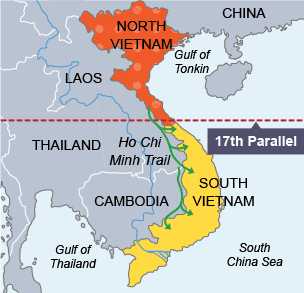
Images like this one refer to what theory about the spread of Communism in Asia (China, Korea, Vietnam)?

a)

The Mar$hall Plan

b)

The Domino Theory

c)

Proxy Wars

d)

Flexible Response

120.

Which leader promoted communism in North Vietnam?

a)

Ho Chi Minh

b)

Mao Zedong

121.

Truman's policy of preventing the expansion of communism was -

a)

containment

b)

deterrence

c)

militarism

d)

perestroika

122.

What were the defining characteristics of the Cold War?

a)

Prohibition, Flappers, Jazz

b)

Arms Race, Space Race, Red Scare

c)

Holocaust, Nazi Germany, Pearl Harbor

d)

Poverty, Unemployment, Dust Bowl

123.

What American policy provided Western European countries financial assistance so they could recover from WWII?

a)

Marshall Plan

b)

Domino Theory

c)

Truman Doctrine

d)

Big Stick Policy

124.

What individual/group contributed to the Red Scare and accused American citizens of being communists?

a)

Martin Luther King & Black Panthers

b)

Jane Addams & Settlement Houses

c)

Joseph McCarthy & HUAC

d)

Cesar Chavez & United Farmworkers Union

125.

What happened as a result of the launch of Sputnik in 1957?

a)

It started the space race.

b)

U.S. began to invest more money into math & science education.

c)

The U.S. started NASA.

d)

All of the above

126.

During the Cuban Missile Crisis, what did JFK do when he heard that the Soviet Union was construction a missile site in Cuba.

a)

JFK gave into the Soviet demands.

b)

JFK bombed the Soviet Union with an atomic bomb.

c)

JFK ordered a naval blockade of Cuba.

d)

JFK invaded Cuba from Guantanamo Bay.

127.

How did the G.I. Bill contribute to the economic prosperity of the 1950s?

a)

It decreased consumer spending.

b)

It allowed Veterans to get an education and buy homes in suburbs.

c)

It offered incentives under the Bracero Program to temporary laborers.

d)

It created federal domestic programs as part of the Great Society.

128.

After WWII what happened to the population of the U.S?

a)

The population moved westward as a result of the railroad.

b)

African Americans moved north as part of the Great Migration.

c)

The population shifted from the Rust Belt to the Sun Belt.

d)

The population grew due to the Baby Boom.

129.

What did those in the counter-culture do when the government escalated deployment of troops in Vietnam and implemented a draft?

a)

The counter-culture organized protests.

b)

There were mass anti-war demonstrations.

c)

Some individuals burned their draft cards.

d)

All of the above

130.

What wars were fought during the Cold War as a result of containment and the Domino Theory?

a)

Korean & Vietnam War

b)

WWI & WWII

c)

Civil War & Spanish American War

d)

Persian Gulf & War on Terror

131.

How did the media (television) impact the Vietnam War?

a)

Negative press coverage contributed to the public disillusionment with the war.

b)

The positive press coverage encouraged enlistment in the military.

c)

The impact of the media in Vietnam was rather minimal.

d)

The media showed that the majority of Americans supported the war effort.

132.

What policy implemented in the Cold War said the U.S. would give military aid to a country that needed to resist communism?

a)

Marshall Plan

b)

Truman Doctrine

c)

Domino Theory

d)

Open Door Policy

133.

What amendment was passed to lower the voting age because it was unfair that 18-20 year olds could be drafted into the army but not vote?

a)

17th amendment

b)

21st amendment

c)

22nd amendment

d)

26th amendment

134.

The Cold War refers to the period of tension between the United States and the Soviet Union from

a)

the end of World War II to the fall of the Soviet Union.

b)

the end of World War I to the bombing of Pearl Harbor.

c)

the Cuban Missile Crisis to the fall of the Berlin Wall.

d)

the Bolshevik Revolution to the end of World War I.

135.

What was one major goal of the Soviet Union during the early years of the Cold War?

a)

to expand individual liberties in the Baltic republics

b)

to attract foreign economic investments

c)

to create a defensive buffer zone in Eastern Europe

d)

to establish a competitive market economy

136.

Which of these was a cause of the Korean War?

a)

NATO air and naval forces blocked ships sailing to North Korea.

b)

United Nations inattention allowed guerrillas to infiltrate South Korea.

c)

North Korean forces, with Soviet approval, invaded South Korea.

d)

Widespread anti-colonial riots forced the Korean government to begin the war.

137.
Who didn't we share the plan to build the atomic bomb with?
a)
USA
b)
UAE
c)
USSR
d)
User Error
138.
NATO was formed for this purpose:
a)
To protect it's members from Soviet aggression
b)
To protect against Soviet music
c)
To protect against US and UN aggression
d)
To stop Lex Luthor
139.
Who was the leader of Russia when the phrase "Iron Curtain" was phrased?
a)
President Roosevelt
b)
President Truman
c)
Joseph Stalin
d)
Joseph McCarthy
140.
Who was the president during WWI
a)
Herbert Hoover
b)
Abraham Lincoln
c)
Robert Taft
d)
Woodrow Wilson
141.
The president who was elected at the end of the Great Depression who proposed a series of policies to promote economic growth
a)
Hoover
b)
Roosevelt
c)
Wilson
142.
This program was designed to help farmers.  It offered subsidies for farmers to grow less.  It also offered incentives for farmers who diversified and practiced conservation.
a)
CCC
b)
SSA
c)
REA
d)
AAA
143.
This program provided a retirement income for people over 65.  It also provided unemployment insurance and disability.
a)
AAA
b)
SSA
c)
CCC
d)
REA
144.
This program provided jobs for young men 18-25.  The majority of the work they did was in national parks.
a)
AAA
b)
CCC
c)
SSA
d)
REA
145.
US legislation that allowed the US to remain neutral but loan and "sell" ammunition and machinery/equipment to countries when it was in the best interest of the US.
a)
neutrality
b)
militirism
c)
lend lease program
d)
imperialism
146.

Who transmitted code messages for the allies during WWII?

a)

women

b)

Navajo

c)

African Americans

147.

The Munich Pact incorporated this policy

a)

Isolationism

b)

Neurality

c)

Appeasement

148.

This document laid the foundation for the United Nations

a)

Atlantic Charter

b)

Cash and carry

c)

Lend-Lease Act

149.

What is Genocide?

a)

prejudice, racism, hatred against Jews

b)

systematic attempt to eliminate an entire race

c)

organized attack on Jewish homes and businesses

150.

Which policy had the goal of supporting the allies and maintaining neutrality?

a)

Atlantic Charter

b)

Appeasement

c)

Cash and Carry

151.

What did Philip Randolph do?

a)

served as a spy and stole German battle plans

b)

spoke out against racial discrimination in the war industries

c)

increased reserves of natural resources

152.

What do Adolf Hitler, Benito Mussolini, and Joseph Stalin all have in common?

a)

they are Communist dictators

b)

they are Fascist rulers

c)

they are Totalitarian dictators

153.

Britain and France had this policy toward Nazi Germany

a)

neutrality

b)

appeasement

c)

isolationism

154.

This was a military tactic used by the US in the Pacific Theatre

a)

Blitzkreig

b)

Island-hopping

c)

Trench warfare

155.

What event led to the surrender of Japan in 1945 and ended WWII?

a)

Atomic bombing of Hiroshima & Nagasaki

b)

Hitler committed suicide

c)

Battle of Midway

d)

Battle of Normandy

156.

The creation of these for Japanese Americana violated their civil liberties.

a)

Concentration Camps

b)

Internment Camps

c)

Summer Camps

d)

Winter Camps

157.

What weapon was developed in New Mexico under the Manhattan Project and helped end WWII?

a)

Poison gas

b)

Machine guns

c)

Atomic Bombs

d)

Tanks

158.

What is the name of the African-American fighter pilots whose success helped convince Truman to desegregate the armed forces?

a)

NAACP

b)

WAC

c)

Flying Tigers

d)

Tuskegee Airmen

159.

How did WWII affect women’s economic opportunity?

a)

Gave women jobs in factories

b)

Created the 19th Amendment

c)

Women were able to vote

d)

Gave women property rights

160.
Prohibition was implemented by passage of the
a)
17th Amendment
b)
18th Amendment
c)
19th Amendment
d)
21st Amendment
161.
Prohibition created which one of the following?
a)
Reduction in crime.
b)
Reduction in alcohol related deaths
c)
Organized Crime.
d)
More money being made.
162.
When WWI started, what was the wealth gap between the rich and poor like in the United States?
a)
It was very small gap between the rich and the poor.
b)
Wealth in American society was basically equal among all citizens.
c)
There was a large gap between the rich and the poor.
d)
None of the above.
163.
Who were the Palmer Raids meant to find and root out?
a)
Anarchists
b)
Communists
c)
Socialists
d)
All of the above
164.
The Scopes Monkey Trial of 1925 had to do with teaching of Fundamentalism and ______.
a)
school
b)
Evolution
c)
life
d)
religion
165.
The Red Scare led to which of the following?
a)
The ratification of the 19th amendment
b)
a demand for limits on immigration
c)
the start of the Great Depression
d)
the repeal of the 18th amendment 
166.
Nativists are against _______?
a)
Corruption
b)
African Americans
c)
Railroads
d)
Immigrants
167.
More than likely, the end result of the Sacco and Venzetti trial was a direct result of?
a)
Nativism
b)
Increased racial tensions
c)
Racial prejudice
d)
All of the above
168.
What was the main reason the KKK revived?
a)
WWI veterans had to compete with immigrants for jobs
b)
Sacco + Vanzetti case outrage
c)
Many "New Immigrants" arrived before immigration laws
d)
Bible Belt humiliated by Monkey Trial 
169.
According to the map, where were African Americans migrating from?
a)
The East
b)
The North
c)
The South
d)
The Midwest
170.

Why were the 1920's called the Roaring Twenties?

a)

Many animals began to roar.

b)

Time of excitement and prosperity.

c)

War was about to erupt.

d)

There was a depression.

171.
What were illegal places where people drank alcohol called?
a)
speakeasies
b)
speaksoftly
c)
cellars 
d)
hidden spots
172.
Who became the first person to fly alone across the Atlantic Ocean in 1927?
a)
Babe Ruth
b)
Charles Lindbergh
c)
Amelia Earhart
173.
This was a major innovation found in most homes by the end of the 20s.
a)
Radio
b)
Television
c)
Telephone
d)
Microwave.
174.
What was F. Scott Fitzgerald's most famous book?
a)
The Jazz Age
b)
Prohibition
c)
The Great Gatsby
175.
What were the Charleston, Lindy Hop, and the Jitterbug?
a)
Popular people during the 1920s
b)
Popular places during the 1920s
c)
Popular dances during the 1920s
d)
Popular foods during the 1920s
176.
Which right did women gain in 1920?
a)
to work
b)
to vote
c)
to education
177.
Which was NOT a LONG-TERM cause of the Great Depression?
a)
Buying stock on margin
b)
Stock market crash (Black Tuesday)
c)
too much production and consumer spending
d)
Laisezz-faire economic policies
178.
What effect did the Dust Bowl storms have on the Great Depression?
a)
Many farmers were forced to leave the Great Plains.
b)
Unemployment decreased gradually.
c)
Many homes long the Mississippi River were flooded.
d)
Hoover was re-elected as president.
179.
In the 1930's, people would line up at ____________ to get food.  These were normally run by charities.
a)
churches
b)
businesses
c)
soup kitchens
d)
work
180.
Which economic factor contributed most directly to the start of the Great Depression?
a)
low worker productivity
b)
high income taxes
c)
decreasing tariff rates
d)
buying stocks on margin
181.
What tool - passed during the Hoover Administration -  designed to protect American manufacturers actually ended up creating a worldwide depression?
a)
Reconstruction Finance Committee
b)
Hawley-Smoot Tariff
c)
New Deal
d)
Second New Deal
182.

Which of the following people created government agencies and social programs that led to the end of the Great Depression?

a)

Henry Ford

b)

Herbert Hoover

c)

Franklin D Roosevelt

d)

Theodore Roosevelt

183.

What was the name of the program created by President FDR?

a)

The Answer

b)

The Solution

c)

The New Deal

d)

The Right Deal

184.

Which New Deal program was responsible for supporting farmers and supplying electricity to rural areas?

a)

Civilian Conservation Corps

b)

Works Progress Administration

c)

Tennessee Valley Authority

d)

Works Progress Authority

185.

What area of the US was primarily affected by the Dust Bowl?

a)

Northeast

b)

Southeast

c)

Great Plains

d)

West Coast

186.

What migration route did many farmers travel during the Great Depression?

a)

Midwest to California

b)

Southeast to Maine

c)

Northeast to Oregon

d)

Northwest to Arizona

187.
Which of the following was a major cause of the Great Depression?
a)
overproduction and underconsumption
b)
a decrease in the supply of consumer goods
c)
an increase in demand for imported products
d)
an increase in the price of wheat on the world market
188.
A major difference between the philosophies of President Herbert Hoover and President Franklin D. Roosevelt in responding to the Great Depression is that Roosevelt
a)
wanted to rely on private charities to provide assistance
b)
stressed the need for individual rugged individualism
c)
supported direct relief to people out of work
d)
thought the government should not be involved in economic reform
189.
FDR addressed the American public in weekly broadcasts known as:
a)
FDR Hour
b)
Hangin' With Franklin
c)
Fireside Chats
d)
Around the Fire
190.
The Civilian Conservation Corps (CCC) and the Works Progress Administration (WPA) were both New Deal programs developed to address the problem of
a)
excessive stock market speculation
b)
high unemployment
c)
increased use of credit
d)
limited income of senior citizens
191.
An advocate of President Franklin D. Roosevelt’s farm policy would have likely supported which economic strategy?
a)
Reducing agricultural output to increase product values
b)
Utilizing minimum wage laws to stimulate farm productivity
c)
Allowing market forces to operate freely to achieve stabilization
d)
Increasing agricultural production to ensure an affordable food supply
192.
The Fair Labor Standards Act of addressed what labor issue?
a)
Workplace safety
b)
Health insurance
c)
Collective bargaining
d)
Minimum wage
193.
A major reason that President Franklin D. Roosevelt proposed adding Justices to the Supreme Court in 1937 was to
a)
make the Court processes more democratic
b)
end corruption and favoritism in handling cases
c)
influence Court decisions related to New Deal programs
d)
ensure the appointment of members of minority groups
194.

13th Amendment

a)

Abolished Slavery

b)

Abolished Alcohol

c)

Abolished womens suffrage

d)

Abolished Income Tax

195.

14th Amendment

a)

Grants Suffrage to African American Women

b)

Grants Suffrage to All Women

c)

Grants Citizenship

d)

Grants Citizenship to Native Americans

196.

19th Amendment

a)

Prohibition

b)

Grants Citizenship

c)

Raises Voting Age to 21

d)

Women's Suffrage

197.

21st Amendment

a)

Repeals 19th Amendment

b)

Repeals 18th Amendment

c)

Repeals 15th Amendment

d)

Repeals 17th Amendment

198.

15th Amendment

a)

Gives Women the right to vote

b)

Gives Native American's the right to vote

c)

Gives All US Citizens the right to vote

d)

Gives male US Citizens the right to vote

199.

17th Amendment

a)

Direct Election of Senators

b)

Direct Election of Governors

c)

Direct Election of the US President

d)

Direct Election of Mayors

200.

California being admitted as a free state and the Fugitive Slave Law are both part of

a)

The Missouri Compromise of 1820

b)

The Kansas-Nebraska Act

c)

The Compromise of 1850

d)

The Nullification Act