wayground logo

Free Printable Worksheets

Font size

S
M
L
XL
Worksheets

The Great Depression / New Deal STD 17 & 18 US History

Total questions: 88

Worksheet time: 2hrs 33mins
Name
Class
Date
1.
Which of the following was a major cause of the Great Depression?
a)
overproduction and underconsumption
b)
a decrease in the supply of consumer goods
c)
an increase in demand for imported products
d)
an increase in the price of wheat on the world market
2.
Who was the President of the United States when the Stock Market crashed?
a)
Franklin D. Roosevelt
b)
Herbert Hoover
c)
Woodrow Wilson
d)
Theodore Roosevelt
3.
How did "bank runs" impact the American people during the Great Depression?
a)
Banks eventually ran out of money to loan, and people's life savings were gone.
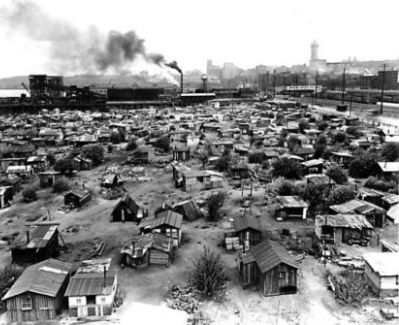
b)
Banks made loans throughout the Great Depression, helping people pays bills until they could find work.
c)
Banks were able to people's deposits safe, but they could not loan out any more money.
d)
Banks were not at all involved in the Great Depression because people did not use them.
4.
What was the main reason for the emergence of “Hoovervilles” like the one shown in the photograph?
a)
Many Americans had lost jobs during the Great Depression.
b)
Thousands of homes had been destroyed by the effects of the Dust Bowl.
c)
Housing projects could not keep up with the demand for homes needed by the poor.
d)
Preparations for World War I had created a shortage of building materials.
5.
During the 1930s, poor land management and severe drought conditions across parts of the Midwest resulted in the
a)
formation of the United States Department of Agriculture
b)
creation of wheat surpluses
c)
growth of the Populist movement
d)
development of Dust Bowl conditions on the Great Plains
6.
Which of these statements is true of the 1932 presidential election?
a)
Franklin Roosevelt won in a landslide.
b)
Hoover lost by a narrow margin.
c)
Huey Long ran a strong third-party campaign.
d)
Roosevelt won a third term.
7.
A major difference between the philosophies of President Herbert Hoover and President Franklin D. Roosevelt in responding to the Great Depression is that Roosevelt
a)
wanted to rely on private charities to provide assistance
b)
stressed the need for individual rugged individualism
c)
supported direct relief to people out of work
d)
thought the government should not be involved in economic reform
8.
FDR addressed the American public in weekly broadcasts known as:
a)
FDR Hour
b)
Hangin' With Franklin
c)
Fireside Chats
d)
Around the Fire
9.
What was a guiding principle of the New Deal economic policies?
a)
Pro-business tax breaks would solve the problems associated with urban poverty.
b)
Antitrust legislation would destroy the free market economy of the United States.
c)
Rugged individualism must be allowed to solve social inequality.
d)
Government must assume more responsibility for helping the poor.
10.
As part of the New Deal, the Securities and Exchange Commission (SEC) and the Federal Deposit Insurance Corporation (FDIC) were created to
a)
allow for a quick recovery of stock prices
b)
provide direct loans to businesses
c)
protect individual investors from stock fraud and bank failure
d)
allow banks and companies to invest in the stock market
11.
The Civilian Conservation Corps (CCC) and the Works Progress Administration (WPA) were both New Deal programs developed to address the problem of
a)
excessive stock market speculation
b)
high unemployment
c)
increased use of credit
d)
limited income of senior citizens
12.
The TVA is significant because it hired people to 
a)
deliver food to the poverty-stricken Dust Bowl residents
b)
build dams and generators that provided electricity
c)
work on farms to help stabilize agriculture
d)
publish important facts about businesses
13.
An advocate of President Franklin D. Roosevelt’s farm policy would have likely supported which economic strategy?
a)
Reducing agricultural output to increase product values
b)
Utilizing minimum wage laws to stimulate farm productivity
c)
Allowing market forces to operate freely to achieve stabilization
d)
Increasing agricultural production to ensure an affordable food supply
14.
How would an African American during the Great Depression most likely have felt about the New Deal?
a)
Disappointed, because the TVA failed to bring power to African American farmers in its Rural Electrification Program.
b)
Outraged, because African Americans were ineligible for any benefits under New Deal programs.
c)
Frustrated, because the CCC and other work programs discriminated against African Americans.
d)
Angry, because President Franklin D. Roosevelt did not attempt to restrain his racially insensitive views.
15.
Passage of the Social Security Act (1935) helped American workers by 
a)
creating jobs for the unemployed
b)
guaranteeing a minimum wage
c)
legalizing the right to join labor unions
d)
providing financial assistance after retirement
16.
Senator Huey Long, Dr. Francis Townsend, and Father Charles Coughlin are best known as
a)
members of President Franklin D. Roosevelt’s cabinet
b)
outspoken critics of President Franklin D. Roosevelt’s New Deal
c)
supporters of President Franklin D. Roosevelt’s reelection campaign in 1940
d)
members of the Supreme Court nominated by President Franklin D. Roosevelt
17.
A major result of the New Deal was that it
a)
eliminated poverty in the US
b)
extended the merit system in the civil service
c)
destroyed the private enterprise system
d)
greatly increased the size and power of the Federal Government
18.

What economic practice became popular in the 1920s and eventually contributed to the crash of the stock market?

a)

Paying only cash for stock purchases

b)

Selling stocks in very rapid succession

c)

Buying stocks with only a down payment

d)

Sharing insider information on stock trades

19.

● Major drought conditions in Texas, Oklahoma, Kansas

● Large numbers of bank failures

● Widespread unemployment

● Expanded role of the federal government


The events listed are most closely associated with which decade?

a)

1910-1919

b)

1920-1929

c)

1930-1939

d)

1940-1949

20.

What kind of changes to American society were the defining issues of both the Great Depression and the New Deal?

a)

Artistic issues

b)

Economic issues

c)

Geographic issues

d)

Chronological issues

21.

Which of the following actions taken by President Franklin D. Roosevelt in response to the Great Depression is a defining characteristic of the era?

a)

Limited movement of farm workers

b)

Reduced number of federal employees

c)

Relaxed restrictions on immigrant workers

d)

Increased number of new government relief programs

22.

Which event signaled the beginning of the Great Depression?

a)

Purchase of Alaska

b)

Election of Franklin D. Roosevelt

c)

Crash of the New York Stock Exchange

d)

Charles Lindbergh's non-stop flight over the Atlantic

23.

Which government agency, established during the Great Depression, still protects consumer savings today?

a)

Social Security Agency

b)

National Resources Committee

c)

Federal Emergency Relief Agency

d)

Federal Deposit Insurance Corporation

24.

Which American novel provides a vivid depiction of the difficulties individuals faced during the Great Depression?

a)

Upton Sinclair's The Jungle

b)

John Steinbeck's Grapes of Wrath

c)

F. Scott Fitzgerald's The Great Gatsby

d)

Ernest Hemingway's A Farewell to Arms

25.

How did high U.S. tariffs on imports likely contribute to the Great Depression?

a)

Other nations raised tariffs that cut U.S. exports.

b)

The United States experienced a rapid rise in inflation.

c)

Other nations boycotted U.S. goods because of high prices.

d)

The United States experienced a moderate rise in employment.

26.

How did the Great Depression impact employment?

a)

The number of people employed stayed consistent.

b)

The number of people employed increased sharply.

c)

The percentage of people unemployed increased sharply.

d)

The percentage of people in the military decreased steadily.

27.
What year did the Great Depression start?
a)
1932
b)
1936
c)
1929
d)
1926
28.
Poor land usage and drought in the West led to what environmental disaster?
a)
Great Oil Spill
b)
Dust Bowl
c)
Great Well Dry Up
d)
The Great Burning
29.
What is it called when a lot of people take their money out of the bank and it runs out?
a)
Bank Failure
b)
Bank Run
c)
Bank Blitz
d)
Bank Closure
30.
Entitlement program that gives the elderly and the disabled money.
a)
FDIC
b)
SEC
c)
TVA
d)
Social Security
31.
What form of technology did FDR use to give his “fireside chats”?
a)
Film
b)
television
c)
Newspaper
d)
Radio
32.
What is it called to send someone back to their home country?
a)
Repatriation
b)
A Send Back
c)
Export
d)
Exonerate
33.
What is “betting on the stock market” called? But low, sell high!
a)
Buying on Margin
b)
Speculation
34.
What was the main goal of the New Deal?
a)
Increase control of state governemnts
b)
increase immigrant population
c)
reduce unemployment
d)
create a fourth branch of government
35.
Whose job is it to maintain economic stability after the New Deal?
a)
Federal Government
b)
State Government
36.
Which New Deal agency provided employment for individuals like the man in the photo?
a)
Agricultural Adjustment Administration(AAA)
b)
Social Security Administration (SSA)
c)
Works Progress Administration (WPA)
d)
Federal Deposit Insurance Corporation(FDIC)
37.
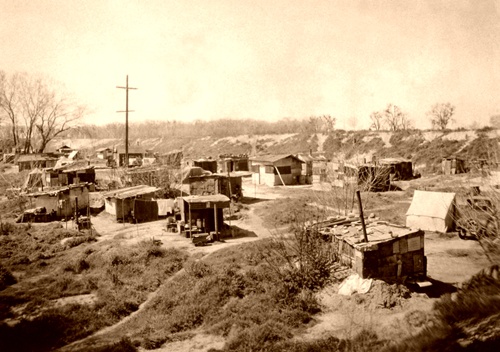
The situation shown in this photograph occurred in which region?
a)
Ohio River valley
b)
Rocky Mountains
c)
Great Plains
d)
Northeast
38.
What was the main reason for the emergence of “Hoovervilles” like the one shown in the photo?
a)
Many Americans had lost jobs during the Great Depression.
b)
Thousands of homes had been destroyed by the Dust Bowl.
c)
Housing projects couldn't keep up with homes needed.
d)
Prep for WW II had created a shortage of building materials.
39.
During the 1920s, which economic trend helped cause the Great Depression?
a)
buying goods on credit
b)
saving rather than spending
c)
continuing shortages of consumer goods
d)
imposing low tariffs on imported products
40.
Senator Huey Long, Dr. Francis Townsend, and Father Charles Coughlin are best known as
a)
members of President Franklin D. Roosevelt’s cabinet
b)
outspoken critics of President FDRs New Deal
c)
supporters of President FDR reelection campaign in 1940
d)
members of the Supreme Court nominated by President FDR
41.
What was a major cause of the Great Depression?
a)
overproduction and underconsumption
b)
a decrease in the supply of consumer goods
c)
an increase in demand for imported products
d)
an increase in the price of wheat on the worldmarket
42.
The New Deal changed American political thinking because it was based on the principle that the
a)
economy will fix itself if left alone
b)
federal government should solve social and economic problems
c)
political parties must work together to deal with problems
d)
states should solve social issues
43.

True or False, people kept naming lots of things in relation to Hoover because he was a great help during the Great Depression?

a)

True

b)

False

44.

What industry was the main reason the railway's were struggling?

a)

Energy sources

b)

Airplane

c)

Taxi Service

d)

Automobiles

45.

What was Hoover's level of concern regarding the beginning of the Great Depression?

a)

Ehh, who cares I am president.

b)

It's not a big deal, this happens all the time.

c)

Okay, we need to act fast!

d)

Mayday, Mayday, the world is ending!

46.
What happened to farmers' income during the 1920s?
a)
their income went down due to a surplus of crops.
b)
more people decided to move east.
c)
their income went up due to the end of the war
d)
more people decided to become farmers.
47.
According to the graph, during which year did the Great Depression have the most  negative impact on the American economy? 
a)
1929
b)
1933
c)
1939
d)
1937
48.
The stock market crash hurt many Americans because -
a)
the price of farm equipment fell
b)
international trade stopped
c)
their stocks became worthless
d)
social security went bankrupt.
49.
Building roads, schools and improving government buildings are examples of which  federal work program?
a)
 Agricultural Achievement Act 
b)
Civilian Conservation Corp  
c)
Works Progress Administration  
d)
Tennessee Valley Authority 
50.
This type of New Deal program was long term, meant to help industry and agriculture, & housing
a)
relief
b)
reform
c)
recovery
51.
This type of New Deal program gave immediate, temporary help to unemployed Americans
a)
relief
b)
reform
c)
recovery
52.
This ideology & president is associated with the belief that the economy would correct itself.  He did not support direct relief.
a)
Conservative;F.D.Roosevelt
b)
Liberal;Hoover
c)
Conservative;Hoover
d)
Radical;FDR
53.
This was the name for the set of programs put in place by FDR to help the depression era economy.
a)
fireside chat
b)
bank holiday
c)
New Deal
d)
packing the court
54.
This was the name for the set of programs put in place by FDR to help the depression era economy.
a)
fireside chat
b)
bank holiday
c)
New Deal
d)
packing the court
55.
Where did Hoover expect the aid to the poor would come from? 
a)
churches & private charities
b)
state government
c)
federal government
d)
foreign countries
56.
This New Deal reform program insured checking and savings accounts. 
a)
Civilian Conservation Corps
b)
Fair Labor Standards Act
c)
Federal Deposits Insurance Corporation
d)
Social Security Act
57.
Which New Deal program employed young men to work on various projects to improve the country?
a)
Social Security Act
b)
Fair labor Standards Act
c)
Rural Electrification Act
d)
Civilian Conservation Corps
58.
Which New Deal program set aside savings through taxes for unemployment, the disabled or retirement? 
a)
Federal Deposits Insurance Corporation
b)
Social Security Act 
c)
Agricultural Adjustment Act
d)
Civilian Conservation Corps
59.

What was the first order of business by FDR when he got into office?

a)

End the depression

b)

closed the stock market for a week

c)

bank holiday

d)

close Hoovervilles

60.
What New Deal program was created in first 100 days to offer relief in the form of relief checks given to states?
a)
FERA
b)
TVA
c)
FDIC
d)
NYA
61.
During the New Deal, how did the government attempt to improve conditions for farmers through the AAA?
a)
By ending the practice of sharecropping
b)
By raising tariffs on farm imports
c)
By paying farmers to grow fewer crops
d)
By training farmers for jobs in a new field
62.
What cause of the Great Depression did the Agricultural Adjustment Act (AAA) attempt to solve?
a)
Stock market speculation
b)
Overproduction
c)
Weak banking system
d)
Unsafe loans
63.
The following may all be true of her, but why was the role of first lady Eleanor Roosevelt SIGNIFICANT?
a)
She was a distant cousin of FDR
b)
She traveled the country, taking on efforts to solve major issues
c)
She had five children
d)
She was the niece of Theodore Roosevelt
64.

Social Security was created to assist

a)

poor elderly

b)

widows & their children

c)

poor disabled

d)

all of the above

65.

This act awarded contracts to companies to build dams, schools, etc

a)

Glass-Steagall Act

b)

Wagner Act

c)

Civilian Conservation Corp

d)

Public Works Administration

66.

Migrants from the Great Plains headed west in search of better lives were called

a)

Okies

b)

Speculators

c)

Wagners

d)

Hoosier

67.

This act offered unemployed men work planting trees & building reservoirs

a)

Wagner Act

b)

Glass-Steagall Act

c)

Civilian Conservation Corp

d)

Public Works Administration

68.

Senator Huey Long called for

a)

redistribution of wealth

b)

a balanced budget

c)

pension for seniors over 60

d)

government to stop interfering

69.

What is one way that charities helped the poor during the Great Depression?

a)

Hoovervilles

b)

Soup kitchens

c)

Dust bowls

d)

Public works

70.

President Roosevelt's bold reforms were called the

a)

Wagner Act

b)

Liberty Plan

c)

New Deal

d)

Townsend Plan

71.

To regulate the stock market, Congress created the

a)

Public Works Administration

b)

Tennessee Valley Authority

c)

Securities & Exchange Commission

d)

Federal Deposit Insurance Corporation

72.

Farmers on the Great Plains lost their crops to

a)

technology changes

b)

frequent rain

c)

soil fungus

d)

terrible drought

73.

Roots of the Depression included overproduction, high tariffs, and

a)

uneven distribution of wealth

b)

inadequate money supply

c)

over-spending by government

d)

excessive reliance on export sales

74.

As a result of the stock market crash, banks were forced to

a)

attract more depositors

b)

approve more loans

c)

increase interest rates

d)

close their doors

75.

The day the Stock Market took its deepest dive was called

a)

Red Thursday

b)

Black Tuesday

c)

Black Friday

d)

Bloody Sunday

76.

What was the "New Deal" of the 1930s?

a)

a government program that gave free land to homesteaders

b)

a government program that helped women get the vote

c)

a government program that spread civil rights throughout the country

d)

a government program designed to help people during the depression

77.
President Franklin Roosevelt asked Congress to pass a series of acts called the New Deal. Which is one way the New Deal helped people during the Great Depression?
a)
It gave all people the right to vote. 
b)
It created programs to put people back to work.    
c)
It let all new immigrants become American citizens. 
d)
It let people travel around the country freely. 
78.
The Great Depression was an economic slowdown in the 1920s and 1930s. Which of the following was one cause of the Great Depression in the United States?
a)
the end of the gold rush 
b)
the crash of the stock exchange 
c)
the ending of World War II 
d)
the high price of oil 
79.
Many people lost their jobs during the Great Depression. People did not have money to pay for necessities, such as shelter, food, and clothing. The national government responded with President Franklin Roosevelt's "New Deal," a program that
a)
provided programs to help people make money to provide for their needs. 
b)
provided new ways for people to apply for unemployment insurance. 
c)
forced people to join the military forces to make money for their needs. 
d)
forced people to use charities to help them provide for their needs. 
80.
When the stock market crashed in 1929, Herbert Hoover was president of the United States. The president who followed President Hoover began the New Deal, a program to help people during the Great Depression. This president was
a)
Warren Harding
b)
Calvin Coolidge
c)
Franklin Roosevelt
d)
Herbert Hoover
81.
This natural disaster served to worsen the effects of the Great Depression on Farmers in the Midwest 
a)
Tornados
b)
Dust Bowl
c)
Black Tuesday 
d)
Hurricanes
82.
What was the Emergency Banking Relief Bill used by FDR to do?
a)
To fix all the bad banks that were in financial trouble
b)
To fix the problems farmers were experiencing that had led to the Dust Bowl
c)
To fix all the bad banks by making them pay money to the Federal Government
d)
To fix the Subsidy system that was given to bank owners
83.
How did the Agricultural Adjustment Administration work to stop the occurrence of another Dust Bowl?
a)
By teaching farmers mondern farming techniques
b)
By working to increase the usage of irrigation to prevent future droughts
c)
By paying a subsidy to farmers so they would not over farm
d)
By paying a subsidy to farmers so that they could afford better machinery to produce more crops
84.
What is the underlying message of this political cartoon?
a)
FDR is taking the necessary steps to fix the American economy
b)
Some sacrifices must be made to stabilize the ecoomy
c)
FDR was on a path to become a dictator because of the power he had
d)
FDR would never become a Dictator because he had polio
85.
FDR's response to the Supreme Court's decision that declared several of his New Deal laws unconstitutional was to...
a)
Ask Congress to limit the Court's jurisdiction
b)
Propose legislation to increase the size of the court
c)
Deman the resignation of several justices
d)
Ignore the court's rulings
86.
The following picture is an example of what aspect from the Great Depression era?
a)
Hoovervilles
b)
Dust Bowl
c)
People moving to California
d)
Stock Market Crash
87.
These were a series of radio addresses given by President Roosevelt
a)
Hooverville
b)
GNP
c)
Fireside chats
d)
Black Tuesday
88.
What was a guiding principle of the New Deal economic policies? 
a)
Pro-business tax breaks would solve the problems associated with urban poverty
b)
Antitrust legislation would destroy the free market economy of the United States 
c)
Rugged individualism must be allowed to solve social inequality
d)
Government must assume more responsibility for helping the poor