
 Worksheets
Waves and Sound Review Game
Total questions: 40
Worksheet time: 28mins
The low point of a transverse wave
crest
trough
amplitude
wavelength
frequency
Half the perpendicular distance from the top of a crest to the bottom of a trough
crest
trough
amplitude
wavelength
longitudinal
Waves that can travel through empty space
crest
trough
amplitude
wavelength
electromagnetic
Unit for measuring frequency
hertz
meters
seconds
meters/seconds
Newton
A traveling wave which causes matter to move at right angles to the direction of the wave
mechanical
transverse
longitudinal
hertz
What is transported by a wave?
air
energy
matter
particles
Lance and Kasi conduct an activity using a slinky. Lance fixes one end of the slinky against a fixed support. He then moves the slinky back and forth, as shown.
Kasi sees the wave moving towards the fixed support. What is true for this mechanical wave?
It transmits energy only
It transmits matter only
It transmits both matter and energy
It transmits both energy and a medium
What kind of wave requires the particles of a medium to vibrate and transfer energy?
infrared light wave
Radio Wave
Seismic Wave
Visible light wave
Which wave is classified as a mechanical wave?
microwave
infrared wave
sound wave
radio wave
Which type of wave can be a longitudinal wave?
light waves
seismic wave
electromagnetic wave
surface ocean waves
Which list below includes mechanical waves only?
seismic waves, sound waves, and water waves
radio waves, sound waves, waves in a rope
infrared rays, ultraviolet rays, visible light
seismic waves, microwaves and x-rays
An undersea earthquake centered 1000 miles off the coast of Hawaii creates a tsunami headed toward the Hawaiian coast. This tsunami encounters a fishing boat 500 miles from the coast. What will happen to the boat?
The tsunami will pick up the boat at its current position and carry the boat on its crest all the way into the coast.
The tsunami will carry the boat toward the coast for many miles, but because the boat is so large, the wave canot carry it all the way to shore.
The boat will be lifted up as the wave passes beneath it, and then be pushed many miles from the coast.
The boat will bob up and down as the wave passes beneath it, but the wave will not carry the boat either toward or away from shore.

This diagram shows two different ways to represent longitudinal waves.
Which letter corresponds to rarefaction in the waves?
Z
X
W
Y
This diagram shows two different ways to represent longitudinal waves.
Which letter corresponds to rarefaction in the waves?
Z
X
W
Y

The diagram shows a research vessel using sonar to map the ocean floor.
Upon which basic behavior of sound waves does this technology depend?
absorption
compression
reflection
refraction
Through which medium is it impossible to transmit sound waves?
space
rock
air
water
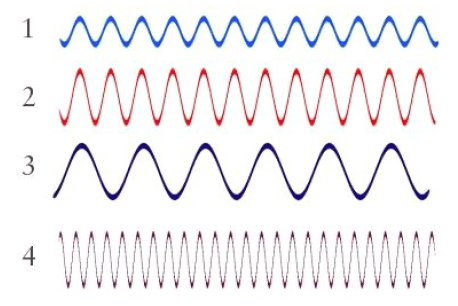

This picture is an example of a
longitudinal wave
transverse wave
i do not know and do not wish to answer.

This picture is an example of which type of wave?
transverse wave
longitudinal wave
ocean wave
I do not know and do not wish to answer.

#1 refers to the
wavelength
amplitude
crest
trough
#2 refers to the
wavelength
amplitude
crest
trough
#3 refers to the
wavelength
amplitude
crest
trough
#4 refers to the
wavelength
amplitude
crest
trough
Wavelength= .5m
Frequency= 150 hertz
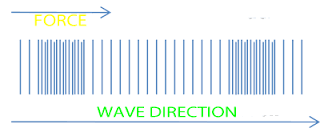
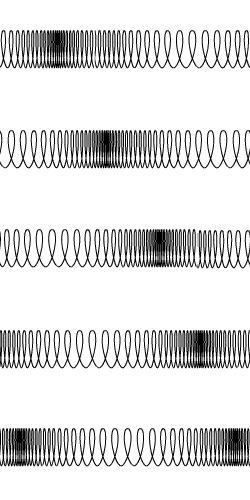
Which type of wave can travel through mass and a vacuum?
Electromagnetic
Mechanical
Electromagnetic and Mechanical
Which type of wave is an ocean wave?
Electromagnetic
Mechanical
What type of wave is an X ray?
Electromagnetic
Mechanical


