wayground logo

Free Printable Worksheets

NEW

Font size

S
M
L
XL
Worksheets

Term 1 Science Revision

Total questions: 54

Worksheet time: 27mins

Name
Class
Date
1.

The data table below shows that as the pressure of a gas sample was changed, the volume of the gas changed. The pressure was measured in atmospheres (atm) and the volume was measured in milliliters (mL).


According to the data table, as the pressure of the gas increases, the volume of the gas:

a)

decreases

b)

increases

c)

remains the same

2.

What is the difference between the number of frogs in the pond when the rainfall was 5cm and when the rainfall was 20cm?

a)

20

b)

40

c)

50

d)

60

3.

The graph below shows tidal changes at an ocean beach over a 24-hour time period.


What is the approximate time interval between the two high tides?

a)

6 hours

b)

9 hours

c)

13 hours

d)

24 hours

4.

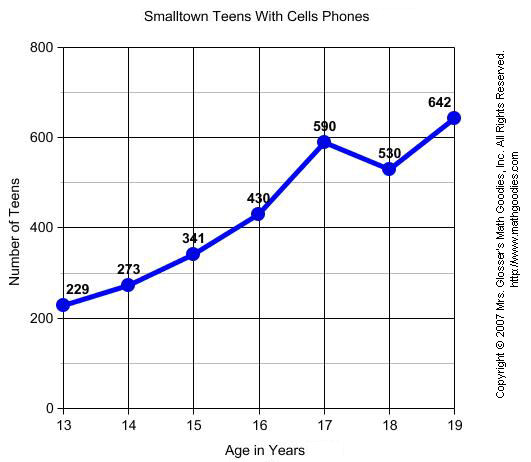
What type of graph is this?

a)

line plot

b)

line graph

c)

bar graph

d)

frequency table

5.
What label is along the y-axis in this graph?
a)
Copyright 2007
b)
Lines
c)
Age in Years
d)
Number of Teens
6.

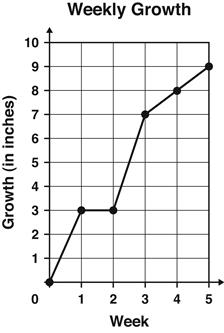
The graph shows the number of inches a plant grew each week.

Between which 2 weeks did the plant grow the MOST?

a)

Week 1 and Week 2

b)

Week 2 and Week 3

c)

Week 3 and Week 4

d)

Week 4 and Week 5

7.
The X axis is _______?
a)
vertical
b)
diagonal
c)
criss-cross
d)
horizontal
8.
The Y axis is _______?
a)
Vertical
b)
Horizontal
c)
criss-cross
d)
diagonal
9.

Students collected trash on a beach over a one-year period and organized the data in the table below.


Which graph is best to display the data shown in the table?

a)
b)
c)
d)
10.

A scientist wanted to see if the amount of garbage that Americans threw away changed over time. He collected information and then showed his results in the graph below.


Based on this graph, what could the scientist say about the amount of garbage that each person threw away?

a)

It increased over time

b)

it decreased over time

c)

it increased the most in 1980

d)

It decreased the most in 1990

11.
Which observation is quantitative?
a)
It is 5 cm long
b)
It is smooth
c)
It looks red
d)
It is dry
12.

These kind of observations are made using instruments such as rulers, balances and thermometers.

a)

qualitative

b)

quantitative

13.

The temperature of the room is decreasing by 4 degrees Celsius.

a)

qualitative

b)

quantitative

14.

The clouds are grey and ground is wet.

a)

qualitative

b)

quantitative

15.
The number of orange Skittles in a bag. 
a)
Discrete
b)
Continuous
16.
The number of suitcases lost by airlines. 
a)
Discrete
b)
Continuous
17.
Joe is losing an average of .5 pounds a week.  Is this continuous or discrete data?
a)
Discrete
b)
Continuous
18.
In discrete functions, the x-values...
a)
Can be all numbers
b)
Can only be whole numbers
c)
Can only be decimals
19.
In continuous functions, the x-values...
a)
Can be all numbers
b)
Can only be whole numbers
c)
Can only be decimals
20.

What is MATTER?

a)

Anything that has MASS

b)

Anything that takes up SPACE

c)

Anything that has MASS and takes up SPACE

d)

Anything that DOES NOT have mass or take up space

21.

All matter is made up of tiny _______________

a)

energy

b)

particles (atoms and molecules)

c)

bits

d)

antimatter

22.

All particles in a PURE SUBSTANCE are _________________

a)

the same

b)

different

23.

Particles are always moving.

a)

True

b)

False

24.

Particles always ________________ each other, this gets stronger as the particles get ___________________.

a)

attract, farther apart

b)

attract, closer together

c)

repel, farther apart

d)

repel, closer together

25.

Particles at a higher temperature, move _____________ than those at a lower temperature.

a)

faster

b)

slower

26.
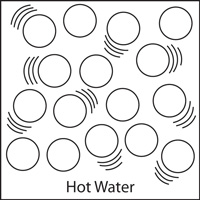
a)

Solid

b)

Liquid

c)

Gass

27.

In which state of matter will there be the LARGEST space between molecules?

a)

Solid

b)

Liquid

c)

Gas

28.

What is between atoms and molecules

a)

Air

b)

Empty space

c)

Magic

d)

Gas

29.

Which of the following is a correct description for solids?

a)

closely arranged and in fixed positions

b)

closely arranged and vibrate in fixed positions

c)

closely arranged and can move around

30.

Which statement about the molecules in the gas carbon dioxide is correct?

a)

The molecules are close together.

b)

The molecules are diatomic.

c)

The molecules move randomly.

d)

The molecules all move with the same speed.

31.

When something goes from gas to liquid, it is called...

a)

Evaporation

b)

Condensation

c)

Deposition

d)

Freezing

32.

Something that goes from liquid to gas is...

a)

Evaporation

b)

Melting

c)

Freezing

d)

Sublimation

33.

Which of the following sentences are true about solids?

a)

Solids are rigid, have a fixed shape but not a fixed volume

b)

Solids are not rigid, have a fixed shape and no fixed volume

c)

Solids are rigid, have a fixed shape and a fixed volume
34.
Which of the following statements about the particle of a gas is true?
a)
Gases can be compressed because their particles are smaller than those of liquids or solids.
b)
Gases can be compressed because there is plenty of space between their particles.
c)
Gases can be compressed because they have low boiling points.
d)
Gases can be compressed because their particles are more elastic than those of liquids or solids.
35.
Which of the following statements about the kinetic particle theory is not true?
a)
The particles of a gas move faster than those of a liquid.
b)
The particles of a solid have more kinetic energy than those of a gas.
c)
The particles that make up matter are always moving.
d)
The forces of attraction between the particles of a solid are very strong.
36.
Freezing
a)
Solid to gas
b)
Liquid to solid
c)
Gas to solid
d)
Liquid to gas
37.
The speed of the molecules determines the _____.
a)
volume
b)
density
c)
pressure
d)
temperature
38.
The slower the particles in a substance move,
a)
the colder it is.
b)
the warmer it is.
c)
the more energy it has.
d)
the less energy it has.
39.
Thermal energy is...
a)
heat energy.
b)
the energy of motion
c)
energy of nuclear processes.
d)
an indication of physical change.
40.
A physical change is...
a)
a change that doesn't change the identity
b)
a change that makes something new.
c)
a chemical reaction
41.
A chemical change
a)
doesn't really change much.
b)
creates a new substance
c)
is a change in the state of matter
42.
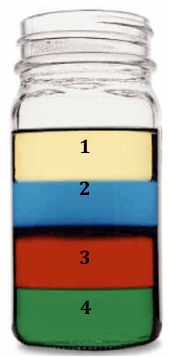
Put the liquids in order from most dense to least dense?
a)
4, 3, 2, 1
b)
1, 2, 3, 4
c)
3, 4, 2, 1, 
d)
4, 3, 1, 2
43.
Why does ice float?
a)
Liquid water is less dense than solid water.
b)
Solid water is less dense than liquid water.
c)
Gaseous water is less dense than solid water.
d)
Liquid water is less dense than gaseous water.
44.
What do we know about the density of lamp oil, rubbing alcohol, and vegetable oil?  
a)
The density is greater than 1.0 g/mL
b)
The density is less than 1.0 g/mL
c)
The density is equal to 1.0 g/mL
d)
The density can not be determined
45.
In general what is the most dense form of matter?
a)
solid
b)
liquid
c)
gas
d)
plasmas
46.
If an object has a density of .6 g/cm^3 and you put it into water, will it sink or float?  
a)
sink
b)
float
47.
What is the formula for density?
a)
density = mass x volume
b)
density = mass / volume
c)
density = mass + volume
d)
density = mass - volume
48.
Jack has a rock. The rock has a mass of 14 g and a volume of 2 cm3. What is the density of the rock?
a)
7 mL
b)
7 g/cm3
c)
28 g/cm3
d)
1/7 g/cm3
49.
Frank has a liquid. It has a mass of 6 g and a volume of 9 mL. What is its density?
a)
3 g/mL
b)
.66 g/mL
c)
1.33 g/mL
d)
54 g/mL
50.
Calculate the density of the cube.
a)
2 g/cm3
b)
4 g/cm3
c)
6 g/cm3
d)
8 g/cm3
51.
If this substance takes up 6 ml of space, what is its mass?
a)
 6 ml
b)
6 grams
c)
0 grams
d)
4 grams 
52.
Adding or removing ______ will change the state of matter
a)
Mass
b)
Energy
c)
Density
53.
Which tool would you use to measure an objects temperature?
a)
Triple Beam Balance
b)
Magnet
c)
Pan Balance
d)
Thermometer
54.
Which of the following does NOT describe a liquid?
a)
Takes the shape of its container
b)
Pours easily
c)
Keeps its size and shape
d)
Escapes into air