wayground logo

Free Printable Worksheets

Font size

S
M
L
XL
Worksheets

Evolution Review

Total questions: 60

Worksheet time: 1hrs 23mins
Name
Class
Date
1.
This mechanism of evolution occurs when individuals migrate between populations.
a)
Extinction
b)
Gene flow
c)
Genetic drift
d)
Natural Selection
2.
Genetic drift is change in the allele frequency of a population due to...
a)
random chance
b)
natural selection
c)
non-random mating (sexual selection)
d)
artificial selection
3.
Which of the following is a factor in natural selection?
a)
Individuals of species compete with one another to survive.
b)
All species are genetically diverse.
c)
Individuals better able to adapt to changes leave more offspring.
d)
All are correct 
4.
The fossil record provides evidence that 
a)
Fossils cannot be dated.
b)
All species were formed during Earth’s formation and have changed little since then.
c)
The fossilized species have no connection to today’s species.
d)
Older species gave rise to more-recent species.
5.
Individuals that are better able to cope with the challenges of their environment tend to  
a)
Decrease in population over time.
b)
Leave more offspring than those less suited to the environment.
c)
Leave fewer offspring than those less suited to the environment.
6.
Structures that share a common ancestry or are similar because they are modified versions of structures from a common ancestor that contain the same basic bone structure are
a)
Not related.
b)
Not homologous. 
c)
Homologous.
d)
Young in origin.
7.

When animals with varied traits reproduce sexually, chromosomes are crossed over in prophase I which creates new alleles, this mechanism of evolution is

a)

mutation

b)

gene flow

c)

genetic recombination

d)

natural selection

8.

A few deer wander out of their native woods into a completely new park where no deer had ever been before. They go on to create an entirely new population.

a)

Genetic Drift - Founder Effect

b)

Natural Selection

c)

Gene Flow

d)

Genetic Drift - Bottleneck

9.
Genetic drift is change in the allele frequency of a population due to...
a)
random chance
b)
natural selection
c)
non-random mating (sexual selection)
d)
artificial selection
10.
 Genetic Drift is more likely to happen in... 
a)
aquatic populations
b)
small populations
c)
terrestrial populations
d)
older populations
11.
What do we call change over time?
a)
Evolution
b)
Natural Selection
c)
Natural Variation
d)
Speciation
12.

What is another name for natural selection?

a)

survival of the smartest

b)

survival of the fastest

c)

survival of the biggest

d)

survival of the fittest

13.

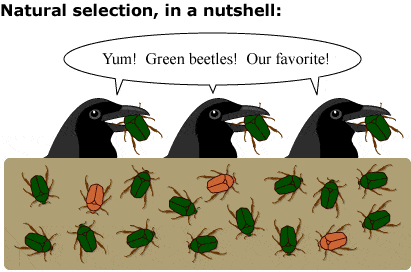
What is this an example of?

a)

diversity of species

b)

variation

c)

vestigial structures

d)

DNA studies

14.

When individuals choose traits possessed by the opposite sex it is called…

a)

Mutation

b)

Gene Flow

c)

Genetic Drift

d)

Sexual Selection

15.
What is non-random mating?
a)
proof of common ancestry
b)
when things don't go well on a date
c)
randomly mating with others
d)
choosing who you mate with
16.
Which mechanism shows genes leaving (immigration) or coming into (emigration) a gene pool?
a)
mutations
b)
natural selection
c)
gene flow
d)
non-random mating
17.
When lions prey on a herd of antelopes, some antelopes are killed and some escape. Which part of Darwin’s concept of natural selection might be used to describe this situation?
a)
reproductive isolation
b)
descent with modification
c)
acquired characteristics
d)
survival of the fittest
18.
Organisms with traits that are favorable to their survival and reproduction are ________ likely to pass on their genes to the next generation, and thus ________ common in the population
a)
more, less
b)
more, more
c)
less, less
d)
less, more
19.

IF 50 BROWN BUGS AND 50 GREEN BUGS ARE LIVING IN GREEN GRASS, THEN BIRDS WILL EAT MORE ________ INSECTS AND THE POPULATION OF __________ INSECTS WILL INCREASE.

a)

BROWN / GREEN

b)

GREEN / BROWN

c)

YELLOW / ORANGE

20.

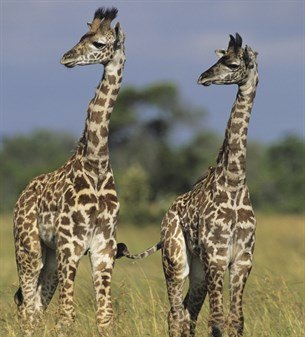
DARWIN BELIEVED THAT long necked GIRAFFES

a)

SURVIVED AND REPRODUCED

b)

STRETCHED THEIR NECKS TO GET FOOD

c)

OVERTIME GREW LONGER NECKS

21.
An inherited characteristic that increases an organisms ability to survive and reproduce in its specific environment is called a(n)
a)
vestigial structure
b)
speciation
c)
analogous structure
d)
adaptation
22.
According to the theory of natural selection, some individuals more likely than others to survive and reproduce because they:
a)
pass on to their offspring their newly acquired traits.
b)
are better adapted to their environment than others and will pass on those adaptations to future offspring.
c)
do not pass on newly acquired traits.
d)
produce fewer offspring than others in the same environment.
23.

A gene pool consists of

a)

all of the genes, including all the different alleles, that are present in a population

b)

some of the genes, including the different alleles, that are present in a population

c)

all of the genes that are present in all populations

d)

all of the genes, including all the different alleles, that are present in all populations

24.

Evolution can be defined as a ____________

a)

change in the frequency of an allele in a population over time

b)

change in the frequency of reproduction in a population

c)

change in the frequency of an allele in an individual

25.
The study of the early stages of development that is one evidence of evolution is:
a)
Homologous Structures
b)
Embryology
c)
Vestigial Organs
26.
Evolutionary Similarities that can be seen in organisms by comparing their DNA is called-
a)
Biochemical Similarities
b)
Embryology
c)
Vestigial Structures
d)
Homologous Structures
27.
The table shows the survival rate of two types of beetles in the same environment over a period of three years.  

Which statement about the beetles in this environment is best supported by the data?
a)
Brown beetles have a shorter life cycle than green beetles have
b)
Green beetles are more fit for their environment than brown beetles
c)
 brown beetles are undergo more unfavorable mutations than green beetles
28.
Preserved remains of an organism that lived in the past…..
a)
fossil
b)
picture
c)
dinosaur
d)
animal
29.
When an organism is no longer in existence……..
a)
lost
b)
hibernation
c)
extinct
d)
found
30.
Which fossil is relatively the oldest?
a)
Trilobite
b)
Ammonite
c)
Crinoid
d)
Gastropod
31.
Which of the following does the law of superposition tell scientists?
a)
Absolute age
b)
Relative age
c)
Exact age
d)
All of the answer choices
32.

Why are adaptations important for an animals?

a)

They make life pass by more quickly for the animal.

b)

They help them survive in their environment.

c)

They complicate life for the surviving animal.

33.
Ten brown mice and ten white mice are placed in a desert environment. What will happen to the white population over time?
a)
It will increase
b)
It will decrease
c)
It will stay the same
d)
There is no way to tell
34.
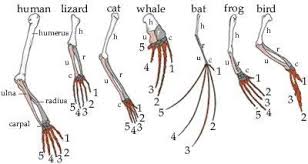
Humans, birds, whales, and lizards all have similar arm bones. What is the reason for this?
a)
The function of these bones is the same in all animals
b)
They live in similar environments
c)
They have a common ancestor
d)
All organisms resemble humans
35.
How old is the Earth?
a)
4.6 billion years
b)
4.6 million years
c)
4.6 thousand
d)
10,000 years
36.
Some species blend in to their environments through ______.
a)
mimicry
b)
camouflage
c)
subterfuge
d)
hiding
37.

The movement of individuals into (or out of) a population is called:

a)

Gene Flow

b)

Genetic Drift

c)

Allopatric Speciation

d)

Polyploidy

38.

Colourful displays of feathers are often a sign of:

a)

Natural Selection

b)

Sexual Selection

c)

Artifical Selection

d)

Disruptive Selection

39.

Colourful displays of feathers are often a sign of:

a)

Natural Selection

b)

Sexual Selection

c)

Artifical Selection

d)

Disruptive Selection

40.

Credit for the Theory of Evolution by Natural Selection belongs to:

a)

Charles Darwin

b)

Alfred Russell Wallace

c)

Gregor Mendel

d)

Thomas Malthus

41.

What is common ancestry?

a)

When a species no longer exists

b)

When organisms are descended from a single ancestor

42.

What is common ancestry?

a)

When a species no longer exists

b)

When organisms are descended from a single ancestor

43.

The forelimbs of humans, cats, whales, and bats are similar in structure due to having a common ancestor hundreds of millions of years ago. Is this considered homolgy or analogy?

a)

Homology

b)

Analogy

44.

The cave fish and minnow are related to each other but the cave fish is blind and only has the remnants of an eye. What type of structure is this?

a)

vestigial

b)

analogous

45.

What is the study of the similarities and differences in unborn fetuses, or developing organisms?

a)

Paleoclimatology

b)

Comparative embryology

46.
What is this an example of?
a)
vestigial structures
b)
embryology
c)
homologous structures
d)
fossil record
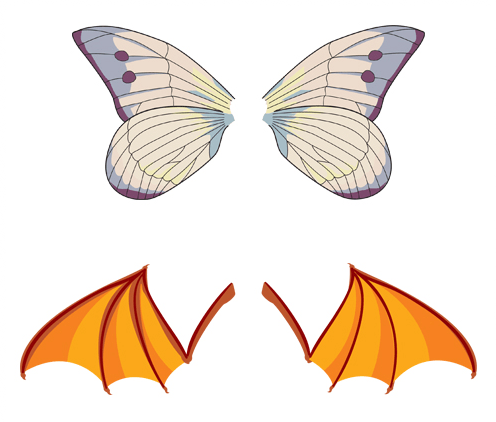
47.

What is this an example of?

a)

Homologous structure

b)

Analogous structure

c)

Vestigial organs

d)

Functional adaption

48.
Which of the following is an example of a vestigial structure?
a)
the wings of a red-tailed hawk
b)
the hind limbs of a house cat
c)
the fins of sharks
d)
the tailbone of a human
49.

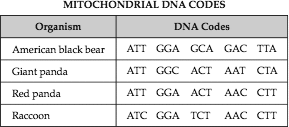
What conclusions can be made based on this table shown?

a)

the American black bear and the giant panda are most closely related

b)

the giant panda and the red panda are most closely related

c)

the red panda and the racoon are the most closely related

d)

the giant panda and the racoon are most closely related

50.
The picture shows the members of the Camelidae family. The physical features and the geographical origin of these animals provide evidence that - 
a)
they live in the same type of environment.
b)
have slowly evolved to become herbivores.
c)
have a common ancestor.
d)
exchanged DNA in the past.
51.
Two organisms that are closely related would have
a)
very similar DNA sequence
b)
exactly the same DNA sequences
c)
no proteins in common
d)
completely different DNA sequence
52.

According to scientists, the Earth is ______ years old

a)

4,000

b)

4.6 billion

c)

4.6 million

d)

400,000

53.

What is the correct order of the appearance of life forms on Earth?

a)

prokaryotic organisms, eukaryotic organisms, multi-cellular organisms

b)

eukaryotic organisms, prokaryotic organisms, multi-cellular organisms

c)

multi-cellular organisms, prokaryotic organisms, eukaryotic organisms

d)

prokaryotic organisms, multi-cellular organisms, eukaryotic organisms

54.

If global climate changed to no snow where the snowshoe hare lives, what will probably happen to the snowshoe hare's fur color in the winter (after several generations)?

a)

The fur will stay white

b)

The fur will be brown all year

c)

The snowshoe hare will not be affected at all

d)

The fur will be light brown.

55.

mimicry -

a)

The false belief that living things can come from non-living things

b)

The hiding of something as a result of its appearance

c)

Ability of an animal to look like another more harmful animal

d)

individuals that have certain inherited traits tend to survive and reproduce

56.

Camouflage -

a)

The false belief that living things can come from non-living things

b)

The hiding of something as a result of its appearance

c)

Ability of an animal to look like another more harmful animal

d)

individuals that have certain inherited traits tend to survive and reproduce

57.
The diagram shows a random change in the population which is:
a)
Gene flow
b)
Gene pool
c)
Genetic drift
d)
Natural selection
58.
When allele frequencies remain relatively constant, ____ has been reached.
a)
Genetic drift
b)
Gene flow
c)
Natural selection
d)
Genetic equilibrium
59.
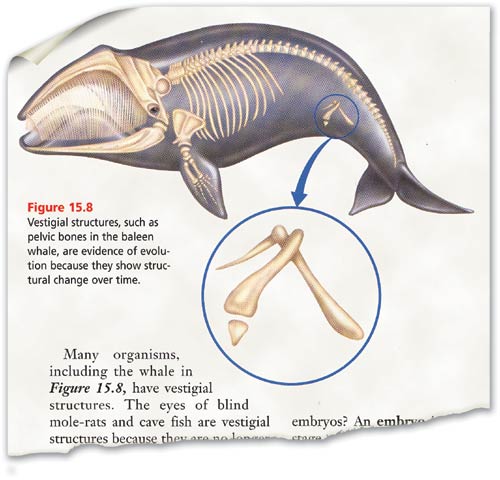
The whale's pelvis is an example of a(n) __ structure. 
a)
Analogous
b)
Homologous
c)
Adaptive
d)
Vestigial
60.
The picture shows the study of the development of organisms, which is the study of:
a)
Anatomy
b)
Biochemistry
c)
Embryology
d)
Paleontology