wayground logo

Free Printable Worksheets

Font size

S
M
L
XL
Worksheets

Physics ni maku

Total questions: 105

Worksheet time: 2hrs 52mins

Name
Class
Date
1.
The momentum of an object depends upon the object's ___________&_____________.  
a)
size and shape
b)
mass and speed
c)
mass and veloctiy
d)
mass and energy
2.
The equation to calculate momentum is
a)
p=mv
b)
p=1/2mv2
c)
p=mgh
d)
p=mg
3.
Determine the momentum of 1000-kg car moving southward at 20 m/s......... 
a)
20000 N
b)
20000 Joules
c)
20000 Kg * m/s south
d)
10000 kg * m/s south
4.
A 2.5 kg ball moving at 5 m/s collides with a 2.5 kg stationary ball in a perfectly elastic collision.  What is the velocity of the second ball after the collision? 
a)
5 m/s
b)
2.5 m/s
c)
10 m/s
d)
7.5 m/s
5.
Momentum is a ____________________ quantity
a)
science
b)
scalar
c)
vector
d)
energy
6.
The impulse is ______ the change in momentum
a)
Greater than
b)
Equal to
c)
less than
d)
always double
7.
When two objects collide, the Pbefore is ____________ the Pafter.
a)
more than 
b)
less than 
c)
equal to
d)
unrelated to
8.
When the speed of an object is doubled, its momentum
a)
remains unchanged in accord with the conservation of momentum.
b)
doubles
c)
quadruples
d)
decreases
9.

A 5 N force is applied to a 3 kg ball to change its velocity from +9 m/s to +3 m/s. The impulse on the ball is ______ N s.

a)

-2.5

b)

-10

c)

-18

d)

-45

10.
A 0.250 kg cart moving at 0.400 m/s has how much momentum?
a)
0.1 kg-m/s
b)
1 kg-m/s
c)
10 kg-m/s
d)
100 kg-m/s
11.
Softer landings tend to
a)
increase impact force
b)
increase force
c)
increase collision time
d)
increase change in momentum
12.
The difference between a car hitting a wall vs. a car hitting a hay stack is
a)
the Impulse on the car hitting the wall is greater
b)
the change in momentum of the car hitting the wall is greater
c)
the force on the car hitting the hay stack is greater
d)
the collision time of the car hitting the hay stack is greater
13.
The units for Impulse are
a)
N/s
b)
N.s
c)
N
d)
m/s
14.
Cart A is pulled with a 2 Newton force for 2 seconds, and Cart B is pulled with a 1 Newton force for 3 seconds.  Which cart experiences the greatest impulse?
a)
Cart B
b)
Cart A
c)
they are the same
15.
The impulse-momentum theorem states that
a)
the impulse on an object is equal to the change in momentum it causes 
b)
the force on a moving object is equal to the magnitude of the impulse.
c)
the impulse on an object is greater than the change in momentum it causes 
d)
the impulse on an object is less than the change in momentum it causes
16.
If an air bag changes a 60 kg person's speed from 40.0 m/s to     0.0 m/s, what impulse must act on the person? 
a)
 2400 kg.m/s
b)
1.5 kg.m/s
c)
0.67 kg.m/s
d)
1500 kg.m/s
17.
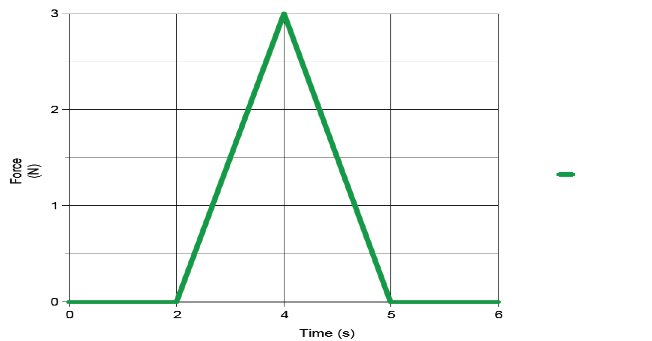
A force acted upon an object for 3 s as shown in the graph below.
What is the magnitude of the impulse on the object?
a)
3
b)
4.5
c)
6
d)
9
18.

Kinetic energy is...

a)

energy carried in ultraviolet waves

b)

energy stored in food

c)

energy in motion

d)

energy from splitting an atom

19.

What two factors affect an object's kinetic energy?

a)

area and volume

b)

mass and weight

c)

weight and height

d)

mass and speed

20.

Kinetic energy is measured in

a)

Newtons (N)

b)

Joules (J)

c)

Kilograms (kg)

d)

miles per hour (mph)

21.

Where would this tossed baseball have the least amount of kinetic energy?

a)

point W

b)

point X

c)

point y

d)

point z

22.

Increasing an object's mass will increase its kinetic energy.

a)

true

b)

false

23.

Increasing an object's speed will increase its kinetic energy.

a)

false

b)

true

24.
How far will an object move in 12 seconds if it is traveling at a velocity of 8 m/s?
a)
96 m
b)
0.7 m
c)
20 m
d)
4 m
25.
Calculate the KE of a moving 4 kilogram object traveling at a velocity of 3 m/s.
a)
18 J
b)
36 J
c)
12 J
d)
6 J
26.
How much KE does a moving 6 kilogram object have if it moves with a velocity of 3 m/s?
a)
27 J
b)
18 J
c)
9 J
d)
2 J
27.
What is the mass of a moving object that has 100 Joules of KE and moves at a velocity of 2 m/s?
a)
50 kg
b)
200 kg
c)
25 kg
d)
100 kg
28.
As mass increases, KE ...
a)
increases
b)
decreases
c)
stays the same
29.
What is the curved path that an object follows when thrown or launched near the surface of the Earth?
a)
Terminal Velocity
b)
Projectile Motion
c)
Free Fall
d)
Gravity
30.

If layers of fluid have frictional force between them, then it is known as viscous.

a)

TRUE

b)

FALSE

31.

According to equation of continuity, when water falls its speed increases, while its cross sectional area decreases.

a)

TRUE

b)

FALSE

32.

If every particle of fluid has irregular flow, then flow is said to be laminar flow.

a)

TRUE

b)

FALSE

33.

According to equation of continuity, when water falls its speed increases, while its cross sectional area decreases.

a)

TRUE

b)

FALSE

34.

If every particle of fluid follows same path, then flow is said to be turbulent flow.

a)

TRUE

b)

FALSE

35.
Bernoulli's principle states that the pressure in a fluid ____________as the fluid's velocity _____________
a)
decreases, decreases
b)
increases, increases
c)
decreases, increases
d)
goes up, goes up
36.

The volume of fluid that flows past some cross-section of a vessel in a time rate of flow (J).

a)

Time rates

b)

Acceleration

c)

Rate of Flow

37.

A consequence of energy conservation as applied to ideal fluids

a)

Bouyancy formula

b)

Continuity Equation

c)

Bernoulli's Equation

d)

Torrecelli's Principle

38.

Water flows through a pipe with different sized cross-sectional areas. Which section has the slowest fluid speed?

a)

I

b)

II

c)

III

d)

IV

39.

It is fluid entering the region between cross-sections. If the pipe size varies, the speed of a liquid also varies so as to keep Q constant,

Jin = Jout

V1A1 = V2A2

a)

Bernoulli's Equation

b)

Continuity Equation

c)

Torrecelli's Equation

40.

Water flows through a pipe with different sized cross-sectional areas. Which section has the slowest fluid speed?

a)

I

b)

II

c)

III

d)

IV

41.

Soda bottle has three holes in it. Which will spray its water the farthest?

a)

top

b)

middle

c)

bottom

42.

The hose nozzle has two settings: one with a small opening and one with a large opening. Which setting will make water spray the farthest?

a)

large opening

b)

small opening

c)

same

43.

Water flows through a pipe whose area is constant but whose height above the ground changes. How does speed v2 compare to v1?

a)

v1 is greater

b)

v2 is greater

c)

both speeds are equal

44.

What is the displacement of a man who walked 10 m east, 5 m north, and 2 m west?

a)

A

b)

B

c)

C

d)

D

45.

A football is kicked 1m from the ground at an angle of 35 degrees with a velocity of 15 m/s. Express the initial velocity of the football in vector notation.

a)

A

b)

B

c)

C

d)

D

46.

The direction of acceleration vector is the same as the velocity vector.

a)

True

b)

False

47.

A particle travels from a point A (2, 4)m to point B (5, -1)m in 3 seconds. What is the average velocity of the particle?

a)

A

b)

B

c)

C

d)

D

48.

A ball is whirled horizontally at 2 m/s. What is the velocity vector of the ball at point A?

a)

A

b)

B

c)

C

d)

D

49.

What is the acceleration vector at t = 4.5 seconds?

a)

A

b)

B

c)

C

d)

D

50.
Two objects are connected by a rope over a pulley.  According to Newton's Second Law of Motion, the masses will start to move if the
a)
acceleration of object 1 is greater than acceleration of object 2
b)
acceleration of object 2 is greater than acceleration of object 1
c)
mass of object 1 is greater than the mass of object 2
d)
mass object 2 is greater than the mass of object 1
51.
Which statement best explains Newton's Third Law of Motion?
a)
An object at rest tends to stay at rest.
b)
For every action there is an equal and opposite reaction.
c)
The acceleration of an object is based on the force applied.
d)
An object continues its motion until an unbalanced force is applied.
52.
An object is resting motionless on a surface. According to Newton's 1st Law, the object will only start to move if
a)
the net forces on the object equal zero
b)
an unbalanced force is applied to the object
c)
the upward force of the object is equal to its acceleration
d)
two forces that are equal and opposite are applied to the object
53.
As the wheels of a train push down on the track, the track pushes back against the wheels. Which of Newton's laws is used to explain these forces.
a)
An object at rest tends to stay at rest unless acted upon by an unbalanced force.
b)
The net force of an object is its mass times its acceleration.
c)
For every action, there is an equal and opposite reaction.
d)
Any 2 objects exert a gravitational force of attraction on each other.
54.
A truck that is travelling at a constant speed is carrying some boxes.  If the truck comes to a sudden stop, what will most likely happen to the boxes?
a)
They will stay in the middle of the truck.
b)
They will slide toward the front of the truck.
c)
They will slide toward the back of the truck.
d)
They will fall off the side of the truck.
55.
The force that draws all objects towards Earth.
a)
friction
b)
gravity
c)
mass
d)
acceleration
56.
A rubbing together force that slows things down and stops them.  It works against motion.
a)
acceleration
b)
mass
c)
gravity
d)
friction
57.
Who invented the 3 Laws of Motion?
a)
Sir Francis Bacon
b)
Sir Isaac Newton
c)
Johannes Kepler
d)
Galileo Galilei
58.
Newton's first law that says an object at rest will remain at rest unless acted upon by an unbalanced force is also called the law of 
a)
acceleration
b)
inertia
c)
action and reaction
d)
may the force be with you
59.
What two types of measurements make up DENSITY
a)
Mass and Volume
b)
Temperature and Mass
c)
Grams and Centimeters
d)
Volume and Weight
60.
Jack has a rock. The rock has a mass of 14g and a volume of 2cm3. What is the density of the rock?
a)
7 mL
b)
7 g/cm3
c)
28 g/cm3
d)
1/7 g/cm3
61.
What units can be used to express density?
a)
g/mL
b)
grams
c)
millimeters
d)
milliliters
62.
If an object has a density of .6 g/mL and you put it into water, will it sink or float?  
a)
sink
b)
float
63.
If an object has a density of 3.6 g/mL and you put it into water, will it sink or float?  
a)
sink
b)
float
64.
Frank has a paper clip. It has a mass of 9g and a volume of 3cm3. What is its density?
a)
3 g/cm3
b)
1/3 g/cm3
c)
27 g/cm3
d)
39 g/cm3
65.
What units are used to measure mass?
a)
g
b)
cm3
c)
g/cm3
d)
cm3/g
66.
An object should float in a liquid if it is 
a)
Denser than the liquid 
b)
Less dense than the liquid
c)
Lighter than metal
d)
 Shaped like a ball 
67.
What is the equation used to calculate pressure?
a)
pressure= force/mass
b)
pressure =mass/volume
c)
pressure=area/force
d)
pressure=force/area
68.
Pressure decreases when the surface area over which a force is applied increases
a)
True
b)
False
69.
Pressure decreases when the surface area over which a force is applied increases
a)
True
b)
False
70.
Atmospheric pressure increases as you move towards lower elevations and decreases as you move into higher elevations.
a)
True
b)
False
71.
Look at the pressure triangle. How do we calculate the area?
a)
f ÷ a
b)
f x p
c)
p x f
d)
f ÷ p
72.
The amount of force pushing on an area is the definition of....
a)
Fluid
b)
Viscosity
c)
Barometer
d)
Pressure
73.

A cylindrical rod of cross-sectional area A experienced pressure p due to a compressive force F. If the force applied is reduced to one-third what happens to pressure?

a)

also reduced to one-third

b)

tripled

c)

remains the same

74.

What relationship exists between applied force and strain?

a)

direct

b)

indirect

c)

none at all

75.

This refers to the ratio of tensile stress to tensile strain.

a)

Bulk Modulus of elasticity

b)

Shear Modulus of Rigidity

c)

Young's Modulus of elasticity

76.

Given the Young's modulus of elasticity below rank the metals according to the magnitude of tensile stress it can hold from highest to lowest.

Aluminum 69 GPa

Brass 125 GPa

Steel 200 GPa

a)

Aluminum, Brass, Steel

b)

Brass, Aluminum, Steel

c)

Steel, Brass, Aluminum

77.

What is the correct label for A and B shown in the figure below?

a)

A - Tension; B- Compression

b)

A - Compression; B - Tension

c)

A - Torsion; B - Tension

78.

The bulk modulus of three materials are listed below. Arrange them from highest to lowest compressibility.

A : 2 x 10¹⁰ N/m2

B : 4 x 10¹⁰ N/m2

C : 10 x 1010 N/m2

a)

A, B, C

b)

B, C, A

c)

C, B, A

79.

Compressibility is the inverse of bulk modulus.

a)

True

b)

False

80.

How much force is required to shear off a metal sheet whose thickness is 2mm and width of 40cm? The shear stress is 5 x 10⁷ N/m2.

a)

400 kN

b)

40 kN

c)

4 kN

81.

A 5cm cube of substance has its upperface displaced by 0.65cm by a tangential force of 0.25N. Calculate the modulus of rigidity.

a)

769 Pa

b)

7.69 Kpa

c)

769 MPa

82.

A nylon string, has a diameter of 2mm, is pulled by a force of 100N. Determine the stress.

a)

315 MPa

b)

31.5 MPa

c)

3.15 MPa

83.

Which of the following does NOT determine shear modulus?

a)

Force

b)

Area

c)

Shear strain

d)

Volume

84.

Increasing shearing force on a steel metal sheet results to lesser shear strain.

a)

True

b)

False

85.

Which is the correct equation to find the change in length of a cylindrical metal rod the experience a tensile stress?

a)

A

b)

B

c)

C

86.

Boiling Water

a)

Conduction

b)

Convection

c)

Radiation

87.

Curling Iron

a)

Conduction

b)

Convection

c)

Radiation

88.

Sun Bathing

a)

Conduction

b)

Convection

c)

Radiation

89.

Feet on Hot Sand

a)

Conduction

b)

Convection

c)

Radiation

90.

Hot Air in a Toaster

a)

Conduction

b)

Convection

c)

Radiation

91.

Microwaving Food

a)

Conduction

b)

Convection

c)

Radiation

92.

Hand Warmer in a Hand

a)

Heat is being transferred from the hand warmer to the hand.

b)

Heat is being transferred from the hand to the hand warmer.

c)

The hand is getting warmer. The hand warmer is getting cooler.

d)

The hand warmer is getting warmer. The hand is getting cooler.

93.

Cold Pack on Person

a)

Heat is transferred from the cold pack to the person.

b)

Heat is transferred from the person to the cold pack

c)

The cold pack is getting warmer. The person is getting colder.

d)

The cold pack is getting colder. The person is getting warmer.

94.

What is the unit for the period of a pendulum?

a)

second

b)

meter

c)

m/s/s

d)

Newton

95.

What does the capital T in the pendulum equation stand for?

a)

pi

b)

period

c)

length

d)

gravity

96.

As a pendulum gets longer, what happens to the period?

a)

doesn't change

b)

decreases

c)

increases

97.

What happens to the period for a pendulum as gravity increases?

a)

doesn't change

b)

decreases

c)

increases

98.

What causes a pendulum to swing?

a)

gravity

b)

mass

c)

friction

d)

air resistance

99.

What causes a pendulum to slow down?

a)

gravity

b)

friction or air resistance

c)

the length of the string

100.

At what point in the swing of a pendulum is the bob moving fastest?

a)

at the top of the arc

b)

at the bottom of the arc

101.

Which of these does not affect the period of a pendulum?

a)

length

b)

gravity

c)

mass

102.

What is the unit of mass for physics?

a)

kilogram

b)

gram

c)

newton

d)

joule

103.

What is the unit of length for physics?

a)

newton

b)

joule

c)

lux

d)

meter

104.

The number of cycles or oscillation made in one second is defined as

a)

time taken

b)

period

c)

frequency

d)

amplitude

105.

A simple pendulum oscillate in simple harmonic motion. Time taken for the pendulum complete 10 oscillation is 5 seconds. Calculate the period of the motion.

a)

0.5 s

b)

2π/5 s

c)

10 s

d)

0.1 s