
 Worksheets
EE-II-UNIT 3-REVISION
Total questions: 100
Worksheet time: 51mins
If a transformer reduces voltage, it is called a....................... transformer.
step left
step right
step up
step down
If a transformer increases voltage, it is called a ......... transformer.
step right
step left
step up
step down
The winding of wire around a core which is connected to a source of energy is called the ....... coil.
primary
secondary
tertiary
Calculate potential difference in the secondary coil based on the information given below.
Vp = 240 V
Np = 20
Ns = 125
Vs ?
1500
500
1000
2000
Which of the following is an example of appliance using alternating power source?


Why transformers work with A.C. current but not D.C.
A.C current produces changing magnetic field.
D.C current produces changing magnetic field.
D.C current is weak
A.C current is powerful
What is the material used for construction of transformer core?
Aluminium
Copper
Iron
Wood
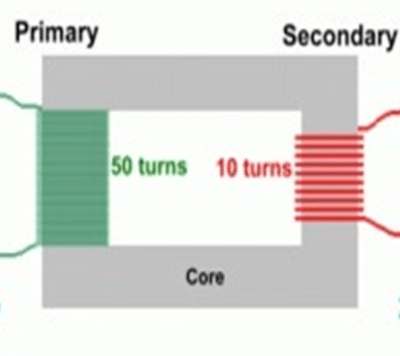
This picture is an example of a ________________.
Motor
Generator
Step-up transformer
Step-down transformer
A transformer has 100 turns in the primary coil and 25 turns in the secondary coil. When a 120 V is applied to the primary coil, what is the voltage in the secondary coil?
480V
30V
20V
450V
In order for electromagnetic induction to occur, there must be relative............between a magnetic field and a conductor.
race
Motion
field
voltage
The transformer is a device used to .......... the value of a voltage.
steady
resist
change
anchor
A laminated transformer core reduces the amount of energy that is wasted in the form of........
solidifying
flux
heat
Which of the following does not change in a transformer?
Voltage
Current
Power
Frequency
Ratio of voltages is equal to ratio of _______________________.
number of iron sheets in core
number of coil
number of turns in coil
number of electromagnetic
The function of a transformer is to ...
raise and lower the apparent power levels
transfer DC voltage from the primary winding to the secondary winding
increase or decrease A.C voltage or A.C current levels
transform mechanical energy into electrical energy
The magnetic material for the core needs to be made of soft iron where its permeability is high
to reduce eddy current loss
to reduce hysteresis loss
to avoid fringing in the core
to reduce copper loss in the winding
Transformer works on which of the following principle
Lenz’s Law
Ampere's Law
Faraday's Law of Electromagenetic Induction
Fleming's Law
What is the meaning of transformer?
Optimus Prime
A device that transfers electrical energy from one circuit to another
Autobots
Megatron
The thin sheets of steel from which transformer cores are made are called...................
lamination
transformer
copper
Transformer works on the principle of _________ .
Self Induction
Mutual Induction
Transformer is always connected to ___________ supply.
A.C.
D.C.
A transformer has primary voltage 200V and secondary voltage 100V , the transformer is called _______ .
Step up
Step Down
None
Transformer transforms _________ from primary to secondary.
Only Current
Only Voltage
Both Voltage and Current
Electrical symbol of a TRANSFORMER


The value of the second winding voltage of an iron-core transformer depends upon the ....... of turns, this winding contains as compared to the number of ........ winding turns.
primary, size
number, primary
size, height
number, size
Primary winding of a transformer is determined by _________.
which winding has more turns
which winding is nearer to the load
which winding is connected to the source
which side has the highest voltage
If a transformer is operated with direct current, the current must be ........ in value, or it must be broken up into pulses.
weighty
light
changed
heavy
A Transformer is an example of a ........................... inductance
mechanical
electromagnetic
transformer
A transformer cannot deliver more..................to a load from its secondary winding than is supplied to the primary winding.
electrololysis
magnetism
energy
The unit of inductance is ......................
henry
pascal
mm
What is created continuously when current is flowing through the primary coil?
changing magnetic field
charging secondary coil
step-up the secondary voltage
increase the output power
Which describe transformer
Primary coil – receives input voltage
Secondary coil – produces output voltage
The voltage produced can either increases or decreases
The voltage produced can either increases or decreases by altering
input voltage
output voltage
number of turns of the primary coil
number of turns of the secondary coil
Two types of transformer are
step-in transformer
step-out transformer
step-down transformer
step-up transformer

Name the type of transformer used in the diagram
(a)
For 2kVA 100/1000 V transformer, High voltage full rated current is
20 A
2 A
200 A
Can not be evaluated
For a transformer copper losses are also known as
variable loss
iron loss
eddy current loss
losses in shunt parameter
For a transformer, core losses are not equivalent to
iron loss
sum of eddy current losses and hysteresis losses
losses in series parameters
losses in shunt parameters
In transformer which quantity do not remain same after transformer action at another winding end.
magnetizing flux
current
kVA
frequency
Which one is true
MMF=FLUX×RELUCTANCE
FLUX=MMF×RELUCTANCE
RELUCTANCE=MMF×FLUX
MMF=FLUX×NUMBER OF TURNS
Which one is true for E1 and E2
Both are equal in magnitude as well as phase angle.
Both are neither equal in magnitude nor in phase angle.
Both are equal in magnitude but 90 degree apart to each other in phase angle.
Both are equal in magnitude but 180 degree apart to each other in phase angle.
Which one is not the condition for ideal transformer.
Resistance of primary and secondary winding must be zero
Leakage flux must be zero.
Permeability must be zero.
Eddy current and Hysteresis losses must be zero.
Which one is not correct for auto transformer
It has better voltage regulation in resistance and reactance of the single winding is less
It has lower efficiency than two winding transformer.
Used only for slight variation of the output voltage from input voltage
It is also used as a voltage regulator
HOW MANY WINDINGS ARE THERE IN AUTOTRANSFORMER?
TWO
ONE
THREE
AUTO TRANSFORMER WORKS ON -----------INDUCTION.
SELF
MUTUAL
NONE
APPLICATION OF CURRENT TRANSFORMER IS--------
POTENTIAL TRANSFORMER
CLAMP-ON METER
CLIPPER
ANOTHER NAME FOR POTENTIAL TRANSFORMER IS------------
SERIES TRANSFORMER
PARALLEL TRANSFORMER
EQUAL TRANSFORMER
ANOTHER NAME SERIES TRANSFORMER IS --------------
POTENTIAL TRANSFORMER
CURRENT TRANSFORMER
PARALLEL TRANSFORMER
EFFICIENCY OF COMMERCIAL TRANSFORMERS ARE ------
0% TO 30%
30% TO 79%
95% TO 99%
IDEAL TRANSFORMERS WILL HAVE ------ EFFICIENCY
2%
5%
98%
100%
IN -------- TRANSFORMER LOSSES ARE ZERO.
PRACTICAL
IDEAL
ISOLATION
MARK THE REASON FOR CHOOSING SILICON STEEL AS CORE IN TRANSFORMER
HIGH PERMEABILITY
HIGH HYSTERESIS LOSS
HIGH EDDY CURRENT LOSS
POWER LOSSES ARE RISES -------- OF THE TRANSFORMER.
VIBRATION
TEMPERATURE
Instrument transformers are used to ________________.
transform mechanical energy into electrical energy.
isolate or transform voltage or current levels.
transfer DC voltage from the primary winding to the secondary winding.
transfer DC current from the primary winding to the secondary winding.
Which of the following is an instrument transformers?
Potential transformers
Current transformers
All of the above
None of the above
What is a current transformer?
A transformer that is used with an A.C. ammeter
A transformer that is used with a D.C. ammeter
A transformer that is used with an A.C. voltmeter
A transformer that is used with a D.C. voltmeter
What is a potential/voltage transformer?
A transformer that is used with an D.C. ammeter
A transformer that is used with an D.C. voltmeter
A transformer that is used with an A.C. ammeter
A transformer that is used with an A.C. voltmeter
The primary winding of a C.T. has_________________.
no number of turns at all
a few number of turns
a large number of turns
The secondary winding of a C.T. has__________________. It is connected in _____________ to an ammeter.
no number of turns at all, series
a few number of turns, parelel
a large number of turns, series
The primary winding of a P.T. has ____________________.
no number of turns at all
a few number of turns
a large number of turns
The secondary winding of a P.T. has ____________________. A low range voltmeter is connected in _____________ with the secondary winding.
no number of turns at all, series
a few number of turns, parelel
a large number of turns, series
The potential transformers are used to measure large voltage using
High range voltmeter
Low range voltmeter
High range ammeter
Low range ammeter
Select the facts about transformer.
Will not work with DC and AC
Will not work with DC
AC will produce change in magnetic field
AC will induce current
Is the core insulated?
Yes
No
The insulation at the transformer's core is meant for
to avoid sharp edges.
to avoid corrosion.
to avoid electrical contact.
to reduce power loss.
Primary loop is connected to the supply while secondary loop is connected to the load.
True
False
Step-up transformer is a transformer that increases...
voltage.
current.
resistance.
conductance.
A secondary coil of a transformer has 500 windings. It was supplied with 200 V. How many windings needed at primary coil to produce 100 V.
(a)
A secondary coil of a transformer is supplied with voltage source, while the primary coil induces voltage (emf).
True
False
Efficiency of a transformer is
(output current)/(input current) x100%
(output voltage)/(input voltage) x100%
(output loss)/(input loss) x100%
(output power)/(input power) x100%
Efficiency of a transformer is
(output current)/(input current) x100%
(output voltage)/(input voltage) x100%
(output loss)/(input loss) x100%
(output power)/(input power) x100%
A transformer has an output power of 500W. It also has core losses and copper loss of 10W. Determine the efficiency (%) of the transformer.
(a)
A transformer is 80% efficient with the primary voltage of 240 V and the secondary voltage of 12 V. If the current in the secondary circuit is 4 A, calculate the current in the primary circuit.
6.50 A
5.50 A
1.00 A
0.25 A

Diagram shows a simple transformer with bulb lights up at normal brightness. What will happen if the alternating current, a.c input is replaced by a 3 V battery?
The bulb blows
The brightness of the bulb decreases
The brightness of the bulb increases
The bulb does not light up
Ways to improve efficiency transformer
Reduced heating effect in coil - using thicker wire made of good conductor like copper.
Reduce eddy current - using laminated core.
Increases magnetisation and demagnetisation - using Soft iron for core for easily magnetised (stronger magnetic field) and demagnetised
increase leakage magnetic flux
- by winding secondary and primary coils on top each other.
Ways energy losses
Heating Effect in Coils (Resistance in coils)
Eddy voltage in Iron Core.
Magnetisation and Demagnetisation of Core.
Leakage Magnetic Flux.

Type of transformer is
Step up
Down up

Diagram below shows a system for the transmission of electricity.
Which arrangement of transformers is correct?


HOW WILL YOU REDUCE CORE LOSS IN THE TRANSFORMER?
By using silicon steel
By reducing the size of winding
By increasing the size of the winding
HOW WILL YOU FIND OUT THE CORE LOSS?
BY CONDUCTING SHORT CIRCUIT TEST
BY CONDUCTING OPEN CIRCUIT TEST
BY MEASURING RESISTANCE OF THE WINDING
SHORT CIRCUIT TEST IS USED TO FIND THE --------LOSS IN THE TRANSFORMER.
CORE LOSS
COPPER LOSS
EDDY CURRENT LOSS
THE TRANSFORMER IS A STATIC DEVICE.
TRUE
FALSE
DIFFERENCE BETWEEN INPUT POWER TO OUTPUT POWER IS KNOWN AS ---------------
GAIN
LOSS
CORE LOSS
COPPER LOSS
KVA STANDS FOR-----------------
Kilo Volt Ampere
Kilo Votage Ammeter
Kilometer Volt Ammeter
In a 3-phase, wye-connected system, the voltage values must be added vectorially because the coils are set 120 electrical degrees apart. In such an arrangement, the phase-to-phase voltage is obtained by multiplying the phase-to-neutral voltage by what multiplier? (select all that apply)
0.58
3.14
1.73
3
The delta wiring configuration places each winding across the phase to phase source voltage. Therefore, the voltage across the winding will be equal to what value?
the winding voltage multiplied by 125%
zero
the line voltage multiplied by 1.73
the line voltage

The transformer depicted in this photo is comprised of which of the following?
A three-phase coil
Three single-phase coils
An oil-immersed coil
One single-phase coil
What type of connection if often used for distribution where a four-wire secondary distribution circuit is required?
Wye-Wye
Wye-Delta
Delta-Wye
Delta-Delta
A 3-phase connection that has one end of each coil connected together and the other end of each coil left open for external connections is known as what?
Delta
Wye
Flying V
Auto
A 3-phase connection method that has the wire from the ends of each coil connected end-to-end to form a closed loop is know as what?
Wye
Delta
Flying V
Auto
The size of a transformer core will depend on
(a) frequency
(b) frequency and area of the core
(c) flux density of the core material.
If ∅m is the maximum value of flux in the core then the average rate of change of flux is
a. f∅m
b. 2 f∅m
c. 4 f∅m
d. 4.44 f∅m
A Step-Up Transformer which has 110/220 turns.What would happen if we replace it with 10/20 turns? (because Turns ratio would be same in both cases)
induced E.M.F wold be same
Induced E.M.F would be decreased
Induced E.M.F would be increased
None of the above
The rating of transformer may be expressed in ____________.
kW
KVA
KVAR
HORSE POWER
Kindly mark the right answers
Transformer is --------
Transfer Electrical power from one electrical circuit to another Electrical circuit It’s working without changing the frequency
Work through on electro magnetic induction.
When, both circuits take effect of mutual induction Can step up or step down the level of voltage.
Its Working without changing the Power.
Nominal ratio of an instrument transformer is defined as the
reciprocal of the rated primary value
ratio of rated secondary value to primary value
reciprocal of the rated secondary value
ratio of rated primary value to secondary value
Winding resistance of a P.T. can be reduced by
using thick conductors
decreasing the length of the winding
shorting the primary and secondary windings
using thin conductors
A transformer has 100 turns in the primary coil and 25 turns in the secondary coil. When a 120 V is applied to the primary coil, what is the voltage in the secondary coil?
480V
30V
20V
450V
A transformer has 100 turns in the primary coil and 25 turns in the secondary coil. When a 120 V is applied to the primary coil, what is the voltage in the secondary coil?
480V
30V
20V
450V
Which of the following is not a basic element of transformer?........
Core
Primary Winding
Secondary Winding
Mutual Flux

