wayground logo

Free Printable Worksheets

NEW

Font size

S
M
L
XL
Worksheets

Aztecs B3

Total questions: 60

Worksheet time: 49mins

Name
Class
Date
1.
Outer, protective layer that controls what gets in and out of the cell
a)
Cell wall
b)
Cell membrane
c)
Cytoplasm
d)
Mitochondria
2.
Control center of the cell and contains genetic material (DNA)
a)
Ribosomes
b)
Chloroplast
c)
Mitochondria
d)
Nucleus
3.
The nucleus is like our...
a)
Skin
b)
Digestive System
c)
Heart
d)
Brain
4.
The moon appears to change in appearance because
a)
of the changing relative positions of the earth, moon, and sun
b)
of the Earth's shadow on the surface of the moon
c)
of the amounts of light the moon emits
d)
of the gravitational pull of the moon as it orbits the Earth
5.
The moon appears to change in appearance because
a)
of the changing relative positions of the earth, moon, and sun
b)
of the Earth's shadow on the surface of the moon
c)
of the amounts of light the moon emits
d)
of the gravitational pull of the moon as it orbits the Earth
6.
Acts like a gatekeeper- allowing some materials to pass through it, but not others. 
a)
cytoplasm
b)
cell membrane
c)
mitochondria
d)
vacuoles
7.

What is this diagram showing?

a)

tides

b)

solar eclipse

c)

lunar eclipse

d)

rotation

8.
If the Sun were a flashlight, the moon was a tennis ball, and the Earth was a basketball; which action would be most correct?
a)
The tennis ball would move around the flashlight
b)
The tennis ball would move around the basketball
c)
The flashlight would move around the basketball
d)
The basketball would move around the tennis ball
9.
"Storage tanks" Can hold food, water or waste for the cell
a)
Ribosomes
b)
Vacuole
c)
Chloroplast
d)
Nucleolus
10.
Found around a plant cell giving it added protection and support
a)
Cell membrane
b)
Organelles
c)
Nucleus
d)
Cell wall
11.
NOT in animal cells:
a)
Nucleus and Cytoplasm
b)
Cell Wall and Cytoplasm
c)
Chloroplast and Cell Wall
d)
Mitochondria & Chloroplast
12.
What planet is the smallest?
a)
Mercury
b)
Venus
c)
Mars
d)
Jupiter
13.

The circulatory system transports

a)

Nutrients

b)

Oxygen

c)

Waste

d)

All of the above

14.

True or False: The heart is apart of the respiratory system

a)

True

b)

False

15.
Which is hotter: Venus or Mercury?
a)
Venus
b)
Mercury
c)
They are exactly the same.
d)
Sun
16.
What are the reasons for the season?
a)
Earth's tilt & rotation
b)
Earth's tilt & revolution
c)
Earth's rotation & rovolution
d)
Earth's tilt & resolution
17.

Which cell organelle acts like a brain?

a)

Nucleus

b)

Brain

c)

Human

d)

Ribosomes

18.
Why is it warmer in the summer?
a)
Closer to the sun
b)
More direct light from Earth's tilt
c)
Stronger light from the sun
d)
Earth spins slower
19.
In winter, the axis of the earth is pointed away or toward the sun?
a)
towards
b)
up
c)
down
d)
away
20.
In spring/summer, the axis of the earth is pointed away or toward the sun?
a)
towards
b)
Neither away or toward
c)
away
21.
What season is depicted in the picture?
a)
summer
b)
winter
c)
fall 
d)
spring
22.
Which season is taking place in the Northern Hemisphere in Position 1?
a)
Winter
b)
Spring
c)
Summer
d)
Fall
23.
What season is depicted in the picture?
a)
summer
b)
winter
c)
fall 
d)
spring
24.
Which season is taking place in the Northern Hemisphere in Position 4?
a)
Winter
b)
Spring
c)
Summer
d)
Fall
25.
Which season is taking place in the Northern Hemisphere in Position 2?
a)
Winter
b)
Spring
c)
Summer
d)
Fall
26.
If its ____ in the Northern hemisphere, then its fall in the Southern hemisphere. 
a)
spring
b)
summer
c)
fall
d)
winter
27.
Which season is taking place in the Northern Hemisphere in Position 3?
a)
Winter
b)
Spring
c)
Summer
d)
Fall
28.

What is the intended purpose of a camp fire?

a)

chemical and sound energy

b)

heat and light energy

c)

electrical and mechanical energy

d)

sound and magnetic energy

29.
What materials would be good insulators for a handle on a pan or pot that would be used on the stove?
a)
wood or plastic
b)
metal or rubber
c)
wood or rubber
d)
copper or steel
30.
What is heat?
a)
a basketball team
b)
thermal energy
c)
electricity
d)
light energy
31.
The particles of a gas move ____than the particles of the same substance in the liquid or solid state.
a)
faster
b)
slower
c)
same speed
32.

Kinetic Energy is the energy of _________

a)

thermal

b)

movement

c)

potential

d)

atoms

33.

Objects with MORE MASS have______________

a)

lower potential energy

b)

lower number of atoms

c)

higher thermal energy

d)

higher temperature

34.
On a cold rainy day a baby is touching a cold window.  It feels so cold. Which way is the heat moving moving? 
a)
Cold is moving from the window to the hand.
b)
Heat is moving from the hand to the window.
c)
Heat doesn't move.
d)
It moves in currents
35.
Which change is happening to the water?
a)
it is changing from a liquid to a gas
b)
it is changing from a liquid to a solid
c)
it is changing from a solid to a gas
d)
it is changing from a gas to a liquid
36.
What happens to particles as they cool down?
a)
They slow down
b)
Nothing
c)
They don't move
d)
They speed up
37.
TRUE or FALSE?  Frying pans made for cooking are made of metal because metals are good CONDUCTORS of heat energy.
a)
True
b)
False
38.
TRUE or FALSE?  The rubber handle on this spoon is an INSULATOR, which means heat energy travels through it very easily.
a)
True
b)
False
39.

In the image below, ________is a region of more heat since________.

a)

Picture A; the particles are vibrating at a faster rate.

b)

Picture A; the particles are vibrating at a slower rate.

c)

Picture B; the particles are vibrating at a faster rate.

d)

Picture B; the particles are vibrating at a slower rate.

40.

What material showed the least temperature change over a 9 minute period?

a)

Glass

b)

Metal

c)

Paper

d)

Plastic

e)

Styrofoam

41.

What are formed when water vapor condenses?

a)

Clouds

b)

Mountains

c)

Transpiration

d)

Valleys

42.

What is the energy source that drives the water cycle?

a)

The moon T

b)

The heat from our home in the winter all around the world

c)

The sun

d)

he heat generated solely from the core of the earth

43.

The process where plants absorb water through the roots and then give off water vapor through pores in their leaves. __________________________

a)

Transpiration

b)

Condensation

c)

Evaporation

d)

Precipitation

44.

The act of turning from a gas into a liquid. ________________________

a)

Condensation

b)

Evaporation

c)

Transpiration

d)

Precipitation

45.

The act of turning from a liquid into a gas. ___________________

a)

Transpiration

b)

Condensation

c)

Evaporation

d)

Precipitation

46.

The process of eroding or being eroded by wind, water, or other natural agents. _______________________

a)

Runoff

b)

Sun

c)

Landforms

d)

weathering

47.
Condensation is when...
a)
A liquid turns to gas.
b)
A gas turns to liquid.
c)
A liquid turns to ice.
d)
All of the answers.
48.
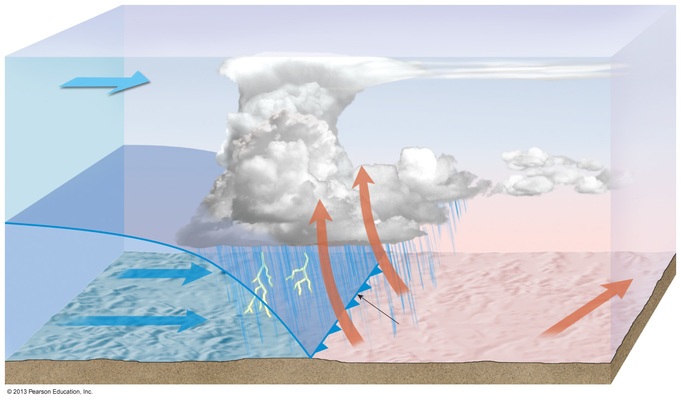
What type of storm front is this? 
a)
warm front
b)
cold front
c)
stationary front
d)
occluded front
49.
_____________ air is more dense and tends to sink
a)
cold
b)
warm
c)
moist
d)
dry
50.
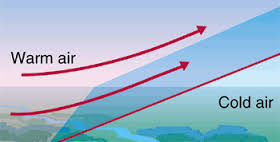
Which type of front is pictured?
a)
Cold front
b)
Warm front
c)
Occluded front
d)
Stationary front
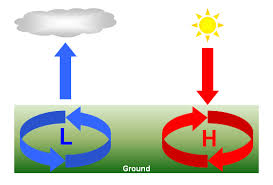
51.
Which system results in drier, fairer weather?
a)
high pressure
b)
low pressure
c)
hurricane
d)
weather system
52.
Which front leads to steady rain for several days?
a)
warm front
b)
cold front
c)
stationary front
d)
occluded front
53.

Which one shows a warm front?

a)
b)
c)
d)
54.
Humidity is the...
a)
Amount of Water Vapor in the Air
b)
Amount of Wind in the Air
c)
Amount of Precipitation in the Air
d)
Amount of Pressure in the Air
55.
________________ are made of water vapor that condenses in the troposphere.
a)
dew
b)
clouds
c)
evaporation
d)
transpiration
56.
What kind of weather is usually associated with a low pressure system?
a)
Sunny weather
b)
Precipitation (rain, snow, etc.)
57.
What kind of weather is usually associated with a high pressure system?
a)
Sunny weather
b)
Precipitation (rain, snow, etc.)
58.
In what direction do winds always blow?
a)
From areas of high pressure to areas of low pressure
b)
From areas of low pressure to areas of high pressure
59.

A _____________ weather front occurs when a cold air mass and a warm air mass meet, but cannot move one another so they both stay still for several days.

a)

Cold

b)

Warm

c)

Stationary

d)

Occluded

60.
Identify the type of front that is shown in the image.
a)
Occluded Front
b)
Cold Front
c)
Stationary Front
d)
Warm Front