

wayground logo

Free Printable Worksheets

Font size

S
M
L
XL
Worksheets

1920s, Depression and New Deal Review

Total questions: 81

Worksheet time: 55mins

Name
Class
Date
1.
Prohibition was implemented by passage of the
a)
17th Amendment
b)
18th Amendment
c)
19th Amendment
d)
21st Amendment
2.
The group most credited with pushing prohibition was
a)
The KKK
b)
African Americans
c)
Women
d)
Business Owners
3.
Prohibition created which one of the following?
a)
Reduction in crime.
b)
Reduction in alcohol related deaths
c)
Organized Crime.
d)
More money being made.
4.
Henry Ford is credited with mastering 
a)
Modern day filming.
b)
Use of the Assembly Line.
c)
Flying aeroplanes.
d)
Radio Broadcasting.
5.
The government of what country was overthrown in 1917 and turned into a Communist country?
a)
Russia
b)
Austria-Hungary
c)
Germany
d)
England
6.
When WWI started, what was the wealth gap between the rich and poor like in the United States?
a)
It was very small gap between the rich and the poor.
b)
Wealth in American society was basically equal among all citizens.
c)
There was a large gap between the rich and the poor.
d)
None of the above.
7.
Who were the Palmer Raids meant to find and root out?
a)
Anarchists
b)
Communists
c)
Socialists
d)
All of the above
8.
Who was A. Mitchell Palmer?
a)
Secretary of State during WWI.
b)
President of the United States during WWI.
c)
Attorney General of the United States during WWI.
d)
General in charge of the Army during WWI.
9.
What did opponents of A. Mitchell Palmer say he was doing?
a)
Weeding out groups who were attempting to take down the United States.
b)
Taking down anybody who was a supporter of Woodrow Wilson.
c)
Protecting people's freedom of speech.
d)
Taking away people's freedom of speech during and directly after WWI.
10.
The Scopes Monkey Trial of 1925 had to do with teaching of Fundamentalism and ______.
a)
school
b)
Evolution
c)
life
d)
religion
11.
The Red Scare led to which of the following?
a)
The ratification of the 19th amendment
b)
a demand for limits on immigration
c)
the start of the Great Depression
d)
the repeal of the 18th amendment 
12.
Nativists are against _______?
a)
Corruption
b)
African Americans
c)
Railroads
d)
Immigrants
13.
More than likely, the end result of the Sacco and Venzetti trial was a direct result of?
a)
Nativism
b)
Increased racial tensions
c)
Racial prejudice
d)
All of the above
14.
Tennessee outlawed the teaching of __________ 
a)
  Math
b)
Evolution
c)
Creationism
d)
History
15.
Beliefs based on a literal interpretation of the Bible are called
a)
fundamentalism
b)
evolution
c)
urbanization
d)
values
16.
The prosecuting attorney in the Scopes trial was
a)
William Jennings Bryan
b)
Charles Darwin
c)
Clarence Darrow
d)
Aimee Semple McPherson
17.

Which group targeted African Americans, immigrants, Catholics and Jews?

a)

Ku Klux Klan

b)

Flappers

c)

Gangsters

d)

Fundamentalists

18.

Why were the 1920's called the Roaring Twenties?

a)

Many animals began to roar.

b)

Time of excitement and prosperity.

c)

War was about to erupt.

d)

There was a depression.

19.
What were illegal places where people drank alcohol called?
a)
speakeasies
b)
speaksoftly
c)
cellars 
d)
hidden spots
20.

Fear of communism in the US during the 1920s.

a)

Black Scare

b)

Communism Scare

c)

Red Scare

d)

Scopes Scare

21.

Court case over the teaching of evolution in schools during the 1920s.

a)

Scopes

b)

Red Scare

c)

Tennessee Evolution

d)

Smith

22.

An arrangement placing a limit on the number of immigrants allowed from each country.

a)

Quota System

b)

Limit System

c)

Number System

d)

Immigrant System

23.

One effect of "The Red Scare" was- (6A)

a)

Women being displaced into secretarial jobs in the North

b)

The ratification of the 18th amendment in Washington, D.C.

c)

discrimination against immigrants, especially those believed to be Communists, in the US

d)

African Americans migrated back to the South for sharecropping jobs

24.

Why was national attention drawn to the Scopes trial of 1925 (6A)?

a)

The case reversed a previous Supreme Court decision on free speech (Federalism v Modernism)

b)

The case upheld the right of veterans to protest in Washington, D.C. (Republicanism v Traditionalism)

c)

The case revealed the extent of prejudice against immigrants (Nativism v Pluralism)

d)

The case represented a conflict between modern science and religion (Modernism v Traditionalism)

25.

How did Henry Ford make production more efficient? (27C)

a)

The assembly line allowed workers to work less.

b)

The assembly line increased the price of automobiles.

c)

The assembly line stopped labor unions from striking.

d)

The assembly line produced automobiles at a faster pace

26.

The increase in the use of the media above during the 1920s led to - (27C)

a)

the isolation of rural families.

b)

a decrease in industrial production.

c)

a decline in segregation in the South.

d)

the rise of mass consumerism

27.

What was a positive effect of businesses copying Henry Ford's assembly line? (27C)

a)

It caused the price of far goods to go up

b)

The rise of mass production lowered the cost of once expensive goods and created more jobs

c)

It caused a surplus of goods causing jobs to be moved overseas to lower costs

d)

It took more jobs from the farms and moved people into the cities

28.

What did the judge tell the jury before the trial?

a)

Sacco and Vanzetti are idots

b)

Sacco and Vaznetti are not true Americans

c)

Sacco and Vanzetti are evil

d)

Sacco and Vanzetti are good men

29.

In what state did the killing that S&V were accused of take place?

a)

Massachusetts

b)

New York

c)

Iowa

d)

Alaska

30.
Fear of communism and anarchism led to mass deportations
a)
Scopes Trial
b)
Sacco and Vanzetti
c)
Red Scare
d)
Isolationism
31.
Immigrant anarchists convicted of murder and executed
a)
Coolidge and Harding
b)
Garvey and Washington
c)
Palmer and Sacco
d)
Sacco and Vanzetti
32.
In 1929, the United States entered an economic slowdown called the Great Depression. One of the early events was the stock market crash. What was a major cause of the stock market crash? (Use process of elimination)
a)
Stock prices went up so fast that investors could not keep up with the changes.
b)
The government decided to close the stock market in New York.
c)
Stock prices fell; investors panicked and sold their stocks, which led to more panic.
d)
People decided to invest their money in stock markets in Europe.
33.
• Became President after Herbert Hoover
• Pushed for many new programs called “The New Deal”
• President during World War II  

 The list above refers to which person?
a)
Duke Ellington
b)
Abraham Lincoln
c)
Theodore Roosevelt
d)
Franklin Roosevelt
34.
Shanty towns (make-shift) towns were named after this person due to the people’s dissatisfaction of the amount of help they were given after the Stock Market Crash?
a)
Franklin D. Roosevelt
b)
Herbert Hoover
c)
Theodore Roosevelt
d)
William McKinley
35.
What is one way the New Deal was supposed to help the economy out of the Great Depression?
a)
by eliminating trading on the stock market
b)
by encouraging war with Germany and Japan
c)
by creating jobs through various new programs
d)
by giving people money through new bank laws
36.
Why was the Tennessee Valley Authority significant to the Southeast during the Great Depression?
a)
it brought the stock market to the Southeast
b)
it gave people jobs doing public work projects
c)
it replaced the old and outdated soup kitchens
d)
it made people want to move out of the Southeast
37.
. In 1929 the Great Depression started in the United States. In 1932 Franklin D. Roosevelt was elected president and he promised a "New Deal" to the American people. Which of the following BEST describes the role of the government during the New Deal?
a)
The government wanted people to take care of themselves and not use the government.
b)
The New Deal led to the government being more involved in the economy of the country.
c)
The government wanted people to let the government provide everything they needed.
d)
The New Deal led to the government being less involved in the economy of the country.
38.
The New Deal was divided into 3 categories: relief for immediate help, reform to fix problems, and _________________________ to help the people and nation “get back on their feet”. 
a)
reinvent
b)
radicalize
c)
recovery
d)
reissue 
39.
This type of New Deal program gave immediate, temporary help to unemployed Americans
a)
relief
b)
reform
c)
recovery
40.
This ideology & president is associated with the belief that the economy would correct itself.  He did not support direct relief.
a)
Conservative;F.D.Roosevelt
b)
Liberal;Hoover
c)
Conservative;Hoover
d)
Radical;FDR
41.
Why were the people of the United States angry at President Hoover during the Great Depression?
a)
he seemed uncaring, opposing most types of government direct relief
b)
he did not take enough action to help enough during the depression
c)
Americans opposed his handling of the Bonus Army marchers
d)
all of these are reasons
42.
The purpose of this program is to regulate the stock market & prevent another stock market crash 
a)
FDIC
b)
SEC
c)
TVA
d)
CCC
43.
During the New Deal, how did the government attempt to improve conditions for farmers through the AAA?
a)
By ending the practice of sharecropping
b)
By raising tariffs on farm imports
c)
By paying farmers to grow fewer crops
d)
By training farmers for jobs in a new field
44.
What cause of the Great Depression did the Agricultural Adjustment Act (AAA) attempt to solve?
a)
Stock market speculation
b)
Overproduction
c)
Weak banking system
d)
Unsafe loans
45.
The following may all be true of her, but why was the role of first lady Eleanor Roosevelt SIGNIFICANT?
a)
She was a distant cousin of FDR
b)
She traveled the country, taking on efforts to solve major issues
c)
She had five children
d)
She was the niece of Theodore Roosevelt
46.

Which of the following is NOT a cause of the Great Depression?

a)

Overproduction and underconsumption

b)

High tariffs restricting trade

c)

buying stocks on the margin

d)

high income taxes

47.

What was President Herbert Hoover's response to the Great Depression?

a)

He believed "rugged individualism" would solve the economy

b)

He created mass welfare

c)

He increased infrastructure to create jobs

d)

He violated his policy of laissez-faire

48.

What was the impact of the New Deal on unemployment in the U.S.?

a)

Unemployment still remained high throughout the 1930s

b)

Unemployment came to be the lowest in American history

c)

Unemployment increased with New Deal policies

d)

Unemployment reduced back to its rate in the early 1920s

49.

What philosophy did the New Deal follow?

a)

Laissez-Faire policies should guide our economy

b)

"rugged individualism" will get us through the Great Depression

c)

the federal government should work to help Americans in poverty

d)

capitalism is a natural cure for economic crisis

50.

What does it mean to "buy on the margin?"

a)

Buy stocks when prices are low, then sell when prices are high

b)

Buy stocks without having to take out a loan

c)

Using an installment plan to purchase goods

d)

Buying goods at the lowest price, then selling for a higher profit

51.

Although President Hoover was believed in laissez-faire, what action did he take in an effort to combat the Great Depression?

a)

the New Deal

b)

the Hoover Dam

c)

the Bank Holiday

d)

relief payments for the unemployed

52.

This New Deal program provided young men with jobs by improving state and national parks.

a)

WPA

b)

PWA

c)

TVA

d)

CCC

53.

The Social Security Act was intended to assist what group of people?

a)

The unemployed.

b)

The elderly and those unable to work.

c)

Children.

d)

Dirty pot-smoking hippy communists.

54.

The causes of the Great Depression were-

a)

Overspeculation, high tariffs, overproduction, & shaky banking

b)

Overspeculation, low tariffs, overproduction, & shaky banking

c)

Overspeculation, high tariffs, underproduction, & shaky banking

d)

Overspeculation, high tariffs, overproduction, & stable banking

55.

First lady who assisted women in increasing their part in U.S society during the Great Depression.

a)

Eleanor Roosevelt

b)

Jackie Onasis

c)

Michele Obama

d)

Barbara Bush

56.

Huey Long, the Alabama Senator proposed a "Share the Wealth" program. This was a-

a)

dramatic redistribution of the nation's wealth

b)

charity event taken place all over the nation

c)

copy of the trickle down theory by Hoover

d)

food stamps program during the Great Depression

57.

Unemployed and homeless people built shantytowns outside the city center during the Great Depression called-

a)

Hoovervilles

b)

Favelas

c)

Barrios

d)

Vecindades

58.

FDR gave a series of speeches on the radio to encourage Americans during the Great Depression called-

a)

Fireside Chats

b)

Radio Chats

c)

Great Depression adresses

d)

One on One chats

59.

The long term effect of the Great Depression was the expanding role of the federal government.

a)

True

b)

False

60.

Law that sent people back to their home country to increase job availability for Americans.

a)

Mexican Repatriation Act

b)

Chinese Exclusion Act

c)

Executive Order 9066

d)

Immigration quotas

61.

New Deal program responsible for the federal government guarantee of protection on bank deposits.

a)

Federal Deposit Insurance Corp (FDIC)

b)

Tennessee Valley Authority (TVA)

c)

Social Security Act (SSA)

d)

Civilian Conservation Corps (CCC)

62.
Which program built roads, schools, buildings, libraries, etc?
a)
Social Security
b)
FDIC
c)
CCC
d)
WPA
63.
Which program insures banks and keeps your money safe?
a)
Social Security
b)
TVA
c)
CCC
d)
FDIC
64.
Which program builds wildlife perserves and plants trees?
a)
CCC
b)
TVA
c)
WPA
d)
FDIC
65.
Which program sets up a tax to help benefit retired people?
a)
FDIC
b)
Social Security
c)
TVA
d)
WPA
66.
In 1929 the Great Depression started in the United States. In 1932 Franklin D. Roosevelt was elected president and he promised a "New Deal" to the American people. Which of the following BEST describes the role of the government during the New Deal?
a)
The government wanted people to take care of themselves and not use the government.
b)
The New Deal led to the government being more involved in the economy of the country.
c)
The government wanted people to let the government provide everything they needed.
d)
The New Deal led to the government being less involved in the economy of the country.
67.
Who created the Share Our Wealth Program
a)
O.K. Allen
b)
Earl Long
c)
Huey Long
d)
Franklin Roosevelt
68.

Long’s control over almost all aspects of Louisiana’s government made people compare him to a _________________.

a)

President

b)

Dictator

c)

Bourban

d)

Farmer

69.
Protects formation of labor unions & collective bargaining
a)
Security and Exchange Commission
b)
Socialism
c)
Social Security
d)
Wagner Act
70.
Proposed pension for elderly, funded by sales tax
a)
Charles Coughlin
b)
Francis Townsend
c)
Huey Long
d)
John Steinbeck
71.

Formed to oppose the New Deal

a)

American Liberty League

b)

Federal Deposit Insurance Corporation (FDIC)
c)

National Industrial Recovery Act (NIRA)

d)

Francis Townsend

72.

Set up a process where unhappy union members could make their complaints heard

a)

Wagner Act

b)

American Liberty League

c)

Social Security Act

d)

Francis Townsend

73.

The most important pieces of legislation from the New Deal

Old age insurance, unemployment compensation, and aid to families were it's 3 provisions

a)

Social Security Act (SSS)

b)

Tennessee Valley Authority (TVA)

c)

Civilian Conservation Corps (CCC)

d)

Works Progress Administration (WPA)

e)

Federal Deposit Insurance Corporation (FDIC)

74.

New Deal's largest public works projects

a)

Social Security Act (SSS)

b)

Tennessee Valley Authority (TVA)

c)

Civilian Conservation Corps (CCC)

d)

Works Progress Administration (WPA)

e)

Federal Deposit Insurance Corporation (FDIC)

75.
Which New Deal program had workers build roads, parks, bridges, airports, and buildings? This program also hired artists to paint murals and build sculptures.
a)
CCC
b)
WWW
c)
WPA
d)
TVA
76.
How did "bank runs" impact the American people during the Great Depression?
a)
Banks eventually ran out of money to loan, and people's life savings were gone.
b)
Banks made loans throughout the Great Depression, helping people pays bills until they could find work.
c)
Banks were able to people's deposits safe, but they could not loan out any more money.
d)
Banks were not at all involved in the Great Depression because people did not use them.
77.
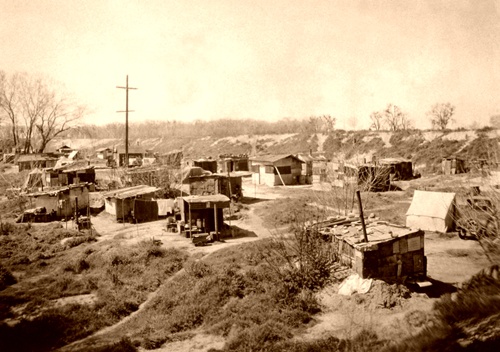
What was the main reason for the emergence of “Hoovervilles” like the one shown in the photograph?
a)
Many Americans had lost jobs during the Great Depression.
b)
Thousands of homes had been destroyed by the effects of the Dust Bowl.
c)
Housing projects could not keep up with the demand for homes needed by the poor.
d)
Preparations for World War I had created a shortage of building materials.
78.
During the early 1930s, the main goal of the Bonus Army was to pressure the Hoover administration to
a)
strengthen the nation’s defenses
b)
end the military draft
c)
bring American troops home from overseas
d)
support the early payment of money promised to veterans
79.
FDR addressed the American public in weekly broadcasts known as:
a)
FDR Hour
b)
Hangin' With Franklin
c)
Fireside Chats
d)
Around the Fire
80.
What was a guiding principle of the New Deal economic policies?
a)
Pro-business tax breaks would solve the problems associated with urban poverty.
b)
Antitrust legislation would destroy the free market economy of the United States.
c)
Rugged individualism must be allowed to solve social inequality.
d)
Government must assume more responsibility for helping the poor.
81.
An advocate of President Franklin D. Roosevelt’s farm policy would have likely supported which economic strategy?
a)
Reducing agricultural output to increase product values
b)
Utilizing minimum wage laws to stimulate farm productivity
c)
Allowing market forces to operate freely to achieve stabilization
d)
Increasing agricultural production to ensure an affordable food supply