
 Worksheets
Scientific Variables and Experiments
Total questions: 21
Worksheet time: 11mins
Which of the following is a quantitative observation?
That noise is annoying.
The temperature is 21°C.
This salad roll is delicious.
It’s too hot in this room.
Which of the following is not used to hold liquids?
Measuring cylinder.
Beaker.
Retort stand.
Test tube.
A restaurant chef conducts an experiment in which several small potatoes of the same size are boiled for various amounts of time from 1 minute up to 15 minutes. Which of the following statements could be an aim of the experiment?
The best time to cook a potato is ten minutes.
After boiling for two minutes, a potato is still too hard to eat.
To determine the time taken to perfectly cook a potato.
Place a potato in a saucepan and cover with water.
Which of the following is an abbreviation for a unit of time?
s
t
m
km/h
To produce a Bunsen burner flame with the highest possible temperature, you would
adjust the rubber hose connection.
open the air hole half way.
fully open the air hole.
close the air hole.
A yellow Bunsen burner flame is called
the safety flame.
the danger flame.
an old flame.
a carbon flame.
How many variables should be changed at a time during an experiment?
none
one
two
as many as possible
Which of the following is not a branch of Science?
biology
geology
chemistry
astrology
Which of the following is a quantitative observation?
The water was hot.
The water was clear.
The water was at a temperature of 34oC.
The water was colourless.
Which is the correct way of writing the unit symbol for kilogram?
kg
kgs
KG
Kg
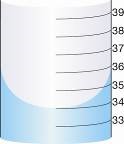
Which of the following measurements is correct for the volume of liquid in the measuring cylinder?
34 mL
35 mL
36 mL
There is not enough information to decide.
Which of the following observations is continuous?
the brands of tomato sauce in a supermarket
the colours of cars in a car park
the height of gum trees in a forest
the types of animals kept in a zoo
Evan ran a series of experiments testing how high different balls bounced. Which of the following is not a good conclusion for his experiments?
Balls bounced higher on concrete than on grass.
Tennis balls bounced higher than squash balls.
Balls bounce higher when dropped from greater heights.
The experiment was lots of fun and I learnt a lot about balls.
'Cooking oil will float on top of water' is an example of a
aim
hypothesis
conclusion
observation
What section of a scientific report would you usually find a table of data?
conclusion
results
aim
method
The garbage bin is on the nature strip. Propose a possible inference.
it’s ‘garbage night’ tonight.
the bin will be empty tomorrow.
the garbage bin is on the nature strip
An inference is
a statement about what may happen in the future.
unwanted advice.
an incorrect measurement.
a logical explanation.
When lighting a Bunsen burner correctly you must always.
open the air hole before lighting the match
turn the gas on, then light the match
light the match, then turn on the gas
panic
Maddie measured how far an elastic band stretched when 50g masses (metal weights) were hung from it. Which of the following is the variable that she is changing (the independent variable)?
How far an elastic band stretches.
The brand of elastic band.
The number of masses hung from the elastic band
The thickness of the elastic band.
Which of the following would be an observation about yourself if you are feeling sick?
I’ve eaten something that was off.
My stomach is not feeling well.
I’ll vomit soon.
Joe noticed that when he washed dishes he sometimes made lots of froth and at other times made almost none. He designed an experiment where he put 1 drop of detergent in the sink and turned the tap on high until the sink was half full. He then repeated the experiment with 2 drops of detergent, then 3 then 4. Identify his dependent variable.
the amount of bubbles
the number of drops of detergent
the brand of the detergent
the temperature of the water

