wayground logo

Free Printable Worksheets

NEW

Font size

S
M
L
XL
Worksheets

Wave Interactions

Total questions: 25

Worksheet time: 17mins
Name
Class
Date
1.
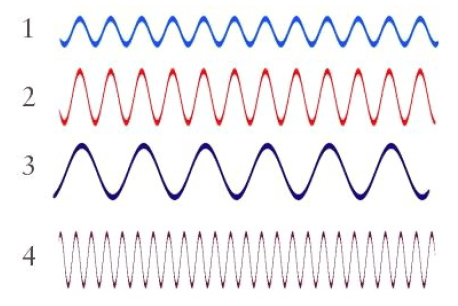
Which wave in the diagram has the greatest wavelength?
a)
1
b)
2
c)
3
d)
4
2.
The changing pitch of a police siren as the car moves past you
a)
sound interfernce
b)
doppler effect
c)
constructive interference
d)
destructive interference
3.
In a standing wave, destructive interference creates points of zero amplitude called nodes. Which letters represent this.
a)
A,E,F
b)
B,D,F
c)
B,C,D
d)
A,C,F
4.
In a standing wave, constructive interference creates larger amplitudes.  The points of maximum amplitude are antinodes.  The letters for these are?
a)
B,C,D
b)
A,E,F
c)
A,C,F
d)
B,D,E
5.
The medium (or tension) through which a wave travels affects its...
a)
Wavelength
b)
Speed
c)
Amplitude
6.
Choose the word that belongs in the sentence. A sound wave is a type of ______________ wave.
a)
parallel
b)
transverse
c)
longitudinal
d)
perpendicular
7.
What is "?" ?
a)
rarefaction
b)
compression
c)
expansion
d)
reflection
8.

Which type of interaction is this?

a)

reflection

b)

refraction

c)

diffraction

9.

Which type of interaction is this?

a)

reflection

b)

refraction

c)

diffraction

10.

Which type of interaction is this?

a)

reflection

b)

refraction

c)

diffraction

11.

The bending of a wave due to the change in speed is called

a)

interference

b)

diffraction

c)

reflection

d)

refraction

12.

Reflection occurs when a wave

a)

bends due to a change in speed

b)

hits a surface and bounces back

c)

passes through an opening

d)

bends around a barrier

13.
The fact the two angles are the same is an example of....
a)
Refraction
b)
Angle of Incidence
c)
Law of reflection
d)
Magnification
14.
a)
Constructive Interference
b)
Destructive Interference
15.
What phenomenon does this image demonstrate?
a)
Constructive interference
b)
Destructive interference
c)
Increasing frequency
d)
Increasing period
16.
All waves carry
a)
energy
b)
light 
c)
matter
d)
particles
17.

What is interference/superposition?

a)

occurs when two or more waves overlap and combine

b)

occurs when two or more waves combine and neutralize each other

c)

when one waves travels alone

d)

occurs when two or more waves combine and make each other bigger

18.

When a sound wave hits a wall and echoes back, this is an example of:

a)

Refraction

b)

Diffraction

c)

Reflection

d)

Interference

19.

What is shown in the diagram?

a)

reflection

b)

refraction

c)

diffraction

d)

deflection

20.

What is shown in the diagram?

a)

Doppler Effect

b)

standing wave

c)

longitudinal wave

d)

mechanical wave

21.

What is shown in the diagram?

a)

constructive interference

b)

destructive interference

c)

Doppler Effect

d)

superposition

22.
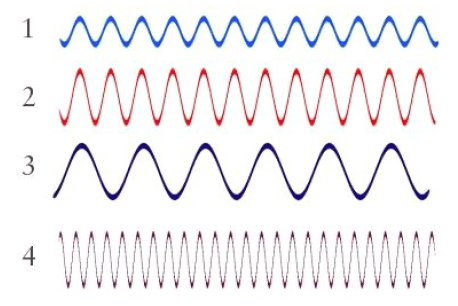
Which wave in the diagram has the greatest frequency?
a)
1
b)
2
c)
3
d)
4
23.
When a wave's amplitude increases it means
a)
it's carrying more energy
b)
its wavelength gets longer
c)
its frequency increases
d)
its wavelength decreases
24.
What can you tell about this object's motion?
a)
Moving to the North (up).
b)
Moving to the South (down). 
c)
Moving to the West (left). 
d)
Moving to the East (right). 
25.
Standing waves resemble _________ waves, but the energy actually does not keep moving in one direction.
a)
Longitudinal
b)
Compressional
c)
Transverse
d)
Medium