
 Worksheets
ENERGY - SUMMATIVE (ADAPTED)
Total questions: 20
Worksheet time: 11mins

A 60-kg skater on the photo is about to move. At this point, what is his kinetic energy?
0 Joule
3,528 Joules
588 Joules
360 Joules

At which point along the track will the skater have the biggest potential energy?
A only
F only
Both A and F
C only

At which point along the track will the skater have the biggest kinetic energy?
A only
F only
A and F only
C only

Look at the picture of the energy graph. Where is the skater on the ramp?
At the top of the ramp
At the bottom of the ramp
In the middle, a little closer to the bottom.
In the middle, a little closer to the top.

At which point would the skater have the most kinetic energy?
A
B
C
D
E

Katy wants to design a roller coaster where the passenger is traveling super fast at the bottom. What characteristics should the roller coaster have?
It should be flat and close to the ground. This way the passenger will have an increase in speed because he/she starts out close to the ground.
It should have no friction and the passenger should start off high above the ground. This way the passenger starts out with a lot of potential energy that can be transformed into kinetic energy.
It should have lots of friction and be very tall. This way the passenger will speed up because of the large amount of friction.
It doesn’t matter how you design the rollercoaster the passenger’s speed will be the same at all points on the rollercoaster.

What kind of energy does the cannon ball have at Points A, C and E?
A-kinetic, C-potential, E-kinetic
A-kinetic, C-energy, E-kinetic
A-potential, C-kinetic, E-potential
A-potential, C-energy, E-potential

Which graph shows the skater at the top of the ramp?


Which graph shows the skater 3/4 of the way down the ramp?
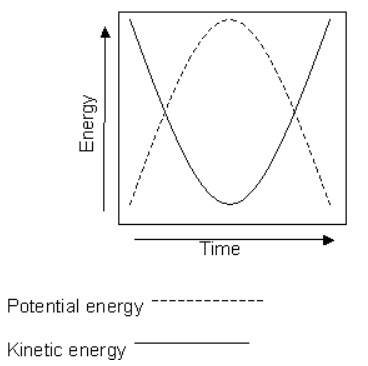
According to this graph, as kinetic energy decreases, potential energy must?
Increase
Decrease
Stay the same
What does kinetic energy depend on?
Mass and Velocity
Height
Height and Mass
Which best describes potential energy?
Energy of moving objects
Energy that isn't there
Energy that is in motion
Energy that is stored up not yet in use

LEAST kinetic Energy
A
B
C
D
What are the units for energy?
Watts
Joules
Newtons
meters

What is the sum of kinetic energy and potential energy of a system?
mechanical energy
electrical energy
moving energy
nuclear energy
An amusement park engineer noticed that the roller coaster cart did not make it to the end of the track. He checks and determined that it was not a friction issue with the cart and track. Explain what he needs to do to help the cart reach the end of the track.
Decrease the distance between the first and second hill to build more potential energy.
Add another hill towards the end of the roller coaster to increase the amount of kinetic energy.
Increase the height of the first hill to increase the amount of initial potential energy.
Remove a hill and decrease the added friction at the end of the track.

