
NEW
Font size
 Worksheets
CHEMSTAR Chapter 10.0: ELECTROCHEMISTRY
Total questions: 12
Worksheet time: 17mins
In a redox reaction, the species that loses electrons _______.
is called the cathode
is oxidized
gains mass at the electrode
decreases in oxidation number
Which of the following is the strongest reducing agent?
Cl-
Cl2
Ag+
Ag
What is a galvanic (voltaic) cell?
It is a cell that destroys electrons on one side and creates electrons on the other side.
It is a cell that contains only one metal bar and one aqueous ion solution.
It is a type of battery that drives a redox reaction when electricity is applied.
It is a type of battery that generates an electrical current from redox reactions.
For a galvanic cell using Ag, Ag+ (1.0 M) and Zn, Zn2+ (1.0 M) half-cells, which of the following statements are incorrect?
GIVEN:
Eo Ag+(aq) / Ag(s) = +0.80 V
Eo Zn2+(aq) / Zn(s) = -0.76 V
The zinc electrode is the anode.
Electrons will flow through the external circuit from the zinc electrode to the silver electrode.
Reduction occurs at the zinc electrode as the cell operates.
The mass of the zinc electrode will decrease as the cell operates.
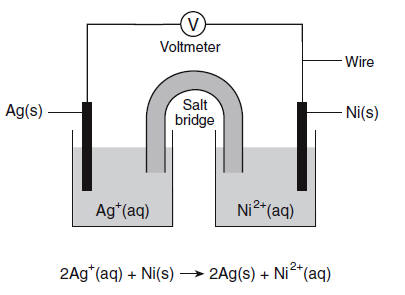
What reaction occurs at the anode?
Ag+/Ag = 0.80V
Ni2+/Ni = -0.25V
Ag+ + e- →Ag
Ag → Ag+ + e-
Ni2+ + 2e- → Ni
Ni → Ni2+ + 2e-
Predict spontaneity of this reaction:
Fe2+(aq) + Co(s) -------> Fe(s) + Co2+ (aq)
GIVEN:
Eo Co2+(aq) / Co(s) = -0.28 V
Eo Fe2+(aq) / Fe(s) = -0.44 V
Spontaneous since the value of Eocell is +0.16
Spontaneous since the value of Eocell is +0.72
Non-spontaneous since the value of Eocell is -0.72
Non-spontaneous since the value of Eocell is -0.16
Fe2+ + 2e– → Fe(s) E° = –0.44 V
Ni2+ + 2e– → Ni(s) E° = –0.23 V
The standard reduction potentials for two half reactions are given above. The Nernst equation for a galvanic cell at 25°C in which Fe(s) reduces Ni2+ is the following:
Ecell = E°cell – 0.03 log ([Fe2+]/[Ni2+])
What is the equilibrium constant for the reaction below?
Fe(s) + Ni2+ → Fe2+ + Ni(s)
1.9 × 10⁻²³
7.6 × 10⁻⁸
3.6 × 10³
1.3 × 10⁷
What could be done in order to get a higher cell potential for this reaction? Cu2+(aq) + H2(g) → Cu(s) +2H+(aq)
Decrease pressure at anode compartment
Increase pH
Decrease concentration of Cu2+
Increase temperature
What gas is collected at anode when an aqueous solution of sodium chloride is electrolyzed?
chlorine
oxygen
hydrogen
water vapour
In voltaic cells, the salt bridge _______.
is not necessary in order for the cell to work
acts as a mechanism to allow mechanical mixing of the solutions
allows charge balance to be maintained in the cell
drives free electrons from one half-cell to the other
An aqueous solution of CuSO4 is electrolysed
using a current of 0.150 A for 5 hours. Calculate the mass of copper deposited at cathode.
(Molar mass of Cu = 63.6 g/mol)
0.0140 g
0.8897 g
0.4449 g
1.7794 g
"35.6 g of magnesium metal formed in an electrolysis of molten magnesium chloride."
Based on the given information above, which statement(s) is / are TRUE:
i. 2.93 mol of electrons were required in the reaction
ii. 2.83 x 10⁵ Coulomb of charge were required in the reaction.
iii. 31.4 A of current needed to produce the specified amount of magnesium metal in 2.5 hours.
i only
i and ii
ii and iii
i, ii and iii

