
 Worksheets
The Earth--Our Home in Space
Total questions: 36
Worksheet time: 20mins
How did the Earth’s interior become separated into layers?
When the Earth was young and molten, the denser metal sank to the center while the less dense rock floated to the surface.
The layering of the Earth's interior was a result of the gravity of our Moon tugging at our planet.
The layering of the Earth's interior was a result of the Earth'd double iron core.
The layering of the Earth's interior was caused by the electrostatic forces acting on small dust particles before Earth fully cooled.


Which is true of Earth's interior?
The interior gets cooler towards the center
The interior is made up of hydrogen atoms that go through nuclear fusion
The interior gets hotter towards the center.
The interior is the same temperature as the upper crust.


Which of the following increases as depth increases into the Earth? (choose all that apply)
time
Pressure
temperature
density
What is the thinnest layer of the Earth?
Mantle
inner core
outer core
crust
How do scientists know the Earth has layers?
Drilling into the mantle
Volcanoes
Seismic waves data
ocean waves

Which statement is INCORRECT relating how seismic waves travel?
Seismic waves are bent as they travel between different materials of various densities
Seismic waves bounce off transitions as they travel through materials with different temperatures
P waves travel parallel (vibrate back and forth) while S waves travel perpendicular (vibrate up and down)
Seismic waves travel through Earth in straight lines at constant speeds.

Choose the statement that is TRUE
Oceanic crust is thinner than Continental Crust and denser than Continental Crust
Oceanic crust is thicker than Continental Crust and denser than Continental Crust
Continential crust is thinner than OceanicCrust and denser than Oceanic Crust
Continential crust is thicker than Oceanic Crust and denser than Oceanic Crust
Earth's Core is made up of mostly Iron and Nickel with high electrical conductivity.
TRUE
FALSE

These are the first waves released during an earthquake
S waves
Surface Waves
P waves
Ocean waves
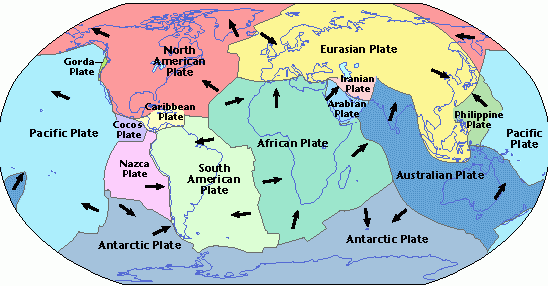
The Earth is composed of four main layers. Many scientists believe that as Earth cooled, the denser materials sank to the center and the less dense materials rose to the top. Therefore, the least dense layer is the __________________________?
Continental Crust
Mantle
Oceanic Crust
Inner Core


What is the correct order (starting from the surface to interior) of Earth’s layers?
crust, outer core, inner core, mantle
mantle, outer core, inner core, crust
crust, mantle, outer core, inner core
outer core, inner core, crust, mantle
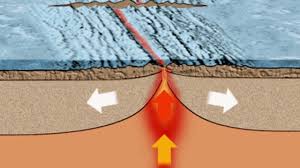
In sea-floor spreading, molten material rises from the mantle and erupts
along the edges of all the continents.
along mid-ocean ridges.
in deep-ocean trenches.
at the north and south poles.

Most geologists think that the movement of Earth’s plates is caused by _______
convection.
continental drift.
subduction.
conduction.
The geological theory of _______ states that pieces of Earth’s lithosphere are in constant, slow motion.
subduction
plate tectonics
deep-ocean trenches
sea-floor spreading

The place where two plates come together is known as a _______
transform boundary.
divergent boundary.
convergent boundary.
rift valley.

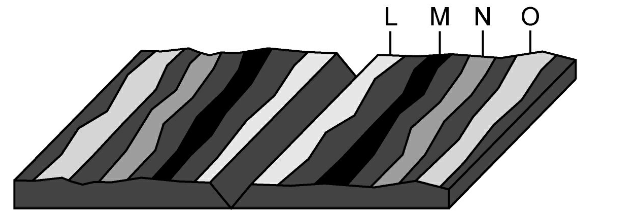
Below is a picture of sea-floor spreading. How are the ocean crusts moving?
Converging
Diverging
Sliding
No movement
The Himalayas (huge mountain range) in Asia are an example of what type of plate boundary?
divergent
continent-to-continent convergent
ocean-to-continent convergent
transform
Element that forms ozone
nitrogen
oxygen
hydrogen
carbon

What DECREASES as you travel up in the atmosphere?
Altitude
Atmosphere
Meteors
Air Pressure
Which of the following is the correct order of the atmosphere layers from Earth to space?
troposphere, stratosphere, mesosphere, ionosphere
troposphere, mesosphere, ionosphere, stratosphere
ionosphere, stratosphere, mesosphere, troposphere
troposphere, stratosphere, ionosphere, mesosphere,
Which of the following is NOT considered part of the Earth's atmosphere?
troposphere
ionosphere
magnetosphere
stratosphere

In what layer of the Earth's atmosphere does the Aurora Borealis occur and can be seen?
ionosphere
ozone layer
stratosphere
magnetosphere
The trapping of the heat in our atmosphere is called
ozone effect
global currents
greenhouse effect
Coriolis effect
Which gas makes up 78% (most abundant) of our atmosphere?
oxygen
Carbon dioxide
nitrogen
argon

