
NEW
Font size
 Worksheets
Refraction
Total questions: 24
Worksheet time: 19mins

As light enters these materials it...
continues its straight line path
bends toward the normal
bends away from the normal
reflects
The refractive index of any medium is always
< 1
> 1
= 1
= 0
Refractive index
n=cv
n=cv
n=vc
v=nc
An incident ray moving from air
( n=1.000 ) into glass ( n=1.532 )
has an incident angle of 30° .
What is the angle of refraction?
39.7°
19.2°
59.1°
12.3°
Light travels through a liquid at 2.25×10⁸ms−1 .
What is the refractive index of the liquid?
1.33
1.00
1.52
2.45
What is the index of refraction
of a refractive liquid if the
angle of incidence in air is 35° and
the angle of refraction is 14° ?
1.33
2.21
2.37
1.72
An incidence ray in air ( n=1.00 ) has an angle of incidence of 30° as
it enters water ( n=1.33 ).
What is the angle of refraction?
15°
22°
43°
17°
Light has the lowest velocity in which medium?
flint glass: n=1.70
barium glass: n=1.60
crown glass: n=1.523
water: n=1.33
diamond: n=2.45
diamond
water
flint glass
barium glass
crown glass

A student placed a pencil in a cup of water. The pencil appears broken because light...
always travels in a straight line
bends when it passes through water
makes the water in the glass evaporate
reflects the pencil on the water's surface
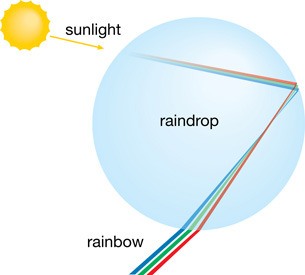
Refraction, then reflection, and finally refraction
Reflection, then reflection, and finally refraction
Refraction, then reflection, and finally reflection
Reflection, then refraction, and finally reflection
Which colour of light is refracted through the greatest angle during dispersion by a prism?
red
orange
yellow
green
blue
The velocity of light in a vacuum.
3×10⁸ms−1
3×10¹²ms−1
3×10⁶ms−1
3×10¹⁰ms−1
How does light energy move?
longitudinal waves
wavelengths
transverse waves
ocean waves
simple harmonic waves

A = angle of incidence
A = reflection ray
A = incidence ray
A = refraction ray
A = normal line
A ray of light travels in glass with an index of refraction of n=1.50 .
What is the speed of light in the glass?
2×10⁸ms−1
1.5×10⁸ms−1
3×10⁸ms−1
4.5×10⁸ms−1
A ray of light travels in glass with an index of refraction of n=1.50 .
The light then hits a glass-air interface. If the angle of incidence is 42° , what is the angle of refraction?
There is no refraction.
Total internal reflection occurs
42°
90°
138°

Where is light travelling fastest?
Inside the box
Outside the box
Both
Light has the highest velocity in which medium?
flint glass: n=1.70
barium glass: n=1.60
crown glass: n=1.523
water: n=1.33
diamond: n=2.45
diamond
water
flint glass
barium glass
crown glass
B = angle of incidence
B = reflection ray
B = angle of refraction
B = refraction ray
B = normal line
C = angle of incidence
C = reflection ray
C = angle of refraction
C = refraction ray
C = angle of reflection
D = angle of incidence
D = reflection ray
D = incidence ray
D = refraction ray
D = angle of reflection
E = angle of incidence
E = reflection ray
E = incidence ray
E = refraction ray
E = angle of reflection
F = angle of incidence
F = reflection ray
F = incidence ray
F = refraction ray
F = angle of reflection
G = angle of incidence
G = reflection ray
G = incidence ray
G = refraction ray
G = angle of reflection

