wayground logo

Free Printable Worksheets

NEW

Font size

S
M
L
XL
Worksheets

Waves!

Total questions: 24

Worksheet time: 27mins

Name
Class
Date
1.

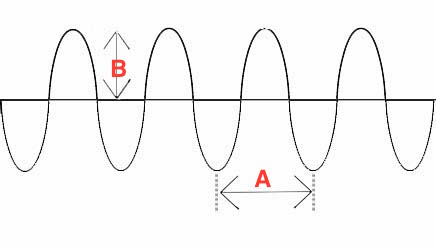
What kind of wave is pictured below?

a)

compressional wave

b)

transverse wave

c)

sound wave

d)

mechanical wave

2.
How often a wave occurs is the wave's __________________
a)
crest
b)
frequency
c)
wavelength
d)
resting point
3.
The distance between 2 corresponding parts of a wave  (example- crest to crest) is its _____________________
a)
trough
b)
frequency
c)
amplitude
d)
wavelength
4.
The frequency of a wave is measured in __________________. 
a)
inches
b)
hertz
c)
periods
d)
eras
5.
In what type of wave does the medium vibrate parallel to the direction of the wave?
a)
surface wave
b)
longitudinal wave
c)
transverse wave
d)
electromagnetic wave
6.
Any material that a wave travels through is called a ____________________.
a)
vibration
b)
compression
c)
medium
d)
crest
7.
What are the highest parts of a transverse wave called?
a)
amplitude
b)
trough
c)
resting point
d)
crest
8.
In longitudinal waves, the parts where the coils are spread apart are called what?
a)
rarefactions
b)
compressions
c)
mechanicals
d)
longitudes
9.

In what type of wave does the medium move perpendicular to the movement of the wave? (in an up, down motion)

a)

Transverse

b)

Longitudinal

c)

Electromagnetic

d)

Radio

10.
What number represents the wavelength?
a)
1
b)
2
c)
3
d)
4
11.
What number represents the amplitude?
a)
1
b)
2
c)
3
d)
4
12.

What property of the wave is represented by the letter "A"?

a)

amplitude

b)

crest

c)

trough

d)

wavelength

13.
Which wave has a greater frequency?
a)
A
b)
B
14.

All waves carry ________ as they travel from one place to another.

a)

matter

b)

space

c)

energy

d)

water

15.
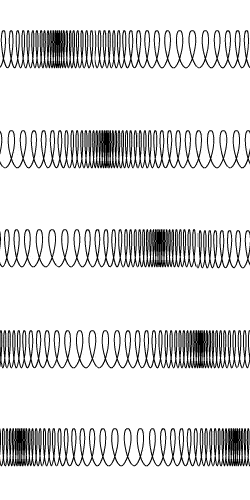
Which wave is pictured?
a)
Transverse
b)
Longitudinal
c)
Both
d)
Neither
16.
What type of wave is this?
a)
Longitudinal
b)
Transverse
17.
What do waves carry from place to place?
a)
Energy, but not matter or particles
b)
Energy and matter or particles
c)
Matter or particles but not energy
d)
Neither energy nor matter or particles
18.
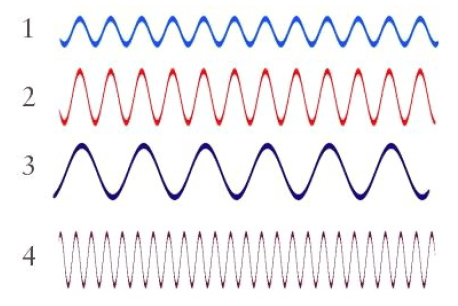
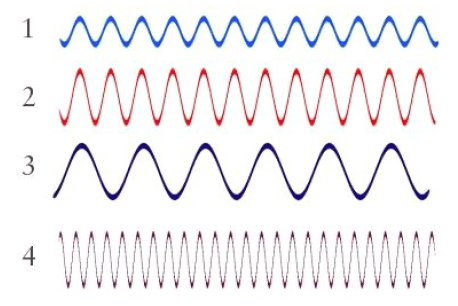
Which wave in the diagram has the greatest frequency?
a)
1
b)
2
c)
3
d)
4
19.
Which wave in the diagram has the greatest wavelength?
a)
1
b)
2
c)
3
d)
4
20.
When the frequency of a wave increases, what happens to the wavelength?
a)
The wavelength is not directly affected by the frequency of a wave.
b)
The wavelength increases.
c)
The wavelength decreases.
d)
More specific information is needed to form a conclusion about the wavelength.
21.

If the amplitude of a wave increases, then the energy of the wave _______________.

a)

Increases

b)

Decreases

c)

Stays the same

d)

They are not related

22.

What type of waves are present in an earthquake?

a)

Transverse

b)

Longitudinal

c)

Both are present

d)

Neither are present

23.

Longitudinal waves move:

a)

at a right angle compared to the direction the wave is traveling

b)

in a circle compared to the direction the wave is traveling

c)

matter

d)

in the same direction as the wave is traveling

24.

True or False: Amplitude can increase or decrease wavelength

a)

True, amplitude can increase or decrease wavelength

b)

False, frequency can increase or decrease wavelength

c)

False, crests can increase or decrease wavelength