
 Worksheets
LOI 2_Review Test
Total questions: 20
Worksheet time: 15mins
Where does most drinking water come from?
reservoirs
lakes
groundwater
oceans

The graph shows the distribution of water on Earth's surface. What can be concluded from this image?
Most of the freshwater on Earth is found in groundwater.
Most of the the water available on Earth is drinkable.
Most of the water available on earth is not drinkable
Most of the freshwater on Earth is found in oceans.

The model below shows the water cycle. What is the purpose of this model?
to show how severe weather forms in the water
cycle
to illustrate how water travels from Earth's
surface into the atmosphere and back to Earth's
surface again
to show how Earth's water formed billions of
years ago
to illustrate how some water is lost on Earth as
some of it never returns to Earth's surface once
it evaporates
Why is most of Earth's water not available to drink?
It is contaminated.
It is in the polar ice caps.
It is underground.
It has a high level of salinity.

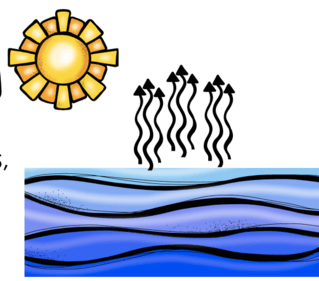

When water evaporates, it changes from a liquid to a gas.
True
False
_______________ provides energy to liquid.
Evaporation
Gas
Liquid
Heat
The particles in a _________________ are farthest apart.
liquid
solid
gas
Water's changing from a liquid to a solid is _____________________.
evaporation
gas
vapor
freezing
Water changing from a liquid to a gas is called _______________.
evaporation
condensation
Water exist in
four states
three different states
two states

Where is water collected?
Mountains and lakes
Forests and rivers
Rivers, oceans and lakes.
Rivers, oceand and mountains

