Wayground logo

Free Printable Worksheets

Font size

S
M
L
XL
Worksheets

Power Packet

Total questions: 50

Worksheet time: 3hrs 30mins
Name
Class
Date
1.
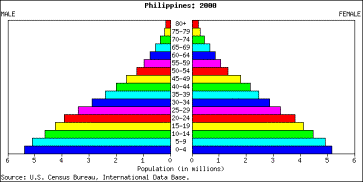
According to the population pyramid of this country, its population is most likely...
a)
growing slowly.
b)
growing rapidly.
c)
decreasing.
d)
not changing.
2.
According to the United Nations, at what number is world population expected to plateau?
a)
9-11 billion
b)
13-15 billion
c)
20-25 billion
d)
never
3.
Which has NOT been a major cause of the population explosion?
a)
modern preventive medicine
b)
increase in life expectancy
c)
improved sanitation
d)
increase in birth rates
4.
Which of the following is likely to be affected by a population of 7 billion?
a)
amount of land for agriculture
b)
amount of clean water
c)
number of people who are unemployed
d)
all of the above
5.
The maximum population size of a species that the environment can sustain indefinitely, given the food, habitat, water and other necessities available in the environment.
a)
sparse population
b)
environmental
c)
carrying capacity
d)
dense population
6.
The average number of people living in a square kilometer is called...
a)
urbanization. 
b)
internal migration. 
c)
population density. 
d)
pull factors. 
7.
One reason for a rapid population growth is...
a)
an increase in pull factors.
b)
declining death rates. 
c)
a sparse population density. 
d)
internal migration.
8.
What is a population pyramid?
a)
A type of graph showing the number of males and females in different age groups.
b)
A type of graph showing the number of males in different age groups.
c)
A type of graph showing the number of females  in different age groups.
d)
A type of graph showing the number of males and females in only one age group.
9.

Which of the following is NOT a strategy that would reduce population size?

a)

Limiting education for women

b)

Public advertising

c)

Economic incentives

d)

Legal punishments

10.

The population pyramid shown is most likely which country?

a)

Nigeria

b)

China

c)

Germany

d)

Japan

11.

Which correctly describes the term demographic transition?

a)

The transition from low birth rates and death rates to high birth rates and death rates as a country develops.

b)

The transition from high birth rates and death rates to low birth rates and death rates as a country develops.

c)

The transition from high birth rates to low death rates as a country develops.

d)

The transition from low birth rates to high death rates as a country develops.

12.

A Density Independent Limiting Factor is a limiting factor of a population that can affect population growth no matter what the population density. What is a density independent limiting factor that can affect the human population growth of North Carolina?

a)

disease

b)

hurricanes

c)

food supply

d)

water supply

13.

Which of the following leads to a decrease in birthrates among women?

a)

Higher Education

b)

High Infant Mortality Rate

c)

No Prenatal Care

d)

No contraceptives

14.

Which problem today is primarily the result of the Industrial Revolution?

a)

extensive air and water pollution

b)

increased transmission of disease between people living in close proximity

c)

decline in quality of agricultural soil

d)

erosion from deforestation as more fuel wood is harvested

15.

According to this graph, Which stage of the demographic transition has the highest level of population growth?

a)

pre-industrial

b)

transitional

c)

industrial

d)

post-industrial

16.
What does the graph represent?
a)
Emigration
b)
Exponential growth
c)
Immigration
d)
Logistic Growth
17.
Which limiting factor would increase due to the number of individuals in a population?
a)
Unusual weather
b)
Natural disaster
c)
Births
d)
Disease
18.
Which limiting factor is independent of the number of individuals in a population?
a)
competition
b)
parasitism/disease
c)
stress
d)
natural disasters
19.
A population is...
a)
A group of one species in one area
b)
Multiple species that live in one area
c)
All of the living and nonliving things in an area
d)
None of these
20.
What is the carrying capacity of the following graph?
a)
1000
b)
8000
c)
800
d)
600
21.

As a population of a species increases within a territory, which of the following most likely also increases?

a)

Immigration

b)

Food supply

c)

Carrying capacity

d)

Competition

22.
No two species can occupy the same niche
a)
Competitive Exclusion Principle 
b)
Limiting Exclusion Theory
c)
Competitive Limiting Principle
d)
Limiting Competitive Theory 
23.
When a population grows past the ecosystem's carrying capacity, what happens to the population?
a)
Continues to grow
b)
The population starts to die off to return to carrying capcity
c)
The population will go extinct due to lack of resources
d)
The population grows then finds a new carrying capacity
24.

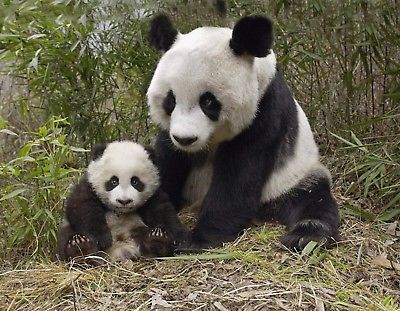
Animals such as pandas are long lived, mature slowly, and generally produce fewer offspring during their life spans but place a greater investment in each. What term is applied to this type of reproductive strategy?

a)

K-strategy

b)

r-strategy

25.

Which of the following describes the population of elephants in Kenya from 1973-1989?

a)

(immigration + births) – (emigration + deaths) = 0

b)

(immigration + births) – (emigration + deaths) = 1

c)

(immigration + births) – (emigration + deaths) < 0

d)

(immigration + births) – (emigration + deaths) > 0
26.

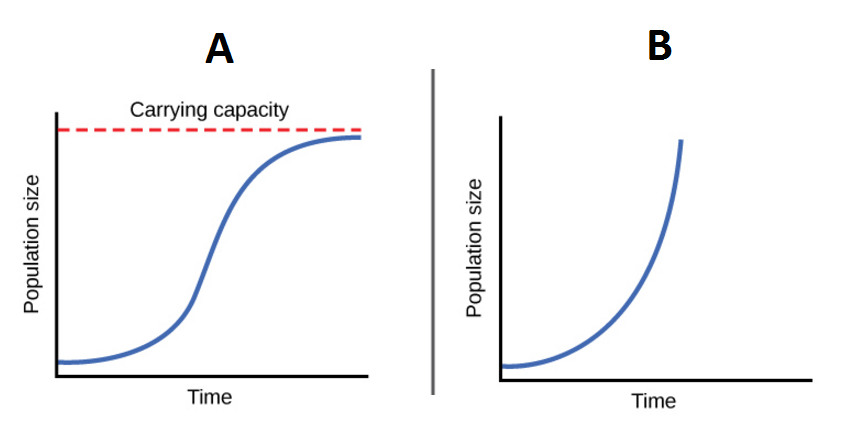
What type of growth model is shown in image A?

a)

Exponential

b)

Logistic

27.
Lichens and mosses that first live in uninhabited areas are examples of
a)
secondary species
b)
non-native species
c)
pioneer species
d)
climax species
28.
Secondary succession is most likely to occur
a)
on a volcanic island
b)
after a rainstorm
c)
after a Thanksgiving Turkey dinner
d)
after a forest fire
29.

Which is a biotic factor?

a)

soil

b)

air

c)

bacteria

d)

water

30.
What does it mean when an animal is extinct?
a)
Something once lived but no longer exists.
b)
Animals that is at risk of extinction.
c)
Place that protects animals at risk.
31.
Why is it important to protect and conserve animal species?
a)
So that the animal have food to eat.
b)
So that the animal have a place to stay.
c)
So that we can see the animal on Earth in the future.
32.
What does it mean when an animal is endangered?
a)
Something once lived but no longer exists.
b)
Animals that is at risk of extinction.
c)
Place that protects animals at risk.
33.
What is a conservation program?
a)
Something once lived but no longer exists.
b)
Animals that is at risk of extinction.
c)
Place that protects animals at risk.
34.
The Endangered Species Act of 1973 protects registered endangered species by removing them from the "take" list which makes it unlawful to
a)
shoot
b)
capture
c)
trap
d)
all of the above
35.
When taken to a new habitat, non-native plants often threaten native plants of the new habitat.  Why do they do this?
a)
Non-native plants are able to mutate rapidly
b)
Non-native  plants cause native animals to relocate
c)
Non-native plants are able to be used for medicine
d)
Non-native plants compete with native plants for resources
36.
Biodiversity refers to
a)
extinct species
b)
the variety of species on Earth
c)
nonrenewable resources
d)
the rate of species decline
37.
Kudzu has overgrown many parts of southern Missouri and native ground plants have disappeared from the area. This is an example of:
a)
Parasitism between kudzu and the native plants
b)
A predator prey relationship between ground plants and kudzu
c)
Competition occurring between the native and invasive species
d)
Commesalism occurring between the kudzo and native plants
38.
1. What makes a species invasive?
a)
Moving to a new ecosystem and taking resources from natives 
b)
Not having papers
c)
Species that can't adapt
d)
Plants that take up too much space
39.
The lack of natural predators makes populations of invasive species unmanageable?
a)
True
b)
False
40.

Which of the following is NOT a major use of freshwater?

a)

Residential

b)

Agricultural

c)

Industrial

d)

Clouds

41.

What does "potable" mean?

a)

Safe to drink

b)

Frozen

c)

Liquid water

d)

Dirty water

42.

Which of the following is an unsafe material that can be found in drinking water?

a)

Fish

b)

Pathogens

c)

Minerals

d)

None of these

43.

In industrial water use, what is most of it used for?

a)

Toilets

b)

Cooling power plants

c)

Making goods

d)

Waste disposal

44.

What is water used for in agriculture?

a)

As a pesticide

b)

Cleans crops

c)

Water parks

d)

Irrigation

45.

In a residence, how is most (26%) of the water used?

a)

Toilet

b)

Bath/shower

c)

Faucet

d)

Dishwasher

46.
During the Exxon oil spill, many marine animals were killed. Why?
a)
The oil spilled into the ocean and poisoned the animals food.
b)
The animals drank the oil from the ship's tank.
c)
The oil was absorbed by the ocean.
d)
Marine animals were not killed because they swam to safety. 
47.
About 97% of the water on Earth is ___________________.
a)
fresh water
b)
groundwater
c)
salt water
d)
ice
48.
When excess nutrients make their way into the waterways,
a)
fish populations increase
b)
algal blooms increase
c)
frog population increases
d)
people get more vitamins in their water
49.

Which of the following is NOT an example of point-source pollution?

a)

Oil escapes from a wrecked ship

b)

Heavy metals leak out of an abandoned mine

c)

Water runoff from a city full of fertilized lawns

d)

Untreated sewage accidentally released from a wastewater treatment plant

50.
Pollutants are introduced into surface or ground water without a specific location source.
a)
point source
b)
non-point source
c)
water pollution
d)
polluntants