
 Worksheets
Chemistry Form 5
Total questions: 18
Worksheet time: 12mins
Name
Class
Date
1.
Which of the following is described as the basic unit of matter?
a)
Element
b)
Atom
c)
Molecule
d)
Compound
2.
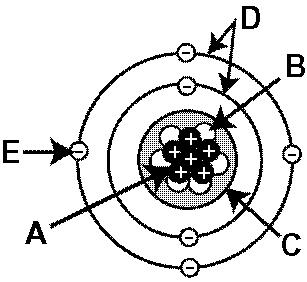
In the atom diagram shown, E is pointing to
a)
An electron
b)
a proton
c)
a neutron
d)
the nucleus
3.
In the atom diagram shown, A is pointing to the darker particles, these are known as
a)
electrons
b)
protons
c)
neutrons
d)
the nucleus
4.
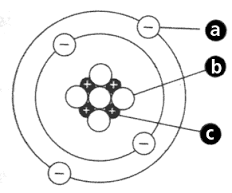
B and C are found in the ______ of an atom.
a)
electron cloud
b)
Space
c)
Nucleus
d)
Outside
5.
A molecule is________
a)
two ions held together by opposite charges
b)
smaller than an atom
c)
can be physically separated into smaller atoms
d)
more than one atom bonded together by covalent bonds
6.
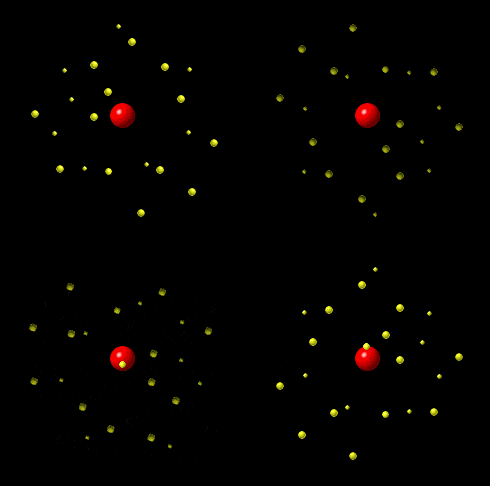
What charge does an electron have?
a)
Negative
b)
Positive
c)
Neutral
d)
Contrated
7.
Which of the following is found in the nucleus of an atom?
a)
electrons
b)
neutrons
c)
The center of an atom, composed of protons and neutrons
d)
molecules
8.
What is a valence electron?
a)
an electron that is found in the outermost orbital of an atom.
b)
an electron found in the innermost orbital of an atom.
c)
an electron found in the middle orbital.
9.
What is oxidation number of H in H2O?
a)
0
b)
-2
c)
-1
d)
+1
10.
What is oxidation number of Cr in Cr2O72-?
a)
-2
b)
+2
c)
+6
d)
+12
11.
Paper burning is a __________________ change.
a)
physical
b)
chemical
12.
Dry ice (solid carbon dioxide) turning into carbon dioxide gas is a
a)
physical change
b)
chemical change
13.
Which property is an example of a chemical property?
a)
the ability to burn
b)
the ability to dissolve
c)
the ability to melt
d)
the ability to evaporate
14.

Consider the picture of the jar holding oil, syrup, and water. It would be easy to pour off the oil to separate from both the syrup and water because the liquids have different
a)
densities
b)
masses
c)
temperatures
d)
volumes
15.
Color, shape, texture, and size are _____________ properties of matter.
a)
chemical
b)
liquid
c)
physical
d)
solid
16.
Name the compound Fe(NO3)2.
a)
Iron (II) Nitrate
b)
Iron (II) Nitrite
c)
Iron (III) Nitrate
d)
Iron (III) nitride
17.
Stirring increases the rate of dissolution because it
a)
raises the temperature
b)
lowers the temperature
c)
brings fresh solvent into contact with the solute
d)
decreases the surface area of the solute
18.
ΔH is always positive for a
a)
spontaneous reaction
b)
non spontaneous reaction
c)
exothermic reaction
d)
endothermic reaction
100 %

